The wave of anti-data center sentiment sweeping the nation has reached the heart of Oregon’s “Silicon Forest”. More than 200 people packed a Hillsboro City Council meeting Tuesday evening to voice concern and frustration with tax exemptions for several planned data center developments in the city.
Across the country, data centers are booming. The large server networks are considered the backbone of the internet, supporting everything from Netflix to TikTok to online banking. The recent proliferation of artificial intelligence into every corner of the internet is now driving data center demand to new heights.
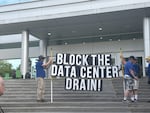
Opponents of data centers hold a sign outside the Hillsboro Civic Center ahead of a city council meeting Tuesday, June 2, 2026.
Holly Bartholomew / OPB
Hillsboro Economic Development Director Dan Dias explained that most of the data centers in the Pacific Northwest support the tech industry, a significant portion of which is based in Hillsboro.
As more data centers crop up in the Northwest and across the country, anger over the facilities is also on the rise.
A recent Gallup poll found 70% of Americans oppose local construction of data centers. Last month, the treasurer of a small Michigan town resigned after she said she received death threats over a planned data center project. In Oregon, data center blowback contributed to the defeat of a longtime Hillsboro state legislator in May’s primary election.
This anger was on display at Tuesday’s meeting, where a number of attendees wore t-shirts calling for a recall of Mayor Beach Pace (Pace was not present for the meeting) and chastised the council for its propensity to “rubber stamp” data center tax breaks.
One attendee yelled out to the council, “What happened to Janeen Sollman should be a lesson to you guys,” referencing the ousted lawmaker.
During public comment, Chris Pinkham, a Beaverton resident and former semiconductor engineer, told the council they were selling their constituents down the river.
Data centers and tax breaks
Hillsboro is home to 34 data centers, more than any other city or town in the state, according to the site Data Center Maps. That number could grow if pending applications go through.
Amid the growing disdain for data centers nationally, frustration in Hillsboro grew this spring as the city signed off on tax breaks for new data centers that extend decades into the future, as reported by the Oregonian.
This spring, the city received an influx of applications for tax breaks for new data center developments under what’s known as the Enterprize Zone program. The state incentive program, which is run through local governments, allows new business ventures within the established zones to forgo local property tax payments for three to five years. Between March and May, Hillsboro saw 17 new applications for data centers through the enterprise zone program. Companies were apparently rushing to file applications ahead of a state-imposed moratorium on tax abatements for data centers beginning June 6.
The enterprise zones are meant to spur new business development. But critics in Hillsboro feel corporations building new data centers are abusing the program.
They point to the fact that data centers typically employ very few people. While building data centers can temporarily create jobs during construction, once operational, the centers themselves rely more on computers than people.
One public commenter, Charolyn Concepcion, pointed out that Hillsboro’s requirements say that enterprise zone participants must pay their employees an average of 102% of Oregon’s minimum wage for the first three years of the program and 125% of minimum wage for the fourth and fifth years. That equates to $16.62 an hour and $20.37 an hour.
“This is not the definition of a living wage,” Concepcion told the council.
Another commenter who self-identified as a local carpenter named Tino, without giving a last name, noted the boost for local construction was limited. Tino said that the companies developing data centers are not offering local training and career development opportunities. The carpenter argued companies receiving tax breaks should be required to pay a livable wage, train employees and hire local workers.
“No one should take advantage of loopholes, take advantage of tax breaks, all while benefiting on the backs of the local workforce,” Tino said.
People who testified also expressed concern about the environmental impacts of the data centers. But their biggest ire was what they saw as the council’s inaction in the face of a “data center explosion,” as one resident put it during the public comment period.
The city has repeatedly stated that enterprise zone applications that meet minimum program requirements must be approved.
“City staff have no discretion to deny an application that meets the standards set forth in state law and local policy,” an informational page on the city’s website states. “By law, City staff must approve such applications.”
Residents weren’t buying it.
“The claim that these developments are legal and just not up to you is a mentality that does not lend itself to a thriving society,” Nicole Cook told the council.
The city’s informational page also says that the City Council sets local enterprise zone policies.
Commenters urged the council to take a range of actions: from declaring an emergency and suing the state to increasing other taxes and fees for data center developments to authorizing comprehensive studies on the impacts of data centers.
Ultimately the council opted to continue its discussion at a meeting on Tuesday, June 9.