Subscribe to OPB’s First Look to receive Northwest news in your inbox six days a week.
Good morning, Northwest.
A federal tax credit launched in the 1980s is being used to supercharge the pace of housing construction in Portland and other cities across the country.
An investigation by OPB and ProPublica found that the program is building housing that many Oregonians can’t afford. That story by OPB’s Tony Schick starts today’s newsletter.
Also this morning, the recently elected president of the Metro regional government is starting his term early.
Here’s your First Look at Wednesday’s news.
— Bradley W. Parks
Top story
Source images: IRS and Flickr
Illustration by Shoshana Gordon/ProPublica
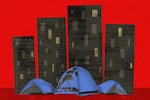
A low-income housing program is pouring big money into housing many Oregonians can’t afford
This article was produced in partnership with ProPublica’s Local Reporting Network.
Portland, like many cities, has raced to increase its supply of affordable housing by turning to a federal program that has existed since the 1980s: the Low-Income Housing Tax Credit. It provides up to $15 billion in tax credits a year nationally to help developers build apartments. Portland supplemented the federal construction money with local dollars, creating incentives that were hard to turn down.
But to meet the affordability requirements, all the developers needed to do in most cases was put rents within reach of someone earning 60% of the median income, an earnings threshold that equates to about $75,000 annually for a family of four. It turns out that this amount of rent is now close to what the typical Portland landlord charges without any subsidy.
The result of the federal tax credit has been a glut of apartments costing renters on the order of about $1,400 a month for a one-bedroom. That’s a manageable outlay for a family making $75,000, but nearly half the monthly income of someone who earns $35,000 at the local minimum wage. (Tony Schick)
3 things to know

FILE - Portland police speak with two people in a tent during the forced removal of an encampment of unhoused people in the central eastside of Portland, Ore., on Jan. 28, 2026.
Eli Imadali / OPB
- While much of the nation saw a slight decline in homelessness last year, a recent federal report shows Oregon’s count jumped by 19%. Some state leaders argue the high count simply demonstrates Oregon is doing a better job at collecting data than others. (Alex Zielinski and Lauren Dake)
- Leaders at Portland State University have revealed more about their vision for a performing arts venue, hotel and conference center on their downtown campus. It’s one option for addressing earthquake safety at Keller Auditorium. (Kyra Buckley)
- As Gov. Tina Kotek works to make a case to voters for another four years, she announced yesterday that she has asked her chief of staff, Chris Warner, to lead the troubled Oregon Department of Transportation. (Dirk VanderHart)
Northwest headlines

FILE - Juan Carlos González speaks at a press conference in Portland, Ore., on Oct. 31, 2025.
Saskia Hatvany / OPB
- Juan Carlos González appointed Metro president (Alex Zielinski)
- After Oregonians reject gas tax, governor’s transportation workgroup fixates on messaging, not math (Alex Baumhardt, Oregon Capital Chronicle)
- Siletz tribal members to host event to honor whale that washed ashore last fall in Yachats (Brian Bull, KLCC)
- Josephine County has Oregon’s lowest student vaccination rate (Justin Higginbottom, JPR)
- Portland Fire torched by Valkyries’ franchise-record 18 3-pointers in 95-77 loss on road (Janie McCauley, AP)
Listen in on OPB’s daily conversation
“Think Out Loud” airs at noon and 8 p.m. weekdays on OPB Radio, opb.org and the OPB News app.
One more look
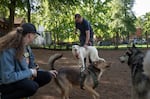
Owners and dogs use the new PSU dog park on May 20, 2026, in Portland, Ore.
Saskia Hatvany / OPB
New dog park brings the bark back to Portland State
In the dappled shade of Southwest Market Street, a small pack of pooches is having a reunion of sorts.
It’s been years since some of these dogs – and their owners – have seen each other after Portland State University put an end to an informal off-leash area on campus.
Dogs big and small – and separated into their own distinct areas, if the owners choose – spent a recent afternoon bounding after balls and frisbees, safely within the confines of a 7-foot agricultural fence.
At the university’s new dog park, dubbed “Valhowlla” after a community contest landed on a reference to Norse mythology, owners and their pups are running into some familiar mugs.
For Tom Weissip, it was sweet to have others at the park recognize his black French bulldog, Eiffel, from his puppy days. “He grew up in the other, informal dog park,” Weissip said. “This is such a great continuation of his life.” (Troy Brynelson)
Subscribe to OPB’s First Look to receive Northwest news in your inbox six days a week.