One idea for generating clean energy from the ocean is to harness the power of tides. In theory, it’s a straightforward idea. Drop a turbine underwater in a high flow area and let the moon do its thing.
But in practice, it’s not so simple.
In the Pacific Northwest, the Puget Sound region has fantastic potential for tidal energy. But before putting a large, cake beater-shaped contraption underwater, there’s a need to make sure it won’t mix anything it shouldn’t — like salmon, diving birds and marine mammals.
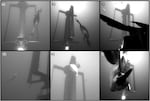
Researchers from the University of Washington and the Pacific Northwest National Lab monitored a small tidal energy turbine for impacts with wildlife in the winter of 2023-24. The team observed diving birds more than 400 times; none came into contact with the turbine.
Courtesy of Cotter et al., 2026, PLOS One
Uncertainty about the impact on wildlife was part of the reason that ambitious, early tidal energy projects like the Aquantis Inc. research turbine and the Snohomish Public Utility District pilot project never made it into the water.
Researchers at the University of Washington and the Pacific Northwest National Lab are working to understand the risk.
The team used underwater cameras to track wildlife collisions with a small tidal turbine in Sequim Bay on the Olympic Peninsula. Over the course of more than 100 days, they saw fish and other animals approach the turbine more than 1,000 times. But no marine mammals or birds hit the spinning blades, and only four small fish were hit. Three of those swam away.
While the study revealed a low rate of wildlife interactions over the few months the turbine was in the water, visual monitoring like this could be tedious and difficult over the long term because of varying visibility and other environmental challenges.
Now researchers working at UW’s Harris Hydraulics Lab are developing a sensor that can attach to the turbine blades to detect wildlife impacts. They’re testing the technology in a flow tank that carries a small toy-sized whale past a turbine. Sometimes the whale passes by without touching the blades. Other times it bounces around, recording multiple impacts.
The team is also testing whether the sensors can anticipate the approach of a marine mammal by detecting changes in water speed as it nears. If this proves possible, a safety system could eventually be developed to slow down the spinning blades with the goal of reducing the chances of harm to the animals.
Ultimately, the sensors could provide an easy way to monitor the impact of underwater turbines on wildlife in real time — potentially speeding up the development of renewable tidal energy in the Pacific Northwest.
The monitoring research is published in the journal “PLOS One” here.
In these All Science Snapshots, “All Science. No Fiction.” creator Jes Burns features the most interesting, wondrous and hopeful science coming out of the Pacific Northwest.
Find full episodes of “All Science. No Fiction.” here.