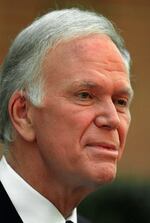
Sen. Bob Packwood, R-Ore., works in his Capitol Hill office Friday Aug. 25, 1995. Packwood, reversing his earlier position, said Friday he wants public hearings into charges that he committed sexual and official misconduct.
DENNIS COOK / AP
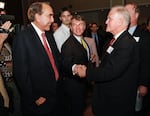
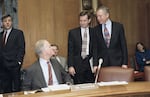
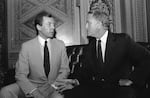
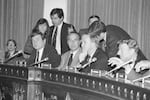
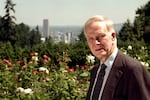
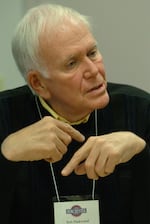
Bob Packwood, a longtime Oregon Senator who entered national politics young and ascended to the pinnacles of congressional power before his career ended in scandal, died Saturday. He was 93.
Packwood died in a residential care facility in southern California, where he and his wife rented a vacation home, according to one family friend. His family released an obituary to media outlets Saturday afternoon.
“It is with great sadness that I share the news that Senator Packwood passed away earlier today,” Packwood’s wife, Elaine Franklin, said in a statement from a private Facebook post that was also provided to OPB. “He touched many lives and leaves behind a lasting legacy of public service. He will be deeply missed.”
A moderate Republican, Packwood spent decades in the Senate building a reputation for bucking his party’s hard-liners and for supporting women’s rights. That included much-heralded stances in favor of abortion rights and securing landmark federal protections for the Columbia River Gorge.
But that reputation came crashing down in late 1992, just after Packwood had been re-elected to his fifth term in the Senate.
The Washington Post published an investigation detailing allegations by former female staffers and others who described a decades-long pattern of forceful kissing and other sexual misconduct by the Senator.
Packwood kept Congressional investigators at bay for years, while also serving in one of Washington, D.C.’s most powerful roles as chair of the Senate Finance Committee.
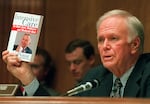
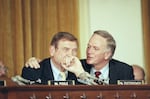
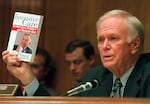
Senate Finance Committee Chairman Bob Packwood, Oregon, holds a book entitled "Intensive Care" by Ross Perot during hearings dealing with the future of Medicare on Capitol Hill Wednesday, Aug. 30, 1995.
DENNIS COOK / AP
But in 1995, he ran out of time.
The Senate Ethics Committee voted to expel Packwood from the Senate, finding he had made unwanted advances toward more than a dozen women and tried to obstruct the investigation into his conduct.
Packwood resigned the next day, but spoke to OPB in 2013 about the scandal.
“In the majority of the cases, I could not remember the woman, could not remember the incident,” he said. “In some cases, it was one time, one night. And all of the charges, save one, were over 10 years old, and in two cases 20 years old, and I just couldn’t remember.”
In the years following his departure from the Senate, Packwood became a successful Washington lobbyist. But he kept a relatively low profile in his home state.
Still, his contributions to his party live on. Packwood played a major role in starting the Oregon GOP’s annual Dorchester Conference, now in its 60th year.
Robert William Packwood was born in Portland in 1932 to a family with a strong pedigree in state affairs. His great-grandfather attended Oregon’s constitutional convention and designed the state seal, Packwood would recall.
His father was a tax analyst at the state Legislature.
After graduating from Grant High School in Portland, Packwood attended Willamette University in Salem and began to dabble in Republican politics. It was there that he first met Mark Hatfield, an advisor who would eventually become governor and Packwood’s equally powerful counterpart in the U.S. Senate.

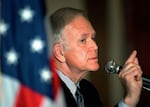
Sen. Bob Packwood (R-Ore.), ranking Republican on the Senate Finance Committee listens during a hearing on Capitol Hill in Washington, March 10, 1994. Packwood, battered for months by sexual misconduct allegations, is taking a combative stance with the news media and his accusers, to rescue his 25-year Senate career.
John Duricka / AP
After attending law school in New York, Packwood returned to Oregon and began his rise through the political ranks. He won a seat in the state House of Representatives in 1962, crediting an army of volunteers – many of them women – who helped to get his name out.
By 1968, Packwood had learned the ropes in Salem and went for a larger prize. He challenged Democratic U.S. Sen. Wayne Morse and made an issue of Morse’s outspoken opposition to the Vietnam War. He won the race by three-tenths of a percent and, at 36, became the youngest senator in the country.
In the Senate, Packwood cultivated a reputation as a maverick.
He was the first Senate Republican to support the impeachment of President Richard Nixon. And he was among the first national politicians to embrace the environmental movement, pushing to protect Hells Canyon in 1975, and helping to preserve the Columbia River Gorge as a national scenic area.
Where Packwood generated most attention, though, was in his stance on abortion and women’s rights. He would ascribe his position favoring a woman’s right to choose an abortion, in part, to the female volunteers who assisted him on the campaign trail.
“They each had, if not personally experienced it, had something very close to a personal experience,” Packwood told OPB. “And they described how brutal it was, how unsanitary it was, and I thought, well, this is wrong.”
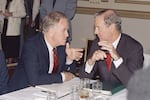
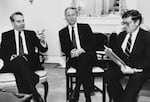
Treasury Secretary James Baker, right, huddles with Sen. Bob Packwood, R-Ore., on Capitol Hill in Washington, Monday, Nov. 2, 1987, during a session of administration and Congressional members working on the budget cuts.
Doug Mills / AP
Packwood unsuccessfully introduced a bill to legalize abortion in the early 1970s. With the 1973 Roe v. Wade decision at the Supreme Court, he was thrust into the national limelight as the voice of support in Congress.
Packwood said he at first assumed furor over the issue would subside.
“It did not, and it went on,” he said in 2013. “It’s going on. I guess it’s going to go on.”
Packwood was also one of two Senate Republicans to vote against the confirmation of Supreme Court Justice Clarence Thomas, who had been accused of sexual harassment.
Packwood said at the time that his vote was based on Thomas’ legal theories, not the allegations against him.
Packwood also played a major role in the nation’s tax policy, eventually ascending to chair of the Senate Finance Committee. And he was among the Senate’s staunchest defenders of Israel.
But the events Packwood would ultimately become best known for were darker. The Washington Post investigation that was published on November 21, 1992, marked the beginning of the end of the senator’s career in elected office.
It detailed allegations that Packwood had forcibly kissed female staffers, attempted to remove one woman’s underwear by force in his office, tried to force himself on another woman in an Oregon hotel room, and more.
The earliest allegation stemmed from Packwood’s first year in the Senate, when a staffer at his Portland office said he came up and kissed her on the neck. “Don’t you ever do that again,” the staffer, Julie Williamson, said she told Packwood.
According to the Post, “Williamson said Packwood then followed her into an adjoining room, where he grabbed at her clothes, pulled on her ponytail and at one point, stood on her toes” to prevent her from kicking him as he tried to remove her undergarments.
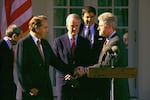
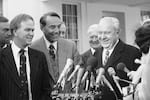
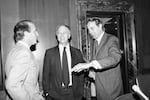
President Clinton shakes hands with Senate Majority Leader-in-waiting Bob Dole of Kansas in the Rose Garden of the White House, Wednesday November 23, 1994, where Dole delivered his support for the General Agreement on Tariffs and Trade(GATT). Sen. Bob Packwood, R-Ore., second from left, and White House Chief of Staff Leon Panetta, second from right, look on.
WILFREDO LEE / AP
Stories from other women followed a similar pattern.
The article launched a three-year process in which Packwood first welcomed – and then obstructed – a Congressional investigation.
That investigation turned up damning evidence from Packwood himself. The Senator’s personal diary included some shocking entries.
In a 2017 memoir, former U.S. Sen. Barbara Boxer included one excerpt detailing Packwood’s account of an encounter with a staffer, NPR noted. It read:
“If she didn’t want me to feather her nest, why did she come into the Xerox room? Sure, she used that old excuse that she had to make copies of the Brady Bill, but if you believe that, I have a room full of radical feminists you can boff. She knew I was copying stuff in there. I had my jacket off and my sleeves rolled up, revealing the well-defined musculature of my sinewy arms which are always bulging with desire. I know what she wanted. This didn’t require a lot of thought.”
The investigation concluded with a nearly 200-page report detailing findings that Packwood had committed at least 18 instances of sexual misconduct between 1969 and 1990. The document also concluded that Packwood attempted to obstruct investigators’ work, and that he had sought to use his position as a senator to win work for his then-wife.
Rather than being formally expelled by the Senate, Packwood opted to leave on his own.
“It is my duty to resign,” he said on the Senate floor. “It is the honorable thing to do for this country, for this Senate… I leave this institution not with malice, but with love.”
CORRECTION: This article has been updated to reflect that Packwood and his wife did not own the vacation home in southern California where they were living when he died. OPB regrets the error.