A brief moment of bipartisanship in the U.S. Senate turned political on Wednesday, when Republican lawmakers introduced a new provision to a wildfire bill.
That bill, called the Wildfire Prevention Act, would mandate increasing prescribed fires and forest thinning in federal forests.
It had support of both Democrats and Republicans when it was first introduced before the Senate Energy and Natural Resources Committee last year. That common ground evaporated after Senate Republicans attached a repeal of what’s known as the “the roadless rule” to the bill.
Republicans, who have a majority on the committee, were able to advance the wildfire bill with that rule attached. The move all but guarantees the wildfire bill’s failure, Democratic leaders say, at a time when wildfire prevention work is most needed.
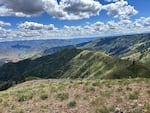
New road construction is banned in much of the Hells Canyon area, seen here on May 20, 2026, near Enterprise, Ore.
April Ehrlich / OPB
The 2001 roadless rule prohibits new road construction and intensive logging in 59 million acres of federal forestland, including 2 million acres in Oregon and the same amount in Washington.
It’s been controversial since the beginning, drawing support from hunters and environmentalists and criticism from logging companies.
Democrats, including U.S. Sen. Ron Wyden of Oregon, are decrying the push to tie forest road construction to a bill meant to increase prescribed fire and forest thinning in federal forests.
“There are a number of Republican senators who will stop at nothing in their crusade to sell off Americans’ public lands,” Wyden said at a press conference Thursday morning. “And now the crusade is coming in the form of this effort to repeal the roadless rule.”
Timber leaders and their Republican allies have argued that these areas need roads to fight fires and remove trees that could become fire fodder.
“The Roadless Rule is based on a false, unscientific premise: if we draw artificial lines on a map, do nothing, and walk away, we are ‘protecting’ the environment,” timber associations said in a statement in support of its repeal. “This is demonstrably false with catastrophic impacts to our lands, resources, and people.”
The roadless rule does allow federal agencies to take steps to prevent the spread of wildfires, however. It allows prescribed burning and forest thinning for fire prevention and improving habitats for native species. And most research suggests that roads increase wildfire frequency in forests. That’s because more roads bring more people, and humans spark most wildfires.
Republican Sen. Mike Lee of Utah, the Energy and Natural Resources Committee’s chairman, proposed the amendment to nullify the roadless rule.
“While its intent may have been to preserve the environment, its actual impact has been an environmental disaster,” Lee said in a written statement.
Wyden and other Democratic members proposed striking Lee’s amendment, but committee members voted in favor of it along party lines, 11-9.
At Thursday’s press conference, Wyden said legislation like the Wildfire Prevention Act is especially needed now.
“The snowpack is low. We’re having a drought that’s increasing,” Wyden said. “And we’ve got, in my part of the world, a ticking time bomb waiting to detonate in this fire season.”
The number of wildfires that have burned across the country is already double what it was around this time last year. Meanwhile, the U.S. Forest Service has done far less fire prevention work this year and in 2025 than in previous years, according to an NPR analysis.
Last year, U.S. Forest Service leaders announced plans to rescind the roadless rule, but they first needed to ask the public to weigh in and publish a draft proposal.
More than 625,000 people submitted testimony. Most comments appear to have opposed rescinding the rule.
The agency has yet to publish its draft proposal for nullifying the roadless rule.