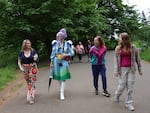
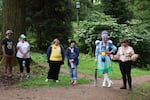
Efemmera Gendera talks with Amanda Giel, left, of Vancouver, WA during a Drag Me Outside drag nature hike at Mt. Tabor Park in Portland, Ore., on May 10, 2026.
Amanda Loman for OPB
It’s a sunny spring afternoon on Portland’s Mount Tabor Park, and a few dozen people are gathered to go on a nature walk. But it’s not just any stroll through the park. The leaders of this gathering have decades of science and educational experience between them, and also the rare ability to walk on gravel paths in high heels.
“Drag is supposed to be radical and so is education, so let’s put those things together. That’s exactly what people need right now,” said Efemmera Gendera, one of the founders of “Drag Me Outside.” She uses her drag name for these walks.
It’s a stereotype that Pacific Northwesterners love the outdoors, but not everyone feels comfortable outside.
“We want people to feel like they are welcome in the outdoors regardless of what society has decided they can or cannot do,” said Thespis D. Light, a wildlife conservationist, park ranger, and the other founder of the bi-monthly nature walk. He also uses his drag name for these walks. “Everybody’s allowed outside. Everybody should have a place on our hikes.”
This day’s walk begins with a discussion of everyone’s favorite bird.
“My favorite bird is the Cedar Waxwing” said Efemmera. “They will pick berries off of plants and feed them to each other and pass them around. “If they eat too many overripe berries, they will be lying on the ground drunk.”
The winding roads and wooded trails that climb through the towering firs, maples, and 50-something other species of trees in Mount Tabor Park lead to sparkling reservoirs lined by lush hills. Joggers and bicyclists whiz by on the roads criss-crossing this ancient volcano.
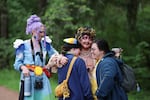
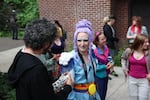
Thespis D.Light hugs Ronnie Prince, left, and drag parent Axcilla B. Hart, right, before a Drag Me Outside drag nature hike at Mt. Tabor Park in Portland, Ore., on May 10, 2026.
Amanda Loman for OPB
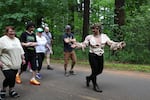

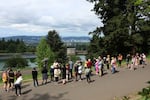
Mount Tabor was an island surrounded by really dense forests.” Efemmera said as she gave the group some history. “In 1846 there was a wildfire that happened from about the Lents neighborhood all the way up to the Columbia. That allowed the white man to come in and start to settle down.”
The outings are meant to be popular and create a fun, inclusive, educational, low-impact experience. “We are here not just to enjoy nature, not just to see our beautiful faces, but also to build community,” said Thespis.
The walk is part science, part philosophy, and part history.
“Can anyone tell me why grass is bad?” Efemmera asked during a Q&A. “Lack of biodiversity” someone shouted. “Yes! What else?” she said. “It takes up a bunch of water!” shouted another attendee. “YES! We use more water in this country to irrigate grass than anything else. And what does it do for us? NOTHING!” she said.
“It’s a lot of work to get people interested in something that they don’t have an interest in,” says Thespis. “You gotta find a way to connect to every single person that’s there. From the person that loves bees more than anything in the world to that guy who hates bees.”
Thespis says that doing these walks in drag transforms it into a kind of show – which makes people want to sign up.
At one point Thespis stopped the group to point out a bright green bush.
“Oh, we’ve got some Thimbleberries,” he said. “They are a really beautiful, native berry plant. A ranger that I worked with called them “nature’s toilet paper.” Thespis encouraged the group to gently feel the leaves. “That’s like 30-ply right there,” he said.
Efemmera pointed out that there’s a personal reason they do this work.
“Science should give you awe, and a wonder for the natural world and a curiosity to explore more,” she said. “I’m working on building the world I want to live in.”
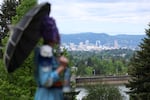
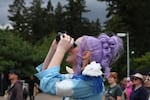
Efemmera Gendera looks out over downtown Portland during the event.
Amanda Loman for OPB