A "landslide head scarp" marks the boundary where a sliding mass pulled away from stable ground, leaving behind a crescent-shaped cliff, as seen in this provided photo on the Oregon Coast in 2017.
Photo courtesy of Josh Roering, University of Oregon
When it comes to carbon storage, trees get a lot of attention. But researchers are now finding carbon trapped in unusual places, including ancient landslides.
Scientists at the University of Oregon co-led a study modeling how much carbon is stored in landslides along the Oregon Coast. There are nearly 10,000 landslides across the region, ranging in age from 4 to 480,000 years old. It turns out that these mixtures of rock and soil hold onto much more carbon than scientists initially thought.
The findings could help other researchers understand how mountainous areas mitigate climate change by keeping carbon out of the atmosphere. And that understanding could inform carbon markets, in which businesses earn financial incentives by conserving areas that hold onto or absorb carbon.
“When there’s an opportunity to think about carbon as a commodity, we are going to need this information,” said Josh Roering, professor of earth science at University of Oregon.
Related: A giant Oregon wildfire shows the limits of carbon offsets in fighting climate change
Landslides are made up of rocks, plants and soil. Plants absorb carbon dioxide from the atmosphere and use it to build their stems, leaves and roots. When they decompose, they become the organic material contained in soil, and that soil continues to hold onto carbon.
The more dense soil is with nutrients, the more carbon it can store.
But carbon storage in soil isn’t Roering’s area of focus, so it wasn’t what he was looking for when he initially set out on this research. He specializes in geomorphology, the study of landforms and the processes that shape them.
“This is one thing that is really fun about science,” Roering said. “A lot of the most interesting discoveries you make are ones that you didn’t set out to answer at the beginning, you just sort of happened upon.”
Roering has been studying landslides in western Oregon since the 1990s. Since then, he has focused on studying what triggered these massive deposits.
To see if Oregon’s landslides happened around the same time, Roering and his colleagues looked at the trees killed during those landslides. By measuring tree rings, they could determine roughly when each landslide occurred.
That’s when they noticed that the soil and rocks in these landslides were much more rich with nutrients than they originally thought.
“And it just happened that my student, Brooke [Hunter], came around and she got really interested in this,” Roering said. “And so we looked at this interface between the soil carbon world and our world of geomorphology.”
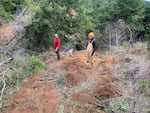
A provided photo of University of Oregon students Logan Wetherel and Brooke Hunter researching a landslide along the Oregon Coast in 2021.
Photo courtesy of Josh Roering, University of Oregon
So Roering and Hunter, a doctoral student in his lab, used an auger to drill into a handful of landslides along the Oregon Coast. They found that the older a landslide was, the more dense its soil, the more carbon it held onto.
Their results showed how scientists have dramatically underestimated how much carbon landslides can hold. They used that information to extrapolate how much carbon all of Oregon’s documented landslides are holding onto, based on age.
Hunter is now an assistant professor at Appalachian State University. Roering hopes to build off this research by doing similar research in mountainous areas where landslides haven’t occurred.
Their peer-reviewed study was published June 12 in the journal Science Advances.