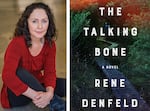
Portland author and licensed investigator Rene Denfeld's new thriller novel "The Talking Bone" releases July 21st, 2026.
HarperCollins
Author Rene Denfeld got the inspiration for her latest book, “The Talking Bone,” while taking a walk in her North Portland neighborhood, thinking about a case she was investigating at the time. Her work as a licensed investigator had her looking into the process of having bones tested for DNA.
“And this sentence kind of popped into my mind,” Denfeld said. “I wonder if people bury bones so they don’t have to listen to what they have to say.”
The thriller, out on July 21, follows Ruby Spencer, also known as “the exonerator,” as she investigates the case of a man on death row.
Denfeld spoke with OPB Morning Edition host Jess Hazel on the top of Mt. Tabor ahead of her book release event at Powell’s Books in downtown Portland.
This conversation has been edited for length and clarity.
Jess Hazel: Thank you so much for meeting me here at the top of Mt. Tabor in Portland. First off, can you explain the significance of Mt. Tabor for Ruby?
Rene Denfeld: So she takes on a case that’s actually in the South and it involves a man who has been set for execution. His execution is only two weeks away. Now, at the same time this is happening, Ruby has a second passion that really informs her life. Ruby tries to find missing women and is often successful.
When she finishes a case, she likes to go up to the top of Mt. Tabor. And she lets go of whatever information she has found and lets the wind carry it away. I think it’s her kind of beautiful way of processing and giving these missing women dignity and recognition, even if the rest of society kind of moved on and stopped caring a while ago.
Hazel: Half of the story takes place in Georgia and then the other half is in Oregon — in Portland, where Ruby grows up, but then also a place called Chinook. Can you tell me a little bit about how you came up with this town and what it represents in the story?
Denfeld: So, doing my investigative work, I travel a lot. I especially travel in Oregon. I’m constantly going out to different detention centers and jails and prisons and small towns and locations all over Portland, all over Oregon, to find witnesses. So, I wanted to create this little rural, small town of Chinook that, actually, I think if you’re familiar with Oregon, you’re gonna recognize this place and go, ‘Oh, that’s a lot like Town X or Town Y.’
Hazel: There’s also a lot of tension between Ruby as an investigator and then the criminal justice system in general. So, what kind of systemic failures did you feel like were most important to highlight there?
Denfeld: I have done this work now for almost 20 years. I’ve worked hundreds of cases. I have exonerated innocent people. One of the things I wanted to focus on in this novel is, a lot of times, it’s not always outright corruption. A lot of times, the people that are behind a false conviction are themselves convinced that this person did it. The state becomes focused on obtaining a conviction against this person that they have decided is guilty. That’s one of the many reasons false convictions can happen. All the people involved might be extremely well-intentioned.
Hazel: I think you treat the characters throughout with a lot of empathy. What do you think we lose when we tell stories that turn monsters out of people who do harm?
Denfeld: I think the cost of that is we end up othering people that do harm. We say, ‘Well, that person is not a product of their environment. They couldn’t possibly reflect anything that happened that we might collectively be responsible for.’
Hazel: It could have been just a straight literary fiction book and still been extremely powerful. So, why include elements of magic?
Denfeld: When I started the book and the concept of the ‘talking bone’ came to me and I realized I didn’t just want it to be a literary concept, the idea that bones speak to us through DNA, they speak to us through history. Instead, I just kept being nagged by the idea that there actually needed to be a character in the novel that was a talking bone.
I think it helps connect the reader to something that I feel doing this work, which is — there’s so much that is unknown in our lives. And personally, I really love embracing the unknown. Like sitting up here right now in this completely magical environment on Mt. Tabor and we can hear the birds singing, and there’s so much of a sense of the beauty of the world.
For me, there’s always a sense of like [with] all this beauty that I can see, what am I not seeing? How much joy and beauty and magic is out there that we might not even be able to see? The character of the talking bone also offers to me this really startling hope that if we start listening to the past, if we start taking the past seriously, if we ask the past to tell us what it knows, maybe we can be a little further along on a journey to justice.