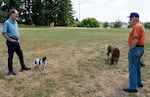
Dean Suhr, left, talks with Jim Driscoll as Suhr walks his son's dogs through Oppenlander Field in West Linn, Ore., on July 17, 2026.
Saj Sundaram / OPB
On a sunny afternoon in July, Miles McIntosh pitches softballs to his daughter Delilah on one of the three baseball diamonds at West Linn’s Oppenlander Field. On the other side of the spacious park, Jim Driscoll walks and tosses tennis balls to his son’s two dogs, Cowboy and Mookie. This is how the 10-acre Oppenlander property has been used for the past 50 years. But likely not for much longer.
The property is one of two sites in the city where developers plan to build a total of 365 new homes. That’s a historic housing boom for the suburb south of Portland, and would seem a positive start as the city seeks to meet its estimated need of over 1,000 new homes in the next 20 years.
But both proposals — one for 320 new apartments and another for 38 duplexes and seven single-family homes — have been met with skepticism and pushback from neighbors in the affluent Clackamas County city.
Residents’ unease at the proposals is not surprising. A 2021 survey conducted by the city as part of a state-mandated housing needs analysis found that West Linn residents preferred a “less dense, single-family neighborhood character” over multi-family units like apartments or “middle housing” types like duplexes and townhomes. Respondents also expressed concerns that “housing affordable to renters and/or low-income residents will affect neighborhood character” and endorsed “the sentiment that current residents earned their way to living in West Linn.”
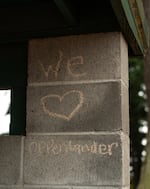
A message scrawled in chalk on the inside of the baseball dugout of Oppenlander Field in West Linn, Ore., on July 22, 2026.
Saj Sundaram / OPB
The possibility of 365 new homes becoming available around the same time would mark a significant increase in West Linn’s housing production. According to West Linn planning manager Darren Wyss, the last time a development of 45 or more homes was approved was nine years ago when the 50-home Tanner Ridge subdivision went through. The city hasn’t seen a new multifamily development since the late 1990s, he added. In all, West Linn built an average of 120 new homes a year between 2000 and 2020, according to the city’s housing needs assessment completed in 2024. The two new planned developments would triple that average.
The size and pace at which the new homes could come has alarmed some residents who question whether West Linn has adequately planned for so much housing.
Wyss said the city’s housing capacity analysis and housing production strategy, also completed in recent years, ensure the city is prepared.
“These documents guide how the City plans for housing needs over time and helps the City ensure that its long-term public infrastructure needs are addressed,” Wyss said via email after declining an interview.
Still, residents’ concerns about the projects reach beyond capacity and infrastructure.
Oppenlander development would replace neighborhood park with houses
Community members worked for several years to keep the 10-acre property owned by the West Linn-Wilsonville School District a park. So whoever ended up buying and developing the land was bound to be met with pushback from neighbors.

Oppenlander Fields includes three baseball fields and has been used as a space for youth sports since the school district purchased the site in the 1970s.
Saj Sundaram / OPB
Oppenlander Fields, as the property on Rosemont Road is known, includes three baseball fields and a small stand of towering fir trees. The community has used the space for youth sports and dog-walking since the school district purchased the site in the 1970s.
When the school district declared the land “surplus” and put it up for sale in 2021, outcry from the community pushed the city and district to work together on a plan to maintain the property as a public park. Despite the city’s passage of a $3.5 million bond to buy and upgrade the land, talks between the city and school district devolved over the sales price. That culminated in a multi-year lawsuit the district eventually won.
The court victory left the district free to sell off the property. In stepped developer Venture Properties. Earlier this year, Venture agreed to buy the land for $7.9 million. The deal will close once it completes permitting with the city. The developer has proposed a 45-home subdivision, the majority of which will be a kind of townhome called “detached duplexes.”
Dean Suhr’s backyard abuts the Oppenlander property. For several years, he helped organize the efforts to keep the property a park, meeting with school and city officials, and campaigning on behalf of the city’s bond.

West Linn resident Dean Suhr has advocated to keep the 10-acre Oppenlander property as a park.
Saj Sundaram / OPB
He’s resigned to the fact that the property will not remain a park, despite his best efforts.
“We’re losing a park, and we’re losing those resources and that space, and that’s not the character we want that we have in West Linn,” Suhr said. “People move in here because we have a strong park infrastructure and so on.”
According to the city’s 2019 Parks, Recreation and Open Space Master Plan, there are 548 acres of parks and open space in the city.
The neighborhood surrounding Oppenlander consists of large single family homes. For Suhr and his neighbors, two-and-a-half dozen duplexes on 5,000 square foot lots going up next door is not ideal.
“We don’t want to be looking like, you know, the middle of Portland, to be honest with you,” Suhr said. “We’re a suburban community because we want some of the suburban quote ‘benefits,’ which include a little more elbow room, a little more open space, a little more of that rural-ish feel, but not being too far away from the city and its services.”
Still, Suhr has had several conversations with Venture Properties hoping to make the best of what he considers a less than ideal situation.
The city has held two pre-application conferences with Venture Properties, but the developer has not yet submitted an official development application with the city.
Venture plans to discuss its plans in more detail at a neighborhood meeting Aug. 6.
Tannler Drive proposal moves ahead under new Oregon law
The larger of the two housing proposals would bring 320 new one-to-three bedroom apartments to a hillside above I-205 overlooking the Willamette River. That proposal, from land owner Jeff Parker, would build 10 apartment buildings. Four would have commercial space on the ground floor, and the project would include a neighborhood clubhouse.
According to Wyss, the city’s planning manager, West Linn has deemed the application from Parker and his development company, Tannler Holdings LLC, complete. The West Linn Planning Commission will hold a public hearing on Aug. 10 regarding the project’s commercial space.
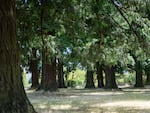
Large trees line an edge of Oppenlander Field, one of two sites in West Linn where developers plan to build a total of 365 new homes.
Saj Sundaram / OPB
The city will not hold a public hearing on the housing portion of the project, in an effort to comply with a new state law. Passed by the Legislature earlier this year, Oregon House Bill 4037 includes a number of provisions aimed at streamlining the process for building new homes — including a prohibition on public hearings for new housing developments that meet “clear and objective” review standards.
The law has drawn the ire of residents who feel it silences their voices. As of July 17, West Linn had received about a dozen written comments about the proposal, many taking issue with the city’s interpretation of the new law. Neighbors argue the development application was submitted last year, well before the law had passed, and should not be subjected to the new approval process.
“Regardless of anyone’s position on the proposed development, basic fairness requires that both the applicant and the affected community have a meaningful opportunity to participate,” one resident wrote to the city.
A handful of neighbors have hired an attorney to fight the state’s public hearing prohibition for this project.
Neighbors are also concerned by plans to re-route Tannler Drive — a road that runs adjacent to the site — through the southern end of the new development, and about the addition of hundreds of new cars to local roads.
In written comments to the city, neighbors also expressed a range of other concerns, including noise and light pollution caused by the new apartments, the loss of trees and of a walking trail, and anticipated reductions to their home values.
Need for new, more affordable homes
West Linn’s housing needs analysis from two years ago estimates the city will need 1,005 new homes in the next year. One third of those, according to the analysis, should be affordable for people making up to 80% of the area’s median income. To meet that need, West Linn has identified incentives to encourage developers to build homes other than the large single-family houses that currently make up most of the city (according to the analysis, single-family homes make up 81% of the city’s current housing supply).
While the Oppenlander and Tannler developments will provide some of that needed middle and multi-family housing, it’s not yet clear what prices these homes will be offered at.
Neither Venture Properties nor Tannler Holdings LLC responded to requests for comment for this story.
West Linn leaders, including Mayor Rory Bialostosky, have previously spoken about the need for more affordable housing in the city. During a 2023 City Council discussion about housing affordability, Bialostosky said he couldn’t, at that time, afford his own apartment in the city.
“We know that home prices in West Linn are pretty expensive, but having the ability to have socio-economic diversity is a good thing,” he said in another conversation that same year, when discussing the lack of affordable housing in the city.
Bialostosky declined to comment for this story, citing the potential for both housing developments to be appealed to the City Council.