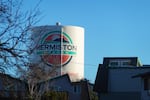
FILE - A water tower in Hermiston, Ore., in 2025, bearing the watermelon logo the city adopted in 2016.
Antonio Sierra / OPB
Hermiston had a marketing problem.
Once best known for warehousing bombs, then for growing fruit, by 2013, leaders of the Eastern Oregon town wanted to showcase more wide-ranging possibilities. The city council adopted “You can GROW here” as its official slogan, but by the following year, they had some complaints.
Some residents jeered the slogan’s logo, a simple, brown script prominently featured on the water tower by the southern entryway to the city, as “bland” and “boring.” Some members of the community joked that it encouraged cannabis cultivation.
The worst sin of all: it did not feature a watermelon.
The city went back to the drawing board and unveiled a new slogan and logo in 2016.
Hermiston leaders went all in on the staple crop. The new logo centered around a watermelon slice with a green, black and red color scheme. The slogan, “Where life is sweet,” drew a line under the importance of an industry connecting its community to markets across the country, fueling not only the economy, but history, art and culture. This Saturday, Hermiston hosts its annual MelonFest, a celebration of all things watermelon as harvesting season hits full swing.
“Idaho is known for potatoes,” Judy Currin-Pederson, one of MelonFest’s organizers, said. “Hermiston is known for watermelons.”
The melons’ fame stems from science, and spin
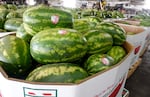
Hermiston is known for watermelons, like these seen at Walchli Farms near Hermiston, Ore. on Aug. 19, 2026.
Antonio Sierra / OPB
Before melons, weapons put Hermiston on the map. The town experienced a population boom in the 1940s after the federal government built the Umatilla Army Depot nearby to store bombs, munitions and eventually, nerve gas that would famously leak from the storage facility.
But that’s not what Hermiston leaders wanted their town known for. Local boosters after World War II aggressively promoted watermelons to divert attention away from the depot, according to the Oregon Encyclopedia.
Their effort worked, but ideal growing conditions are what made the spin last, said Curtis Pederson, a manager at Walchli Farms near Hermiston.
In addition to the area’s soft, sandy soil, Pederson said watermelons react well to its high desert climate. The hot summer days followed by the cooler nights help activate the melon’s sugars, Pederson said, making for a sweeter fruit.
Eastern Oregon is known for producing crops like potatoes, onions and wheat, but Pederson said nothing quite captures the public imagination like watermelons.
“A bushel of wheat, you wouldn’t say, ‘Man, that was the best bushel of wheat I’ve ever had, he said. “But on watermelon, it’s more personal. It’s different.”
A teen started one of the most successful farms
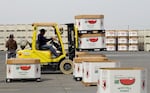
A forklift driver transports boxes of watermelons on Walchli Farms near Hermiston, Ore., on Aug. 19, 2026.
Antonio Sierra / OPB
Walchli Farms is very much a working farm.
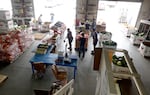
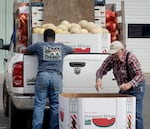
Late Wednesday morning, forklifts buzzed to and from the farm’s sorting facility carrying boxes of watermelons bound for some of the largest grocery chains in the Northwest. The sorting facility is within eyeshot of a farmer’s market just east of Hermiston, where the customers’ careful inspections of watermelons are punctuated by firm thwacks to check for ripeness.
Away from all the hubbub is the Walchli family’s party room — a garage-like space on the farm for hanging out and displaying memorabilia. Among all the hunting trophies that line the walls are old photos of a young Skip Walchli, perched high atop a tall pile of watermelons. Walchli Farms’ namesake started watermelon farming with his brother at age 17 and quickly made it his career.
All images: Antonio Sierra / OPB.
A lot has changed since the farm was founded in 1957, when Skip Walchli used to personally deliver watermelons to local supermarkets that bought fruit by the cartful. His son, Patrick Walchli, said changing industry standards, rising costs and regulations mean watermelon farming has become a lot more complex and riskier. The family decided to reduce its watermelon acreage this year, he said, to improve the farm’s sustainability by spending less on labor, water and equipment.
Despite all the challenges, Patrick Walchli said the farm is on track to hit its target of producing 25 tons of watermelons this season. Patrick said it was important that Walchli Farms not only continue to send watermelons across the northwest, but also serve the community.
“Hermiston melons as a whole have always been family operations,” he said. “It is people that do the job and do the job well. We like to take pride in our community and we represent our community with our melons.”
The crop has become a force for culture and art
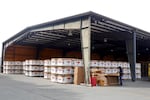
The Walchli Farms sorting facility near Hermiston, Ore. on Aug. 19, 2026.
Antonio Sierra / OPB
While watermelons have been a Hermiston staple for decades, MelonFest is a relatively new event.
Organizer Currin-Pederson, Curtis Pederson’s wife and Patrick Walchli’s sister, leads the Hermiston Downtown District and helped come up with the idea of a watermelon-themed festival with city officials back in 2019.
Since the event started that year, Currin-Pederson has tried to grow it a little bit with each year. This year’s event includes a watermelon seed spitting contest, a bathtub race, and for the first time, a local watermelon carver.
By day, Roger Pope is a graphics and media producer for the Hermiston School District. But since he was a boy twisting tin foil into new shapes and figures, Pope has sculpted as a hobby.
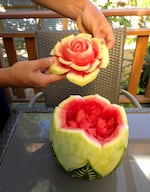
In this provided and undated photo, a watermelon carving made by Roger Pope, of Hermiston, Ore.
Courtesy of Roger Pope
As an adult, that usually involved elaborate pumpkin carvings and sandcastles. He was even featured on the Food Network show “Halloween Wars” in 2013. But carving watermelons wasn’t his medium of choice until the Umatilla County Fair invited him to try it out last year.
Now he has a new passion. Using a carving knife, he turns watermelons into delicate flowers or green and red calligraphy.
“Not comparing myself to Michelangelo, but if you think about those types of sculptors, they take a big block of rock and then they clear away what they don’t want and what remains is the piece of art,” he said. “That’s subtractive sculpting.”
Pope will be carving the MelonFest logo at the event. He said he’s looking forward to the looks on attendees’ faces once he’s done with it.
“The Hermiston watermelon is iconic to the town because it brings the community together,” he said.