Pacific Northwest cherry growers had a bad season last year. And now, as this year’s harvest wraps up, growers are getting a glimpse at what their fruit earned them.
It wasn’t what they hoped.
“Last year we were really in the red. Now our eyeballs are just peeking over the surface of the water in terms of profitability,” Ian Chandler, a cherry grower in Wasco County, said.
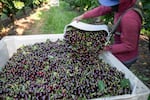
FILE - A worker dumps harvested cherries in a collection bin at a cherry orchard Ian Chandler runs in Wasco County, Ore., July 2, 2025.
Morgan Barnaby / OPB
As with most agricultural goods producers, Chandler said, cherry growers are not price makers — they’re price takers. They’re at the mercy of what the people who sell fruit from the packing houses say the market is for their product.
This year’s price was just a few cents above what it costs to produce the fruit. It might not cover the debt some growers had to take to keep afloat after last year.
“The problem is we’re having to carry debt forward year-after-year and we’re going backwards,” said Chandler, who also chairs the Oregon Sweet Cherry Commission. “And that’s a tough place for our industry to be in.”
Last year cherry growers said they were hurt by the Trump administration’s aggressive immigration enforcement efforts. Immigration enforcement kept many migrant farmworkers from their typical route following the harvest through the country’s top three cherry-producing states: north from California into Oregon and Washington.
By the time enough people made their way up, the harvest window for some cherry varieties had passed. Some of it was left to rot in the field.
This season, growers had enough workers. But it took more planning than usual before harvest began to make sure migrant workers, who predominantly are Latino or Hispanic, felt safe to travel from California, Chandler said
“We have excellent people who are great human beings and who come and help us every year,” Chandler said. “To explain to them why our country at this particular time is going after them specifically for no true reason other than politics, and completely devaluing the contribution that they’re making here to the greatness of our country, is hard.”
But what perhaps contributed most to last year’s bust was an oversupply of fruit during the peak of the season, flooding grocery stores with enough fresh cherries to outpace demand and lower the price growers could earn for their fruit. The cherries left unpicked and rotting compounded farmers’ losses, particularly when they were varieties that fetch higher prices or crops that ripened on the shoulders of the season, when supplies are lower and prices are higher.
This time around, sweet cherry production in Oregon was forecasted to be down by 24%. But that doesn’t matter much if a growers gets caught in the same harvest window as everyone else, said Tiffany Davis, business manager at K&K Land and Management — a labor contractor for orchards based in The Dalles.
Growers whose cherry crops are ready to harvest earlier or later than typical crops usually can profit by selling their cherries when few others are available, Davis said.
“If you’re in between that, which is 95% of us in this area, you’re breaking even or maybe even losing a little bit of money,”Davis said.
Preliminary revenue reports show some growers are likely to net just a few cents above what it costs to produce the fruit — enough to cover operating costs, but not enough to make up for last year’s losses. Some growers don’t yet know what they will earn for their fruit since they likely won’t receive their final check from the packing houses until at least November, Davis said.
“Maybe there’s going to be a year that we knock it out of the park and that makes up for those years of going backwards,” Davis said. “That’s kind of what we’re waiting on right now and it’s just not happening.”