Roseburg city councilors voted 6-2 Monday to stop considering two downtown parking lots as homeless campground sites, saying the locations weren’t right.
The decision ends consideration of two city-owned lots, but councilors unanimously agreed to hold a future study session to further discuss urban campgrounds.
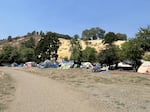
Deer Creek Park in Roseburg in July 2025, where many homeless people are camping illegally.
Jane Vaughan / JPR
Roseburg has previously considered and rejected multiple sites for an urban campground, including canceling a deal to buy property for that purpose. Councilors discussed these two downtown sites in July as a possible way to address the city’s longstanding homelessness crisis.
Councilor Ellen Porter said she was frustrated by the council’s lack of action on the issue.
“I really hope that something within council changes, and we are able to actually start discussing some of these tough issues and be able to start acting on some of these tough issues for the betterment of the whole community and the homeless population,” she said. “I’m quite discouraged with the whole thing, and frankly, somewhat disgusted.”
Councilor Ruth Smith said the city needs to make a decision.
“We have to do something,” she said. “I’m willing to sacrifice two parking lots to just prove that we can do something.”
The two sites are right down the block from each other. The Phillips Lot, at 840 SE Stephens St., covers about .38 acres and has 45 parking spaces. The Shalimar Lot, at 734 SE Stephens St., is about .2 acres and has 19 parking spaces.
City staff said Monday that Phillips could accommodate about 41 tent spaces and Shalimar about 23, with restrooms, dumpsters and fencing. Fencing for both lots was estimated to cost more than $20,000, and a wheel-chair accessible shower trailer was estimated to cost more than $78,000.
Staff had a variety of questions for the council, including the types of structures that would be used, the amenities that would be included and the rules or eligibility requirements that would be in place.
Using either property as an urban campground would require a conditional use permit, which would involve a Planning Commission decision and a possible appeal to the City Council or Oregon Land Use Board of Appeals.
Staff recommended hiring a land-use consultant to prepare the permit application for an estimated cost of $30,000 to $35,000.
Resident Susie Osborn spoke against the sites during public comment.
“Quit cramming it down our throats. Where’s the accountability to the people in our ward that actually work and live there and want to stay there and have a decent place to live,” she said. “You’re not going to stop the problem with this.”
Both lots are near Deer Creek Park, where homeless people camp without city management.
Another issue with the proposed lots is Umpqua Community College is relying on that parking for a planned housing development.
“We will not move forward if this is the city’s plan,” UCC President Rachel Pokrandt said at the July meeting.
Mayor Larry Rich said residents are never happy with the proposed locations for such projects.
“Whenever you choose a site, then you’re going to hear the same comments: wrong neighborhood, great idea, but did you check another section of town because it’s the wrong place,” he said.
Rich suggested the city provide services at the Point in Deer Creek Park instead.
Councilor Zack Weiss also disliked the locations but said the council would eventually have to decide how to address the problem.
“This silver bullet idea of finding a place that’s going to check all the boxes is foolish,” he said. “We are going to have to make a plan that’s not going to make everybody happy, but it’s going to look out for the people in our community at large. That’s why we’re in these positions.”
Roseburg doesn’t have any urban campgrounds, but staff said the city still spends about $114,000 a month on homelessness-related issues, including law enforcement and public works.
Jane Vaughan is a reporter with Jefferson Public Radio. This story comes to you from the Northwest News Network, a collaboration between public media organizations in Oregon and Washington.
It is part of OPB’s broader effort to ensure that everyone in our region has access to quality journalism that informs, entertains and enriches their lives. To learn more, visit our journalism partnerships page.