
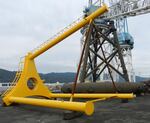
Politicians and wave-energy players get a close look at a "PowerBuoy" built for Ocean Power Technologies at Vigor Industrial in Portland.
Bonnie Stewart



PORTLAND -- Not much is known about how new wave-energy technologies will affect the environment. There's been little research -- particularly ocean-based research -- to see how marine life, sediments, and coastlines could change if a self-sustaining wave industry emerges.
What is known is that companies forming the industry need capital and connections, and they are finding both in Oregon.
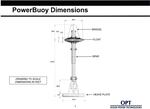
Some of the major players who support ocean energy projects met in Portland Friday to get a first-hand look at a New Jersey-based company's "PowerBuoy," a giant buoy system designed to capture the power in the waves off Oregon's coast.
The Oregon Coast is perfect for the project, Ocean Power Technologies Vice President Robert Lurie told a small group of politicians, Oregon State University representatives and others involved in ocean energy work. Oregon is at the best latitude for catching waves and it offers all the infrastructure for putting the "PowerBuoys" into the ocean. "They are big and heavy and need to be made near to the point of deployment," Lurie said.
Public Input
Hearing:
Wednesday, Oct. 25
6 p.m.
Reedsport City Hall; 451 Winchester Ave.; Reedsport, OR 97467
Comment:
Submit to DEQ/Marilyn Fonseca
811 SW 6th Avenue; Portland, OR 97204
Fonseca.Marilyn@deq.state.or.us
And they are expensive. Lurie's company, Ocean Power Technologies, (OPT) has spent about $100 million on research and development, he said. Building the first buoy cost another $10 million, Lurie said. The U.S. Department of Energy provided about $2.4 million for the project. OPT also recently announced that Lockheed Martin has signed on(see press release) to the project to provide design, manufacturing and supply chain management expertise.
Although OPT has tested its product off the coast of Scotland (see video). Lurie said that experiment wasn't used to monitor the environment. The company chose Scotland because it was less expensive to deploy the device there and the regulatory process was easier to navigate than the U.S. system.
That's where the politicians come in. U.S. Sens Ron Wyden, D-Ore., and Lisa Murkowski, R-Alaska, asked the industry representatives what they needed to be successful.
Their answer: long-term, significant financing and easier regulatory systems to navigate. The two lawmakers already have been trying to gain support in Congress for the ocean-based industries. Murkowski introduced and Wyden co-sponsored SB 630, the Marine and Hydrokinetic Renewable Energy Promotion Act of 2011. It calls for federal grants to support the demonstration test facilities in "operating marine environments." The bill calls for $70 million in grants for 2012 and $75 million in 2013, but has not moved beyond the committee stage.
OPT's Oregon project, known as Reedsport OPT Wave Park, recently received a thumbs up from the Oregon Department of Environmental Quality. It will begin with putting one PowerBuoy off the coast of Coos Bay in 2012 and another nine on the 30-acre ocean bottom plot. When all is complete, the pod of wave power buoys is expected to produce about 1.5 megawatts of electricity, or enough to power 1,500 homes, according to the company.
The DEQ will require the company to monitor certain environmental conditions, such as turbidity of the water, and conduct studies of the impact the project has on aquatic resources.
Oregon State University will conduct some of the scientific evaluations, said Belinda Batten, who directs the university's Northwest National Marine Renewable Energy Center. Until the wave devices are in the water, it will be hard to know how they will impact ocean life, she said.
The National Oceanic and Atmospheric Administration gathered some environmental information on the subject during a 2007 workshop on the ecological effects of Wave Energy in the Pacific Northwest and published its proceedings. (View the report.)
