
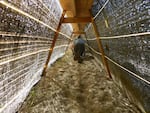
Nearly 30,000 cormorants are nesting on the other side of these black tunnel walls.
Cassandra Profita

Editor’s note: EarthFix Field Notes are reporters’ personal impressions and experiences from their coverage of the Pacific Northwest. In this entry, Cassandra Profita describes what it takes to get up close and personal with a colony of 30,000 cormorants.
I think it's fair to say I have mixed feelings about crawling through the largest cormorant colony in North America.
It was hot, stinky, dirty and I got bitten from head to toe by what I later learned were bird fleas.
But oh my, the sounds these birds make! They groan like cows, thrum like xylophones, croak like frogs and hoot like owls. And it was all happening just inches away as I drug my knees through feather-dusted sand.
Nearly 30,000 cormorants were nesting on East Sand Island last month when I got the chance to visit. Researchers have built a tunnel system out of wood and black landscaping fabric that allows them to sneak through the colony without getting their eyes pecked out.
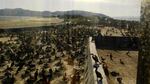
The tunnels lead you to an observation blind right in the middle of the colony. You can look out from the windows in the blind and see nesting birds in all directions.
Listen to a journey to the center of a cormorant colony:
Our tour guide, researcher Don Lyons of Oregon State University, stopped us before we got anywhere near the colony to give us instructions on how to crawl through the colony without scaring off all the birds in the process.

Don Lyons crouches to avoid being seen by the birds.
"Cormorants are very nervous about people approaching them so we stay out of their sight essentially," he said. "You may see me start to crawl, and what I'd like you to do is when you get to the spot where I started crawling, you start to crawl as well."
And he wasn't kidding. As we neared the colony, he started walking in a crouched position. A half-dozen of us on the tour followed suit. We also had instructions for how to handle ourselves once we got into the above-ground tunnel system.
"They often are aware that something is in the tunnel," Lyons told us. "They don't really recognize it as a threat so they don't react much, if you stick your face up against it, though, they might recognize your face or an eye or something and they might peck at you so don't put your face too close to it."

The view through the observation blind window.
Sound advice. Once we got into the tunnel, I could see why it would be tempting to press one's face against the black fabric. It's somewhat porous, and the cormorants were nesting literally right on the other side. At some points, I could see and hear the birds brushing up against the fabric. That's why we could also hear the crazy sounds they make so clearly.
"They are not that vocal compared to gulls but their vocalizations are croaks and groans," Lyons told me. "That's mostly to communicate with mates. They can also communicate with their chicks that way."

We can see the birds, but they can't see us.
When we got to the observation blind, we had to climb a ladder to get in. It's like a tree house with one-way glass windows so the birds don't know you're inside.
Lyons tells us we're lucky. Not many people in the world have blinds this close to birds. You can see a lot more when you get close up.
"From a distance these birds just look like black birds, but up close here you can see their crests, which are often white," he said. "You can see the blue-green eye and blue-green eye ring and you can see the blue gape, the inside of their mouth. They're really surprisingly cool when you get a chance to see them up close."
As I reported yesterday, within the next four years, many of the birds I saw and heard that day may be killed by wildlife officials to protect threatened and endangered fish. Scientists say the cormorants on East Sand Island ate around 18 million salmon and steelhead last year.
--Cassandra Profita
