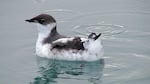
The marbled murrelet has been listed under the Endangered Species Act since 1992. The latest studies by federal researchers show significant population decline in one range of its habitat.
US. Fish and Wildlife Service

A couple of years ago, a research team from the U.S. Forest Service and U.S. Fish and Wildlife Service released a report showing marbled murrelet populations declined 30 percent between 2000 and 2010.
Those findings made the rounds in the news and fit the narrative for the marbled murrelet, an endangered seabird that lives along the West Coast from San Francisco to Puget Sound and has become known for its role in lawsuits to stop Northwest logging, much like the northern spotted owl.
But after three more years of monitoring and gathering data, those researchers no longer claim that same downward trend.
When they run the numbers for 2000-2010, they do get the 30 percent decline, according to Martin Raphael, a wildlife ecologist with the Forest Service and member of the monitoring team. But when they run the numbers for a longer period of time, 2000-2012, the statistical significance of that trend disappears. Instead, they're left with data that could be a trend or could be just the natural ups and downs of a population that is not in the midst of a larger decline.
Of the five marbled murrelet habitat regions defined by the Northwest Forest Plan, only one, the outer coast of Washington, showed a significant decline over 2000-2012. The Puget Sound area surprised researchers with an inexplicable bounce-back in murrelet numbers.
The latest edition of the Forest Service journal Science Findings, released this week, focuses on the marbled murrelet monitoring team and their findings (although not with a headline that reflects the nuance Raphael and other team members describe).
 Annual marbled murrelet populations at a 95 percent confidence interval. Source:
 U.S. Forest Service and U.S. Fish and Wildlife Service.
In this case more data has added mystery to the secretive marbled murrelet, a species that has complicated timber sales as recently as last month and will feature prominently in new debates over how to manage the Northwest's forests. The murrelet is the only seabird that makes its nests in inland forests, requiring older, larger trees and continuous cover, Raphael said.
Though all the factors driving population numbers aren’t known, Raphael said his team has found a close correlation between the number of murrelets counted on the coast and the amount of inland habitat — a seemingly obvious correlation, but one that’s stronger for murrelets than for many other species, he said.
“Any changes that managers do to either increase the acres of habitat or decrease the acres of habitat, we think are going to be reflected in numbers of birds that are supported on that outer coast,” Raphael said. “So even if numbers are stationary in Oregon, that doesn’t mean managers can now disregard what they do with the nesting habitat.”
Increased recreation and development in and along Northwest forests also damage murrelet population, because food and trash left behind attract jays, crows and ravens that prey on murrelet eggs and chicks. Studies show development attracts those birds, and development along public forestland has more than doubled in the past few decades. Other potential factors driving population include changes to the marine environment such as warming coastal waters, overfishing and reduced quantity and quality of food.
All of the team's analysis is based on counts of actual birds they observe on the water. The next step in the team’s research is population modeling based on oceanic data, which the team will compare to forest habitat modeling. They hope the research might reveal which one has a stronger influence on the bird.
“We’ve got things that are happening on the ocean and things that are happening in the forest — what is really driving the population? Just getting a little closer to cause/effect stuff,” Raphael said. “So we can say that it’s definitely the trends in forest habitat that influence the birds or its a combination of both forest and oceans.”
-- Tony Schick
