
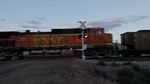
Coal trains like this one in the Powder River Basin of Wyoming are generating political debate in the Northwest, where the industry wants to establish as many as five terminals for exporting to Asia.
Katie Campbell
Update: Portland City approves resolution. Click here for the story.

Portland is exploring its power to regulate the coal industry as the business looks to expand in the Northwest.
City Commissioner Amanda Fritz has drafted a proposal that would put Portland on the record opposing coal export shipments traveling along rail lines within city limits until more is known about the possible health and environmental effects of those shipments.
Fritz is seeking re-election to the Council. Northwest politicians at the local, state and federal levels have been raising the issue and calling for additional study of the impact coal trains could have on traffic, human health the economy and the environment.
Fritz says her resolution is in response to community concern. Her resolution calls on the rail companies to give proper public notification of any expansion in rail traffic.
It also asks the U.S. Army Corps of Engineers to complete a full Environmental Impact Statement. That's a technical term for a complete in-depth study, typically conducted over a period of years. Fritz's request asks specifically for an "area-wide" EIS, incorporating projects across the region.
The corps sometimes conducts what's called an environmental assessment. That's less in-depth than the impact statement, and would take less time. Fritz says the latter is not acceptable.
"We want an environmental impact statement rather than an environmental assessment because that allows more pubic input. We know this is an issue people care about on all sides," Fritz says.
(Hover over markers to hear reports on coal in communities of the Northwest. Then click "website" for more coverage. Click here for larger map view. Note: Train routes are approximations. They illustrate potential corridors based on existing lines and publicly available information.)
The city of Portland has no power to restrict coal exports moving along railroad lines. The rail companies have their own right-of-way. But if Portland passes the resolution, it would join the ranks of at least twenty local governments that have passed similar resolutions. The City of Eugene is deliberating a coal resolution, with a hearing scheduled for early October.
Councilwoman Kate McBride of Hood River spoke at an August rally about regional concerns in the Gorge.
Kate McBride "Over thirty trains travel through Hood River daily right now. With as many as fifty additional coal trains in the Gorge, daily spewing coal dust, adding the noise pollution, and potential safety hazards, our quality of life will suffer and stifle the tourism in our community too."
At least four regional cities have gone so far as to ask the Army Corps for the Environmental Impact Statement - that's the more intensive form of review. The Corps is obliged to consider all such requests cities may make, but it also has latitude in interpreting its regulations and policies to determine how far to take an investigation. The list of elected officials piling on to the cities' requests include some heavy hitters, like Oregon Governor John Kitzhaber, and Washington Senator Patty Murray. At this time the Corps has no plans to act beyond the narrowly-tailored studies it has planned for individual projects. Scott Clemans is with the U.S. Army Corps of Engineers' Portland District. He didn't rule out the possibility of the longer study— the EIS.
"Our position is that an area-wide EIS may be useful when there are similar permit actions that share common timing and geography. And if, at some point we find that an area-wide EIS would be a better way to address cumulative impacts, we'll proceed along that path,” Clemans said. “But at this time, we think that doing the project specific environmental reviews we and Seattle District are currently working on, we will identify and document those cumulative effects."
There's one active project that would send increased coal shipments through Portland, although several others have been proposed throughout the Northwest.
The Alliance for Northwest Jobs and Exports is an industry and labor group that includes Union Pacific and BNSF railways. The alliance says the coal exports will be an important source of jobs in years to come.
Communities outside of Portland, that are more welcoming to the coal industry, are keeping an eye on the city's actions. John Whitty is an attorney in Coos Bay, and former Port Commissioner. He's familiar with the project that would send an additional ten million tons of coal per year through Portland, and to the Port of Coos Bay for shipment overseas. "It would give Coos Bay a shot in the arm by construction of the facilities that would be used to export the coal - some longshore jobs, some maritime jobs. They pay well, they usually have insurance. That's the kind of jobs we used to have around here," Whitty said.
That's until around 1980, Whitty says, when the forest products industry began to go away.Whitty notes Eugene's October hearing is slated to include testimony from supporters of coal export expansion. He says he hopes Portland City Council will also make time to hear both sides of the issue.
Fritz says she hopes Wednesday's hearing will lead to a fuller understanding by all sides.
Bonnie Stewart contributed to this report.(This was first reported for OPB News.)
