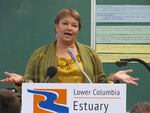
Lisa Jackson, administrator of the Environmental Protection Agency, at a May 4 event in Portland. Jackson highlighted a local rain garden project that helps curb pollution from stormwater runoff.
Rob Manning/OPB
When U.S.EPA Administrator Lisa Jackson visited Portland in May, she sat down with EarthFix to talk about the Clean Water Act's 40th anniversary and the water-quality challenges that face the nation.

EarthFix: The first question I had, and it started back with Bill Ruckelshaus looking at how he laid out his plan, and I'm from Indiana. And I was wondering how far you think we have come and what does that mean?
Jackson: You know in 40 years of the clean water act, it's important to realize that the clean water act was born out of time when rivers were literally on fire, and it was not unusual in many cities that you could smell the waterfront before you actually saw it because of raw sewage and other things that were dumped into it. And so it's hard to believe today that those things happened and that's a testament to the power of the Clean Water Act. It's 40 years of making sure that we stop raw sewage discharges or that we ensure that any discharge into our water is permitted and that we are using technology to reduce it. And we've made incredible progress and every anniversary or birthday is a time to look back, but of course, just like to honor Bill Ruckelshaus we also have to look forward and look at the challenges that we face going forward.
>
(EPA Administrator Lisa Jackson in a May 4 interview with Bonnie Stewart of EarthFix/OPB.)
EarthFix: What do you see as the challenges?
Jackson: Well first, we have 92 percent of Americans who drink water that meets all federal standards. The Clean Water Act basically says the water has to be drinkable and fishable and swimmable. So if you start with drinking, 92 percent is great, and that means that 8 percent still drink water that doesn't meet standards. Now a lot of time that isn't surface water but we still have work to do understanding new contaminants whether its drugs that pass through our bodies and through treatment plants, whether it's hormone impacts whether it's other synthetic or new chemicals, we have to continue to be vigilant. We can't assume because we've tackled yesterday's threats we're OK on the drinking water front.
When it comes to fishing and swimming about two-thirds of the waters that when we test them and assess them, and we don’t assess all our waters, but about two-thirds meet fishable, swimmable criteria, but a third don’t, and that’s just a third of the ones we know about.
And I think last but not least is the sort of iconic vision of water pollution has to change in our mind. Back in 1970 it was a pipe spewing something into an open waterway and now, sadly, the pollution is much more invisible. It’s sheet runoff that runs through our streets, over our farms, over our lawns and picks up contamination and sediment and oil and fertilizer and pesticides and dumps it in a much more difficult way to contain or do something about.
EarthFix: I've been to this water monitoring conference this week, a few of those sessions. And the people there have been really worried about the whole monitoring end of it because they don't have the funds, they don't have the staff. Volunteers can't fill that gap. What can be done to make sure that we are monitoring and know where we are?
Jackson: You know EPA does provide funds to each and every state to do some amount of monitoring. But we've never been able to fund all the monitoring to really get a comprehensive look. We have to also look at some of our federal partners. We know that U.S.Geological Services does a great job as well. And then of course we would be remiss if we didn't recognize that a lot of monitoring happens at the state and sometimes even the county and local level. The coolest thing about water, especially surface water, is that it is always a local issue. It's sort of like they say about politics, it's global but it really comes down to your local creek, your local fishing hole, your local river. In the case of an urban area, an urban waterfront and the move that's taken place in the last couple of decades that people want to be back on the water and it's an amenity rather than a dumping ground.
And I think we have to make good of a partnership with academia. Water is an incredible learning experience. Oftentimes a child’s or even a graduate student’s real science can revolve around the science of water. And try to find ways to leverage all the resources that can be brought to bear to build a monitoring network. We’ve continued, I think one of the great things the EPA has done is to try to build a network of monitoring that is including more and more citizen volunteers, academics so that we get a fuller picture. But it’s going to be a challenge in economically strapped times.
EarthFix: One of the things that I've noted in looking through the data that is kept by the federal government and the local governments is that the wastewater plants that are getting fined a lot are the small communities that maybe their wastewater treatment plants were funded when the Clean Water Act began but now it's deteriorating and nobody wants to pay to fix it. What do we do about our infrastructure?
Jackson: You know the American Society of Civil Engineers gives us a D- I think for water infrastructure. It's one of the challenges that we have. And you are absolutely right, in the 40 years of the Clean Water Act, we have moved from a construction grants program that gave out billions of dollars across the country to fund these plants to now a construction loan, a revolving loan program for new construction and that money, the president has increased that dramatically in the Recovery Act and in the years he has been in office, but it is still nowhere near our needs.
So we are going to have to do a couple of things. We’re going to have to not walk away from needing to continue to invest in our water infrastructure. It means we have to be sensitive to the fact that a lot of communities are economically strapped, but we can’t step backwards. We have to leverage the money that we give out in loans. Small communities actually qualify for loan forgiveness so they are back to grants. And here in this region in many places, that’s a really important tool to be used. When you combine that with some really smart thinking and we see that--I saw some of that today in Portland, in the Green Streets and around Portland State University--you start to see that you can really use green infrastructure, smart planning, putting water back into the ground instead of in conveyances to take it through treatment plants, you can minimize the amount of water. When you do that you can save an incredible amount of money. I heard a figure just in Portland, I think $63 million they were talking about in savings because they don’t have to use the energy to move the water. In most cities, moving water is the biggest use of energy by far on the municipal level.
EarthFix: How will that work for a trailer park that just has a little thing and you have some relatively low-income folks living there?
Jackson: Well, you know, it's very true that the maintenance of those systems can sometimes be difficult. I think the partnerships there have to be the states. States generally are going to be on the drinking water side, and this is usually under the Safe Drinking Water Act or the Clean Water Act if its wastewater. They are going to have to work to either get technical assistance or sometimes other assistance where we can. But you know the infrastructure problems that we face are huge at the big urban level but at the rural level, they tend to be more about having the mass of people to actually be able to pay for infrastructure investments. And we do see that around the country, too.
