
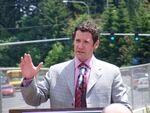
Vancouver Mayor Tim Leavitt says that by declaring an affordable housing state of emergency the city is taking an important step towards addressing the city's housing problems.
Washington State Department of Transportation
Voters in Vancouver could decide whether to create an affordable housing fund this November. If approved, the fund would generate $42 million over seven years.
While it’s still in draft form and unclear whether it will even make it onto this fall’s ballot, the goal of the fund is help the city’s poorest residents get — or in other cases keep — their housing.
Vancouver residents would pay for the fund by increasing property taxes. According to estimates from the city, property taxes would increase $90 per year on a house appraised at $250,000.
The city is facing some of the fastest growing rents in the country. For the last 18 months, the city's rental vacancy rate has been below 2 percent, according to city staff.
“We’ve had some rapidly increasing rents,” said Peggy Sheehan, community development programs manager, as she spoke to the Vancouver City Council on Monday.
From May 2015 to March 2016, Vancouver was listed as the No. 1 city in the nation for the fastest rent growth, Sheehan said.
The City Council declared a housing emergency in April.
“We have a growing homelessness problem” Sheehan said.
The city found 231 people are living on the streets in Clark County. That’s a 12 percent increase from last year. Sheehan said an additional 456 people are living in shelters.
“Both Evergreen and Vancouver school districts are reporting an uptake in the number of children and families that are homeless, living in their cars or doubled up,” she said.
“What this levy does, is allows communities to put a ballot measure and ask folks to increase their property taxes to support affordable housing,” Sheehan said. “We can’t use it for police, we can’t use it for fire. None of the other things government spends money on. It has to be used to directly impact low income families.”
The fund could help pay rents and increase the supply of affordable housing through buy-downs, which effectively turn existing market rate units into affordable units. It would preserve current affordable housing by paying for things like a new roof or other fixes to help keep a low income family in their home.
The fund would also help prevent homelessness, according to city officials.
The city estimates even if the housing fund gets on the November ballot and is approved by voters, it wouldn’t have money in it until midway though 2017, after spring property taxes are paid.
Reaction to the housing fund from city councilors was mixed. Most agreed affordable housing is a growing issue in the community, but were less in agreement about whether raising property taxes was the best way to create more housing.
“We have a certain segment of our community that we have an obligation to, in partnership with others, ensure that they have stable housing,” said Mayor Tim Leavitt.
But Leavitt noted that the current plan is too complex to bring before voters.
Council member Alishia Topper pushed back against that idea, saying the fund is aimed at helping the city’s most vulnerable residents.
“This is going to accomplish what none of the private market can do on their own,” she said. “That’s what we can tell the voters: That this is the people that are working minimum wage, more than 40 hours a week, they can’t afford our rents. We’re going to help them.”
Councilmember Jack Burkman said November is too soon to put the fund before voters. In order for the it to be successful, he said it need to be more focused so voters better understand what they’re paying for.
“The people I’m talking with in the community bluntly say, ‘No, I do not want to pay this.’ That’s the starting point,” he said.
But Burkman said during those discussions people do want to help many of the people the fund aims to assist: the families with kids, the homeless and the elderly.
“It needs to be really clear. Here’s a specific program, we collect the money from our residents and we apply it over 20 years and this is what happens,” Burkman said.
Some council members suggested that it’s not fair for local residents to pay for something when it should be dealt with at the federal or state level.
“The reason that we’re having this discussion is that our federal government refused to have a housing policy,” said council member Ty Stober.
Topper said the affordable housing fund is a tool Washington state lawmakers gave to local communities.
“We claw constantly at the Legislature to get more local control, to have more local options for issues that are impacting our own cities and towns," Topper said. "And this is one option the Legislature gave us."
Council member Bill Turlay said he was concerned about raising taxes and also concerned that if the program was “too good,” more people in need of assistance would move to the region.
“I’m concerned about unintended consequences,” Turlay said. “If we make this really attractive then we’re also going to attract a population here that wants to use it.”
City staff said that wasn’t something they had discussed.
Sheehan said city staff will hold two community meeting later this month to explain the idea to residents before coming back before the council in mid-June.
“We’re looking forward to the feedback form the community” Leavitt said.
