
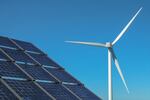
Wind and solar energy production in Washington state.
Ed Suominen
InvestigateWest takes a hopeful look at the ways the Pacific Northwest has already started transitioning to a more climate-friendly economy. We talk with independent journalist and InvestigateWest co-founder Robert McClure about some of the other stories in the “Decarbonizing Cascadia” series.
This transcript was created by a computer and edited by a volunteer.
Dave Miller: This is Think Out Loud on OPB, I’m Dave Miller. Over the course of 2021, journalists at InvestigateWest, in conjunction with partners from around the Northwest, focused on climate solutions for their series Getting to Zero: Decarbonizing Cascadia. At the end of the year, Robert McClure and Peter Fairley summarized a lot of what they had found. And despite the fact that 2021 gave us plenty of reasons for clear-eyed climate despair, McClure and Fairley argued that, in terms of technology, economics and policies, there are actually some reasons for hope. Robert McClure is an independent journalist and a co-founder of InvestigateWest. He joins us once again. It’s good to have you back on Think Out Loud.
Robert McClure: I’m happy to be here to visit with you, Dave.
Miller: There is a paradox at the heart of your most recent piece, which as I noted, argues there are reasons for hope, because you start by acknowledging that state and provincial leaders in Oregon, Washington, British Columbia have not lived up to their stated climate goals over the last decade. How much have they, have we, collectively fallen short?
McClure: Quite a bit, actually. Oregon, back about 10 years ago, said it would reduce emissions from 1990 levels by 10%. Washington promised to get back to 1990 levels by 2020. And British Columbia actually said it would get beyond 20% reductions compared to what we were doing in 1990. But that’s not at all what happened. In fact, the Washington numbers, even though they were the least ambitious, came out the best. They were pretty close to getting back to that for a while. Oregon itself ended up more like 15% above rather than 10% below, and British Columbia, which made the biggest promises, also had the biggest flop. It came in at about 20% increases.
That’s a lot of numbers. But basically, all three governments promised to get back to 1990 levels, and none of the three were able to do that.
Miller: Given that, why be so bold as to say there are reasons for hope now?
McClure: Well, we pointed out in the piece that this is a matter that needs a year by year effort. And yet they made promises about what’s going to happen 10 years down the road. And they failed. I live in Seattle, and up here, the Washington governor Jay Inslee, for instance, based his whole political campaign on doing better, and yet his state did not do better.
But a couple of really hopeful things have happened in the last 10 years. Peter in particular did a pretty good look at the technology that’s now available. And there’s been a whole lot of technological firepower added to this effort to go carbon neutral by mid-century.
The other thing is that the economics have fallen into place. Renewable solar and wind power now, this is just a development in the last few years, typically cost less than building fossil fuel alternatives, like a coal fired plant or a natural gas plant. And that’s not just true here by the way, that’s largely true across North America and the world. So that’s economically very encouraging news. And then finally, all three governments have in the last year adopted some pretty strict and much better policies that aren’t going to allow them to sort of say “Oh, 10 years from now, we’ll do better.” Oregon and Washington passed their most concrete plans to date to rein in greenhouse gasses, and in British Columbia, the Premier John Horgan’s government detailed policies to nearly double their climate protection efforts. So I think those are really important: the technology, the economics, and the law have now fallen into place. And of course, these governments will need to be policed on a year by year basis.
Miller: So let’s dig into some of the details here. Two of the items on your list are basically two sides of a very big and very important coin. Both greatly increasing clean electricity, at the same time, massively transitioning the fossil fuel powered things in our lives to electrical things in various ways. How much more capability is there in the Northwest right now for more renewable power?
McClure: There’s quite a bit. There’s gonna have to be a lot of effort though. It’s not going to be easy. We’re going to have to find ways to build more transmission lines for instance. And to build more solar and wind facilities. Luckily, there’s suddenly a lot of interest in the venture capital community. So there’s a lot of hope there. This region already has a head start on much of the rest of the world because we get so much of our power from hydro power, from dams. So what we did was looked at how you would go ahead and and and read and get rid of natural gas, which is the fossil-fuel alternative that has really surged to the lead in the last 10 years, largely because of fracking, hydraulic fracturing, which makes it much cheaper. But right now, the economics have gotten into place for solar and wind power.
Miller: Well, so stick with natural gas for a second, because you write this: “Natural gas made sense as a bridge to a carbon free future back when environmentalists began promoting it as an alternative to dirtier coal and petroleum two decades ago. But now, that bridge has grown too long and too wide.” What do you think the transition away from natural gas will look like in the Northwest?
McClure: Well, this is starting to happen in some places right now. Local governments are starting to say that, as of 2022 or 2025, if you’re going to build new housing, you cannot put in natural gas. You have to go with electric. So the whole theory is that we reduce the demand for natural gas, and as demand decreases, you will see that replaced by electricity.
Miller: And then for cooking, there would be electric stoves, conventional ones, or induction cooktops. Instead of a natural gas fired furnace and an air conditioner, there might be a heat pump. But the pushback that we hear, from various quarters, including very loudly and in various ways from the natural gas industry, is that this is more expensive for consumers right now, which is especially problematic for low income consumers. What’s the response to that?
McClure: Well, that’s definitely true. Natural gas, because of fracking, is economical. And it’s also in place in a lot of places. So this is not going to be an overnight transition. But the point that you raise is super important, about making this transition to a carbon free future, which is that if we do not employ the right policies, you can end up just making people of lesser means have to carry a lot of this on their back. And there’s already been a lot of that going on. You’re gonna need policies. For instance, in British Columbia, they collect a carbon tax, and then they turn around and, in the annual tax return season, those people who are on the lower end of the economic scale essentially get a refund, and then some. Another example to think about, there’s some data out of the Lawrence Livermore Laboratory down in California showing that 80% of the rooftop solar that’s been installed in the last 20 years in Washington and Oregon went to houses where people were living who were above the median income. So there need to be policies and plans to make rooftop solar and other carbon neutral forms of energy available to those people who could not otherwise afford it.
Miller: What about fuels? You note that the key will be making low carbon fuels without creating new problems. What are some of the possible pitfalls here?
McClure: For instance, I think the one that we just talked about is a big one. One thing that could be done, just for example, and some people advocate this, is we have a lot of wood. Let’s burn a lot of wood, the theory being that if you burn wood, you can replace the trees.
The trees suck up the carbon, we burn the trees, that releases a whole bunch of carbon all at once. And then it’s decades before the trees that are planted to replace those trees actually suck up an equivalent amount of carbon. We’re going to have to look very closely at any so-called solutions, and think carefully about whether that’s actually going to solve the problem. And in the case of burning wood, biomass is what that’s called, it not only doesn’t do that, it releases a whole bunch of carbon now. And you also need to look at these various policies, like a big tax on gasoline in order to encourage people to go to electric cars. A lot of the people who are burning that gasoline are people who can barely afford to fill their tanks now. So that’s what I mean about, this is gonna be tough, and people are going to have to concentrate on equity, and figure out how to do this without putting a lot of this on the backs of poor people.
Miller: One of your prescriptions when it comes to the electrical grid, and the generation of electricity, is to “give consumers more power.” It doesn’t seem like you’re talking about giving them necessarily more electricity, you mean power in a different way. What do you have in mind?
McClure: Yeah. I’m actually working on a project looking at how to make the whole US grid carbon neutral. One way to do this would be: if you wanted to have lots of people, including people who are of modest means, having rooftop solar, maybe we need some changes. Instead of people having to go out and buy it themselves, you could have a third party, a finance corporation, come in and say “We’re gonna put solar panels on your roof. We’re gonna be able to produce electricity for you at less than it costs from the grid, and we’ll split the difference. You get lower electric rates, we make a small profit.”
I’m not sure if I answered your question. Did I answer your question?
Miller: Well, I think you did. In other words, it’s time to think more creatively about the electrical grid, both in terms of economic equity, but also what’s possible within one single person’s home?
McClure: Yes, sure. I think that’s a good way to put it. There has to be a much wider spread use of what they call distributed energy resources, those that are out in the communities, as well as building a whole bunch of solar and wind farms, and the transmission lines that are going to be required to bring that power to the more populated areas. It’s all a hard nut to crack.
Miller: You noted that Jay Inslee largely based his presidential campaign on being the climate candidate. That didn’t pan out for him, and he doesn’t have a huge amount to show for his efforts, even simply at the state level. You could argue that part of this is because the electorate wasn’t behind him in terms of climate, that it was not the number one concern of a majority of voters. What do you see as the future of climate activism?
McClure: Well, yeah, we had a piece on this as well. I think that what we are starting to see, just to take a broad look at it, activists along the West Coast, from southern California to northern BC, in the 2000s and early 2010s and up through this decade, they turned back, something like 36 fossil fuel export proposals. And that was to send mostly coal to Asia, but was also liquefied natural gas.
So they were successful, and they didn’t really expect to be. And what’s happened in the last five years or so is those campaigners have now started looking at what’s happening locally. And so the exports aren’t happening, but now there are things happening like Seattle and other places, I want to say Portland, saying that you’re not going to be able to put natural gas into new buildings. So that’s that activism that’s going to happen.
Your point about the electorate not being too electrified about climate change is a good one. I do think though that you see things like all the fires, people are starting to kind of grok that this is not normal, and this is never gonna be normal until we can get a hold on this climate situation. So I’m hopeful that when people have smoke filled skies and see fires and see unusually large storms in the winter, they’ll realize that this global weirding really is affecting them. I think that’s still a big part of the challenge, though. Is the electorate really going to take to heart the need to do this?
Contact “Think Out Loud®”
If you’d like to comment on any of the topics in this show, or suggest a topic of your own, please get in touch with us on Facebook or Twitter, send an email to thinkoutloud@opb.org, or you can leave a voicemail for us at 503-293-1983. The call-in phone number during the noon hour is 888-665-5865.
