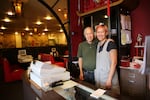
FILE - Cindy Louis became the third generation in her family to own and operate the Canton Grill, after she took the restaurant over from her father, Fred Louis. The restaurant celebrated its 75th anniversary in 2019 and closed in 2020.
Samantha Matsumoto / OPB
Behind the Wok is a new digital archive from Asian Pacific American Network of Oregon that looks at the six historic Chinese restaurants that helped form Portland’s Jade District. These include Hung Far Low, Canton Grill, Chinese Village, New Cathay, Legin and Wong’s King Seafood. The archive explores how these restaurants became community hubs and how early restaurateurs leaned on one another. Suenn Ho is a principal urban designer at Resolve Architecture. Brian Liu is the community development manager at APANO. They both join us to share more on the project.
Note: The following transcript was transcribed digitally and validated for accuracy, readability and formatting by an OPB volunteer.
Jenn Chávez: From the Gert Boyle Studio at OPB, this is Think Out Loud. I’m Jenn Chávez. A new digital archive and research project shows the history of Portland’s Chinese American communities through food. Behind the Wok is a tribute to six iconic Chinese restaurants that shaped the city, with a special focus on the Jade District on Portland’s east side. The archive explores how these historic restaurants became community hubs and how early restaurateurs leaned on one another. It’s a project of the Asian Pacific American Network of Oregon, or APANO.
Joining me today to talk more about Behind the Wok is Brian Liu, APANO’s community development manager, and Suenn Ho, a principal urban designer at Resolve Architecture. Brian and Suenn, thank you so much for joining us today.
Brian Liu: Thank you.
Suenn Ho: Thank you for having us.
Chávez: So I just want to start off by asking … maybe Suenn, I’ll start with you: How did you all go about compiling all the research and materials you included in this amazing digital archive that’s on APANO’s website?
Ho: It’s very challenging. We actually have collected a lot more than you see on the website. And a lot we have to put aside just because we want to make the website a little bit more user-friendly and not not be overwhelming. APANO has the folders that actually collect a lot of information that is on the cutting floor, editing floor.
We have many other restaurants that we want to cover, but we wanna focus on the few that is very relevant within the Jade District. That way, we can be more concise and a little bit more reflecting the essence of the project, where it becomes the foundation of a digital archive that can keep growing.
Chávez: The first restaurant you profiled for this archive, Hung Far Low, opened in the 1920s. But you look back further to the 1800s, when a vibrant community of Chinese immigrants was already establishing itself here in Portland. What do we know about what Portland’s Chinatown and Chinese immigrant communities were like in those early days?
Ho: I have to give a shout out to Oregon Historical Society Library librarian.
Chávez: Shout out to Oregon Historical Society!
Ho: We did not know there was actually a Hung Far Low back in 1917. It was actually south of Burnside and it’s a place with the same name. Then, in 1928, the Wong On family bought it. Now you’re testing my recollection of a lot of detailed factoids. Even Oregon Historic Society, they were very surprised to actually find some printout in the old Chinatown, south of Burnside, where they were looking for “first class waitress.”
A lot of very quirky things that we discover, and of course, when we saw Hung Far Low was in the Jade District, it was already changed hands. Without looking back into the history, we couldn’t actually tell the full story of Hung Far Low in the Jade District, which actually we have very little information. So the research opened up a lot of incredible stories.
Chávez: Brian, I want to turn to you now. Several of the restaurants documented in this archive, as we just heard, opened in what’s now known as the Jade District, near 82nd Avenue, a little bit later in the 1940s. What were some of the reasons that Chinese Portlanders were moving further east at that time, out of Portland’s historic Chinatown on the west side?
Liu: I think one interesting thing that I want to highlight here is to emphasize both the historical context matter, but also their own family decisions play a significant role. Just by looking at the larger trend back then, it was a couple of decades after the Chinese Exclusion Act was enacted. There was a federal level of xenophobia, with the limitation of where Asian or Chinese people were allowed to rent or purchase properties. At that time, 82nd Avenue, current day, was the eastern boundary of the city of Portland. It was a relatively less developed area. So some of the newer generations that came to Portland were able to find some available lands and landlords that were willing to lease out the properties for them to operate restaurants.
Some of them already had certain kinds of business relationships with each other. So when there was one restaurant that opened a site along 82nd and Division, there were also other partners that came along and established their own restaurants that were a few blocks away from the original location. There are also many other implications that went into the decision, including, for example, the Louis family of Canton Grill. They were actually operating gambling houses and other businesses in old Chinatown, but eventually, because of the changes of the landscape as far as other unfortunate events that happened, they had to move out and pursue pretty limited businesses, including a restaurant or laundry services back then.
And looking back it’s so funny, because both Suenn and I, we are Chinese Americans that are working here in the U.S. We are working in different professions, but back then it seemed to be pretty limited. Even though Robert Louis Sr., who was the founder of Canton Grill, had a degree in chemistry, he was not actually not able to find any jobs in the related profession. So, ultimately that led them to open a restaurant on the east side.
Chávez: And I have to say I was particularly interested in the Canton Grill, as a few years ago, Think Out Loud actually had a conversation with the folks involved with Canton Grill, and fascinating history. In the oral histories that you all have collected, Cindy Louis talks about growing up in Canton Grill. She said it was like a living room. And I know many of these restaurants had large banquet spaces, too. How important were these restaurants as community spaces for local Chinese American residents?
Ho: It’s interesting, the fact that, for the very beginning when these restaurants were established in the, especially the ‘40s, along 82nd Street is one of the newer so-called “cruising street,” where families will come in a car. They always advertise there’s plenty of parking. The Chinese families we interviewed said they come to these restaurants so that they can eat American food. And then the non-Chinese patrons, typically white patrons, they will come and eat Chinese food.
So, there’s a little bit of a reversal of interest in the kind of palette. So there’s a lot of these, because there are families, there are intermingled business level. The Chinese family will get together and they treat that place as like a family gathering place. Not until later, where there’s actually like in the Legin or the Lung Fung restaurant, they’re starting to actually accommodate larger space for banquet style, which really made a big difference when you can actually have celebrations and events. That was not really available in the smaller, so-called “chop suey house” back then, which is more family gathering setting.
Chávez: It’s so clear how important these third spaces were to folks who lived in Portland. And fast-forward many years later and the restaurants that you all have featured in this archive are now closed. They closed due to a variety of challenges, one of which was the pandemic. But I feel like they really influenced the Jade District that we see today.
Maybe, Brian, a question for you: What do you see when you look at the wider Asian business community and the Jade District today, and how it was influenced by these historic places?
Liu: Yeah, just to build off of what Suenn has mentioned about the difference from the original Chinese American restaurants to the current day, you see a lot more regional cuisines in Asia – not just Chinese restaurants – but also just the fact that during the ‘70s and ‘80s there was a huge immigration wave from East Asia overall, that came to the U.S. Some of them followed the path of these pioneers, and start to develop their own businesses, and find foothold and employment opportunities along the corridor of 82nd Avenue. So in that sense, I think these newer waves of efforts from immigrant entrepreneurs built on top of the spatial history of what these Chinese restaurants paved way for.
As in current day, I think ever since Prosper Portland has designated the area as the Jade District, to basically promote the small business development in the area, I think that supported part of the business development, even some of them were able to sustain after the pandemic. Not to say that the ones that failed were not able to survive because of many other reasons, but also, just given the fact that the landscape is changing so quickly, both economically, politically, and also our consumption pattern also changed a lot.
We are hoping to sustain as many businesses as possible. We also acknowledge the fact that places evolve based on a lot of different economic factors, and our role here is to try to preserve the ones that are the most culturally relevant and the most meaningful to the community that we represent. And we’re continuing this work by our small business program as well as other community development programs that we’re doing in the Jade District.
Chávez: To talk a little bit more about that community development, I know a couple years ago, APANO bought the old Canton Grill, two or three years after it had closed. And this is not the first development of its kind that APANO has undertaken. What do you plan to do with that site? What are some of your plans behind purchasing that land?
Liu: Yeah, actually this archive is part of the plan for our placekeeping effort. We hope to incorporate the history and use it as a foundation to provide some vision for the future site. Starting 2023, we started early planning stages that developed a master site plan with SERA Architects and we incorporated community feedback from different rounds of engagement sessions. We have a lot of needs for both affordable housing, some community gathering spaces. And also, given the fact that 82nd Avenue is currently undergoing a pretty transformative redesign process with PBOT and TriMet to incorporate better pedestrian infrastructure as well as public transit, we see an opportunity for the Canton Grill site, especially at the location of the intersection of 82nd and Division. It could be incorporated into a better community-serving site, but also preserving some of the history.
So the archive is our way to honor that, but also providing important materials for artists and architects to use, and see what kind of material and elements that we can preserve to support the future housing development, as well as the community space. And we’re continuing that effort by talking to community members, and seeking funding to support the implementation of the vision that these artists, architects and historians have put together with so much effort. Hopefully, we’ll preserve the space that can continue to serve the community and just to also keep people in place at the same process.
Chávez: And just one more question, maybe for you, Suenn. I know that later this week, on Friday the 27th, there’s going to be an art show hosted with works inspired by some of the history you’ve shared with this project. What can folks expect to see there? And, I guess, what do you hope folks take away from seeing this art, this history?
Ho: The show is actually under the umbrella of APANO, their art crew, a group of very talented young artists who’ve been in parallel with the digital archive research project. We were able to utilize some of the collected images, stories. I am also very lucky to be included to maybe have a piece at this show on Friday, from 4:00 to 9:00 at APANO’s space, which will be displaying images and creative ideas, how some of the research material is able to capture what’s there that inspires us, what’s lost, and then try to see it from a newer lens.
A little bit of a shout out to APANO, one of the leaders, Duncan Hwang. His mom was the first Chinese restaurant founder in Michigan. I think, when he shared the story with us, it’s almost as if with all these stories or images, we as the younger generation, we lost that kind of connection. And I think the more we engage and showcase that level of visual and storytelling imagery, we hopefully become much more in tune with the importance of history, the community and how we can become more connected.
Chávez: Well, Suenn Ho and Brian Liu, thank you so much for joining us to talk about Behind the Wok today.
Ho / Liu: Thank you.
Chávez: Suenn Ho is with Resolve Architecture and Planning. Brian Liu is with APANO.
“Think Out Loud®” broadcasts live at noon every day and rebroadcasts at 8 p.m.
If you’d like to comment on any of the topics in this show or suggest a topic of your own, please get in touch with us on Facebook, send an email to thinkoutloud@opb.org, or you can leave a voicemail for us at 503-293-1983.