
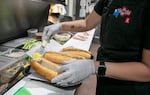
Lisa Tran prepares an order of bánh mì sandwiches at Tân Tân Café and Delicatessen in Beaverton, Ore., June 13, 2025. Tân Tân is known for their specialty meats like pâté, meatballs and ham.
Anna Lueck for OPB
Nestled between a railway track and a state highway, its entrance hidden away in an inner road, lies Tân Tân Café & Delicatessen.
Specializing in authentic Vietnamese food like bánh mì, phở, and house-made delicatessen hams and pâté, Tân Tân has been one of Beaverton’s most enduring and beloved restaurants for nearly 30 years.
“What keeps us here is community. It’s the best,” Lisa Tran said.
Tran helps run the restaurant with her parents. “I grew up here, you know? And my kids, they go to school here. I live here. I remember the trees I climbed here in Beaverton. The trees that I climbed here,” Tran said, pointing outside.
Tân Tân is the kind of successful restaurant Beaverton is prioritizing as part of a yearslong strategy to boost economic development. City leaders have heard for years that the area has lacked magnetism, and that has limited business growth and a sense of community.
But starting about eight years ago, city leaders tackled this problem through a coordinated strategy focused on attracting and supporting restaurants with steps ranging from incentives to targeted changes to city codes, and Beaverton’s downtown surged.
Part of the strategy is ensuring the success of restaurants like Tân Tân.

A photo of Lisa Tran's grandparents in front of their pho restaurant in Sóc Trăng, Vietnam, sits on a shelf in Tân Tân Café and Delicatessen, Beaverton, Ore., June 13, 2025. Tân Tân was founded by Vinh Tran and Hongmai Nguyen, and is now also managed by their daughter Lisa Tran.
Anna Lueck for OPB
Tran grew up in downtown Beaverton — back when restaurants in the area were few and far between. Her parents fled Vietnam after the fall of Saigon and were married in the Galang Refugee Camp in Indonesia, where Tran was born. Eventually, one of Tran’s aunts, who had escaped to Oregon, sponsored Tran and her parents to move to Beaverton in 1981.
Years later, when her parents were experiencing financial difficulties, they needed a new stream of revenue.
“So it’s like, what do we do? Well, we like to cook,” Tran said.

Customers pass around dishes at Tân Tân Café and Delicatessen in Beaverton, Ore., June 13, 2025. Tân Tân has offered Vietnamese products and dishes for over two decades.
Anna Lueck for OPB
They started out selling Vietnamese deli meats out of a space on Broadway Street in 1997. But there was too much demand — and too much curiosity from customers who had never seen a Vietnamese restaurant in Beaverton before.
Their deli grew from two tables, to four, to 10, which attracted attention from a state Department of Agriculture official, who told them: “You’re not a deli. You’re a restaurant.”
By 2005, Tân Tân was a full-fledged restaurant, with a side business selling Vietnamese sauces at local grocery stores.

Photos of Lisa Tran, her parents, and other family members line a shelf above Tân Tân sauces for sale at Tân Tân Café and Delicatessen, Beaverton, Ore., June 13, 2025.
Anna Lueck for OPB
Much of that, Tân Tân did on its own. But now, two decades later, it has successful neighbors — estimated at nearly 400 restaurants, including (to name just a few) popular eateries like Rama Thai, Nak Won, decarli, Coredam, Boriken, and of course, Hapa Pizza, one of The New York Times’ Top 22 pizzerias. About 50 of those opened between 2019-2023 and can be tied to the strategy Beaverton launched in 2017.
‘Where is downtown Beaverton?’
“Back in 2017, Beaverton is surrounded by Nike and Intel and great businesses, but they were hearing from people: ‘It’s hard to get talent to come out here. We don’t have any great restaurants, we don’t have any great activities.’ So that was the impetus behind the whole plan — really as an economic development driver,” said Alisa Pyszka, executive director of the Center for Real Estate within Portland State University’s School of Business.
In 2017, Pyszka was working as a consultant when Mike Williams, Beaverton’s economic development manager, contacted her. Beaverton Mayor Lacey Beaty had empowered the city’s economic development team to launch a restaurant strategy to revitalize the downtown.

Beaverton Mayor Lacey Beaty in a undated photo provided by the city.
Courtesy of Rachel Hadiashar / Photographer Rachel Hadiashar
“When I first ran for office 12 years ago, I would knock on people’s doors and as a way to get them to talk to me, I would say, ‘Hey, where’s downtown Beaverton?’ And we would laugh,” Beaty said. “There wasn’t really one.”
Pyszka helped define the geographic focus of the downtown strategy, while the city’s economic development team worked with property owners to make the vision a reality.
The biggest opportunity she zeroed in on: affordably converting Beaverton’s older, underutilized buildings into usable spaces for local businesses. Plus, it would allow people who already invested in the community to reap the benefits of cheaper rent.
At the same time, the city developed incentives for new restaurants to open in Beaverton’s downtown or for existing businesses to improve their spaces.
Tân Tân took advantage.
Their restaurant was operating out of what originally was a motorcycle shop. During the COVID-19 pandemic, a tenant improvement grant from the city helped them renovate — removing the garage pillars, opening up the space, repainting and redecorating.

The exterior of Tân Tân Café and Delicatessen in Beaverton, Ore., June 13, 2025.
Anna Lueck for OPB
“The city was like, ‘Okay, you guys, we can bring you into the future,’” Tran said, laughing.
Helping longtime businesses like Tân Tân was an intentional part of the strategy, Beaty said.
“It wasn’t just about incentivizing new people to come to Beaverton, but it was celebrating people that were here before and establishing where they’re at,” Beaty said. “And so we wanted to make sure that we didn’t lose what was the best of Beaverton by only chasing new concepts, but really driving depth in what was here too.”
Beaverton strategy extends to Portland businesses and visitors
The next part of Pyszka’s restaurant strategy was to reach outside of Beaverton to the big city to the east.
“Portland was booming and you had restaurants looking for a secondary market. So Beaverton seemed like it was like a new suburban market,” Pyszka said. “But you had to explain to the people in Portland — where, why, what’s happening, right? You couldn’t just say, ‘Hey, come to Beaverton’. You have to sell it.”
It took direct outreach, an online presence and incentives, but now it seems like almost every other street in downtown Beaverton has a Portland restaurant’s secondary location. They include Lazy Days Brewing, Loyal Legion, AFURI Ramen, Top Burmese Bistro, Dough Zone, soon-to-come Canard, and most recently, Latin American bakery Dos Hermanos, which had its grand opening of their Beaverton location last month.
Gabriel and Josue Azcorra, brothers with family roots in Yucatan, Mexico, first launched Dos Hermanos in Portland in 2018. A few years ago, they started selling bread and pastries weekly at the Beaverton Farmers Market.
“After like a month, every single Saturday at the farmers market, we have a huge and long line starting [at] like 8:30 [a.m.] to I think 2 [p.m.]. The line never stopped,” Gabriel Azcorra said.
The long lines at the farmers market — and a $50,000 incentive grant from the city of Beaverton — gave the brothers confidence to open another location.

A mural of a flamingo in the Beaverton location of Dos Hermanos, in this photo from June 2025, before the restaurant's grand opening. Brothers Gabriel and Josue Azcorra started Dos Hermanos and have family roots in Yucatan, Mexico, where flamingos are commonly found.
Courtesy of Dos Hermanos
“We love Portland, Beaverton, and we love working with the family; my daughter working with me, my wife, my brother, my brother’s sons, and this is Dos Hermanos Bakery,” Gabriel Azcorra said. “I’m the first generation of the bakers, now my brother shows their sons and I show my daughters to continue make bread, because I want to continue Dos Hermanos, make it bigger.”
With new and old restaurants like Dos Hermanos popping up, Beaverton is becoming more of a destination. Michele Venlee, a content creator and actor in Portland, finds herself visiting more often.
“Because of that shift, I definitely see Beaverton as a growing city. What started as second locations has now turned into new and exciting restaurants you can only find in Beaverton,” Venlee said in an email.
“I think it started around 2020–2021, when Portland businesses began opening second locations there, which makes sense. I know a lot of people have been moving out that way due to the rising housing costs in Portland.”
It’s a shift that many folks in Beaverton have picked up on. Over at Tân Tân, Tran said she noticed an uptick in homelessness in downtown Portland during the pandemic, and businesses struggling to stay open as a result.
In some ways, she felt Portland was going down in public perception, while Beaverton was growing.
“I’m feeling like there’s Portlanders who are heading west more,” Tran said of her customer base. “It’s like more are discovering this side.”
City code changes and incentives lead to gradual improvements

Cedar Hills Crossing shopping center is home to the Beaverton location of Salt & Straw, just one of many Portland restaurants opening up shop in the smaller city.
Courtesy of Cedar Hills Crossing
Growth of Beaverton’s downtown and emergence out of Portland’s shadow started with a question posed by Tyler Ryerson, the city’s community development division manager:
What is Beaverton missing?
Great restaurants. Places to stay for staff coming in from out of town. Attractions.
Essentially, Beaverton’s downtown had the bones of good infrastructure, but didn’t have the building improvements needed for restaurants. The solution was very technical: change city code.
“We did not have proper code for food cart pods and we changed our code,” Ryerson said. “We worked with a lot of different divisions, did our research to figure out what we wanted to do, and the food cart that’s near our city hall — the BG’s Food Cartel — they did it right. And it suddenly became an attractor to an area that never attracted anyone before.”
Like Pyszka said, before recruiting restaurants, the city first provided incentives and assistance. Ryerson pointed out the Building Improvement Program as a particular incentive that helped small businesses get started in Beaverton and bring life to the town.
The strategy of bringing in local restaurants extended beyond the city’s downtown to local malls, like Cedar Hills Crossing and Beaverton Town Square.
According to Larry Dortmund, chief financial officer of Cedar Hills Crossing, the shopping center has made a concerted effort to lure a host of Portland restaurants to the more suburban area, including Bamboo Sushi, Salt & Straw, Dave’s Hot Chicken, Shake Shack, Kayo’s and Good Coffee. Grassa is set to open at the mall next year.
“It is a safe area, the schools are strong, the public transportation is good, and public uses for the arts and recreation are great and have been continuously invested in,” Dortmund said in an email, noting that Beaverton’s location — between Portland and Hillsboro — is an asset, as well.
Dortmund says Cedar Hills Crossing is the most visited shopping center in Oregon — and growing.
The mayor is quick to remind people, though, that change at this level came about slowly — years of reworking city codes, building strong relationships with local businesses, proactive outreach to larger companies and other work that often happened unnoticed.
“What people see now is 10 years of work,” Beaty said. “And so I remind people that none of this happened overnight.”
Diversity key to Beaverton’s identity and growth

Mony Mao, left, and Mardine Mao share food at Tân Tân Café and Delicatessen in Beaverton, Ore., June 13, 2025.
Anna Lueck for OPB
Beaverton’s food scene started to change around 2018, in Michael Banh’s opinion, who was born and raised in Oregon. Banh has created Portland-area food content on Instagram for over a decade.
“I moved up here around 2016 and I just remember how I felt like it was very limited. I felt myself going to Portland a lot for places I wanted to go to,” Banh said.
People on the west side want food choices, too, and he’s happy they’re finally getting it.
“We want to frequent these places and make them our usual haunts and spots that we go to for amazing food and drinks because — surprise! We love that too.”
Beaverton’s vast culinary options draw from one of the community’s biggest strengths: the city’s inherent diversity.
“I definitely feel like it’s growing so much and especially in terms of the Asian community and the Asian-owned businesses and options and restaurants, like so much good Korean food there, so much good Vietnamese food,” Banh said.

Bún bò Huế, or spicy beef noodle soup, at Tân Tân Café and Delicatessen in Beaverton, Ore., June 13, 2025. Tân Tân has offered Vietnamese products and dishes for over two decades.
Anna Lueck for OPB
According to Beaty, one in three people in Beaverton identifies as a person of color. And according to the city’s most recent Housing Needs Analysis Report, Beaverton has greater racial and ethnic diversity than both Washington County and the state — and it has only grown more diverse between the 2000 and 2020 censuses.
Big challenges ahead for a ‘city on the rise’
Now that Beaverton’s downtown is established and in demand, city leaders are hitting a ceiling. To create the kind of vibrant area they’re hoping for, they’re coming up against downtown’s infrastructure issues.
With highways and rail lines intersecting in the area, central Beaverton has long been difficult to get around. Further economic growth depends on accessibility.
And so enters The Loop.
The project is part of a 20-year Transportation System Plan to make downtown Beaverton more walkable.
“It’s going to need to involve options to meet not only our own desires but those of the state and the metro area, too,” said Andy Varner, the community development director for Beaverton. “They really want cities to be more urbanized with their transportation infrastructure. I think that goes hand in hand with the business strategy too, because it’s creating a more safe, convenient, accessible, walkable environment.”
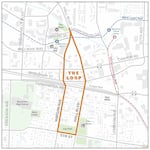
The Loop is a project that would make it easier for people to safely walk, bike, take the bus, and drive through the downtown area in Beaverton.
Courtesy of Beaverton City
The Loop would start in the north at City Hall and loop down 5th Street, near the Beaverton City Library.
“We have a rail line that goes through — like the old historic saying of the wrong side of the tracks,” said Mayor Beaty. “We do have that. A lot of our minority-owned businesses are on Broadway on this side of the tracks. And so our job is to kind of bust through some of the historic zoning. We’re not going to be able to get rid of the rail line. We’ve tried really hard.
“But we can make the intersection safer to cross.”
Beaty says the city wants to work with the rail company to make the tracks safer to cross. And she’s looking at steps the city can take on its own, like widening sidewalks.
“You should be able to walk from City Hall into any of the restaurants in downtown,” Beaty said. “It’s not that far. It really isn’t.”
Last summer, the mayor toured downtown with Gov. Tina Kotek, state representatives, senators and businesses.
Beaty points to a highly competitive grant the city won as a sign of broad support.
The U.S. Department of Transportation’s Better Utilizing Investments to Leverage Development grant program, or BUILD, provides grants for surface transportation infrastructure projects with significant local or regional impact. It allows project sponsors to “pursue multi-modal and multi-jurisdictional projects that are more difficult to fund through other grant programs,” according to their website.
The transportation grant program was recently renamed — a modest change compared to some of the major changes the Trump administration has enacted in other areas. Beaty called recent federal changes “chaos by design,” but is trying to stay focused on what is possible.
“We rewrote our talking points for our project. We’re still going to work on equity. We’re still going to work on walkability and bikeability and we’re going to work on economic development — and that’s something this administration is saying they’re going to fund,” Beaty said.
“So we’re going to give them an opportunity to walk the talk and fund some economic development right here in Beaverton. So that’s what we were back there pitching: that we’re a city on the rise.”

Printed news articles line the entryway of Tan Tan Café and Delicatessen in Beaverton, Ore., June 13, 2025. Tan Tan was founded by Vinh Tran and Hongmai Nguyen, and is now also managed by their daughter Lisa Tran.
Anna Lueck for OPB
The city’s growth isn’t just meaningful for its businesses, residents and surrounding communities. It’s emblematic of what’s possible for other small towns with big dreams.
Before coming to Beaverton, community development director Varner was the city manager of a much smaller town.
“We used some of our urban redevelopment dollars to model a program that Beaverton was doing. And I don’t think we’re the first,” Varner said. “I think several cities have come calling to Beaverton.”
Back at Tân Tân, Tran said she notices the city’s growth every day, one person at a time. There’s more traffic, for one, and more first-time customers who walk in, exclaiming at how they’ve never been there before.
And Tran loves to see it.
“I think it’s a good community,” she said. “It’s not just us. We work hard, but our community works harder.”
