Growing up in Southern Oregon, Andrew liked school. Even in high school, as he was getting into trouble, he enjoyed hands-on classes like ceramics and cooking.
“Women like when a dude can make some good food,” he said.
But school was also rocky for Andrew. OPB is using only Andrew’s first name to protect his privacy, so that he could speak freely about problems he faced as a juvenile.
Andrew started getting in trouble in third grade. Throughout elementary, middle and high school, he received referrals and suspensions for fighting, for skipping school. He stole money from his parents and joined a gang.
“I started holding guns, selling drugs, and it got me to this point,” he recalled sitting in a conference room in Southeast Portland, at Youth Progress’ College and Career Attainment Program, or CCAP.
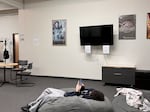
Andrew relaxes on a bean bag at Youth Progress in Portland on Jan. 9, 2025. From October to May, Andrew was with Youth Progress, an organization that works with young people who’ve been incarcerated or spent time in foster care.
Elizabeth Miller / OPB
Andrew is 18. He recently wrapped up six months in CCAP, a program meant to help formerly incarcerated or foster youth attain a diploma and develop career-related skills. Despite being in CCAP, Andrew returned home to his parents’ house in southern Oregon in May, not only without a diploma but without having earned any high school credits.
“As a parent, it seemed like they were not setting my kid up for success,” said Justin Hon, Andrew’s dad.
At the same time, Andrew has come home with newfound confidence in himself and a renewed interest in finishing high school.
“I probably can accomplish more than I say I can,” Andrew said. “I want to do school so I can prove people wrong, but it’s been hard trying to get back in.”
Andrew’s journey through education — and the juvenile justice system — is representative of what circumstances can be like for formerly incarcerated students, a group Oregon has struggled to get to graduation. Schooling can be inconsistent, getting to a diploma may take more time and effort. And traditional measures of progress like graduation rates may not adequately reflect a young person’s growth, creating challenges for a government-run system to support.
On parole in Portland
Andrew arrived in Portland last fall, after a couple of stops in other residential programs in Bend and Grants Pass. CCAP is a service offered under Youth Progress, which works with young people who’ve been incarcerated or spent time in foster care. Andrew moved to Portland for the residential program.
At CCAP, Andrew worked with Jennifer Lopez, Youth Progress’ Education Manager.
“My mission is making education accessible to all students,” Lopez said.
“For the CCAP youth, it’s meeting them one on one, getting them in touch with a tutor that can help them on concepts maybe they’re struggling with, creating study schedules, keeping them accountable.”

Jennifer Lopez, Youth Progress’ Education Manager, works with Andrew at Youth Progress’ office in southeast Portland on Jan. 9, 2025. Lopez said alternative education is the “future of education” because it can meet individual students’ needs.
Elizabeth Miller / OPB
Lopez is also helping ramp up the organization’s new GED prep center, made possible by a grant from the Oregon Youth Authority. In addition to getting a GED, goals at CCAP include learning how to live independently and prepare for adult life.
“The day to day for us, for the guys, is getting them to do some of those basic skills of — I’ve got a calendar, I’ve got appointments, I’ve got to attend to them,” said Gordy Brown, CCAP manager.
By working with youth on those daily tasks like making appointments, Brown and his colleagues help students mitigate the stress and conflict that comes with being an adult.
“I think our main focus on a daily basis is how can you manage yourself effectively, differently than what you did… that helped you get into this system in the first place.”
But there’s also room for joy and relaxation. CCAP’s office feels kind of like a common area of a dorm. There’s a kitchen, a big TV, a pool table, and a few bean bag chairs.
“The bean bags are the key component,” Brown said. “The bean bags allow for the youth to be their age and to kind of figure things out, to take a nap, and not feel like you have to watch your back every second.”
It’s all part of making sure youth feel ready to learn.
“Somebody coming in here that is used to watching their back in lockup… you feel like you can’t rest,” Brown said. “We all know the brain needs rest.”
What Youth Progress and CCAP does is a little different from a typical public school. It’s closer to how things might look in an alternative school.
“I’m a big believer that alternative education is the future of education,” Lopez said.
What does “the future of education” look like?
In a traditional school setting, a student has a set of teachers and a counselor. Even schools offering more mental and behavioral support are often unable to meet the needs of all of its students.
When a student is part of Youth Progress, they have a whole team working with them: caseworkers, guardians, proctors, therapists, teachers and tutors. Youth Progress Education Manager Lopez calls it a “holistic approach”.
“It’s just an approach where academic meets everything else about the student rather than everything has to meet the academics,” Lopez said.
Youth Progress works with students coming from several places, including the Oregon Youth Authority. According to OYA, 55% of youth in OYA facilities in the last two years have a “special education history” and 96% of youth have “known trauma history.”
Andrew qualifies for special education, and has an individualized education program, or IEP, designed to ensure he has the necessary support to learn effectively.
Students who receive special education services graduate at lower rates than their peers. Experiencing trauma or receiving discipline at school are also factors that can negatively affect school performance. Without adequate support, returning to a traditional educational setting after incarceration can be a challenge.
“I think the people that mostly mess up in school, they have other things happening in life, and I was one of them,” Andrew said.
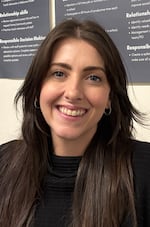
Elyse Meardon is the executive director of Youth Progress. Meardon said Youth Progress is about helping young people overcome their challenges without excluding them.
Elizabeth Miller / OPB
Youth Progress Executive Director Elyse Meardon said the organization is about helping students overcome their challenges without excluding them.
“In a lot of standard schools, there’s an authoritarian approach to it — you do something wrong, you’re punished,” Meardon said.
“If kids mess up, make a mistake, act out, we’re not giving them all these consequences, kicking them out. It’s like we’re working with them, having conversations.”
Andrew liked the independence of CCAP. But he eventually wanted more one-on-one academic support than CCAP could offer. He moved to Rosemary Anderson High School, an alternative school with campuses throughout Portland, in March.
“Andrew, I think he has some challenges that really make him fearful that he can’t learn — but he does well,” Brown said.
“They think that I’m a smart dude, but I never thought I was a smart dude, with the charges I did,” Andrew said.
Back home, still behind
By the end of the school year, Andrew was done with parole and a judge ended his commitment to OYA. He moved back to Southern Oregon, where he’s figuring out his next steps.
“I’m living with my parents, but they want me to get a job so I can start paying a little bit of rent,” he said. “I’m trying to do things, but the big thing is I’m trying to go back to school, but it’s hard.”
Andrew is working with Pathfinders, an organization that helps youth get back on track after involvement in the justice system.
Andrew says he took a GED pre-test in Portland, but didn’t earn his GED. He wants to go back to high school. His dad, Justin Hon, wants Andrew to get a GED instead.
“Honestly, he should be in college right now,” Hon said. “If the system would have worked the way it should have, he should have his GED or his diploma. But the system is so broken right now, he’s so far behind.”
Hon said his son’s IEP was not transferred between facilities, which delayed Andrew’s progress. Hon added that the independence Andrew liked so much in Portland was detrimental to his academic and other goals, like getting a job and saving money.
In an email, Gordy Brown said Andrew’s goal to get home “overshadowed” getting a diploma or a GED.
“In some circumstances we could take longer and push through that, but he came in too far behind — it would have been a long while, even though he was working hard and doing good work,” he shared.

Gordy Brown, left, works with youth at the College and Career Attainment Program to help them build lifelong skills and live independently.
Elizabeth Miller / OPB
“It also takes time to build foundational learning skills,” added Lopez, the Youth Progress education manager. “We always want to shoot for the moon with our students, but we are equally proud when we see them succeed in building these critical skills.”
Andrew’s dad said Oregon Youth Authority “did more harm than good” for Andrew.
“My kid was discharged and he had no supports, none,” Hon said. “I had to step in and get him connected to services.”
Hon thinks Oregon’s juvenile justice system should shut down and start new, with a focus on education and recidivism. He wants to see more resources available for youth once they leave a program.
“They need like another year of at least resources support so that way they don’t fall back in the cracks again because when they get broke, when they get bored, they’re going to go back to their comfort zone, commit crime, sell drugs, or whatever the case may be, and then that vicious cycle continues again.”
Hon made a complaint about one of the facilities Andrew attended before he went to Youth Progress. Hon alleged staff at the facility were not providing adequate supervision, which allowed youth to engage in inappropriate behavior. According to OYA, the complaint remains under investigation.
Keeping track of progress - and success
Andrew’s story is just one of the unique educational experiences of formerly incarcerated youth.
It can be hard and costly to scale individualized programs that serve this group, especially when students’ circumstances are constantly changing. Regardless of the difficulties, the result is a group of young people who often enter adulthood lacking a critical academic credential.
Statewide, students with experience in incarceration or detention graduate at much lower rates than their peers. For the Class of 2021, the four-year completion rate, or percentage of students who graduated with a diploma or a GED, was 84.5%. The statistic for formerly incarcerated students was 48.5%.
It can also be hard to track and measure success.
Oregon only recently started publishing statewide graduation rates for formerly incarcerated students. With the way the state collects education data, Andrew’s diploma completion might not even show up in the state’s annual reports. If his diploma is counted, it will likely help the graduation rate of the last public high school he attended.
Those standard methods of tracking student progress can also be at odds with what Lopez and her colleagues are trying to achieve: success for each youth based on their individual goals and timelines.
“Our societal constructs of success in education — degrees and linear progress — are important, but they don’t always paint a full picture of a student’s success,” Lopez said.
“I think of success like in track and field. In track and field, you’re always pushing for your PR [personal record]. You are always pushing yourself to do better than you have done in the past,” added Brown. “You may not break a school record but you celebrate that personal record because it’s still a success.”
In the future, Lopez wants to see Oregon create different “spheres of education” and provide a broader spectrum of opportunities for young people.
“I think the institution for so long is preparing kids for the workforce and so we have all of these rules and policies embedded for them to do a 9-to-5, to not, I would say, honor themselves in how they take care of their own well-beings,” Lopez said.
These young people are also growing up in a world that looks different than it used to, Brown added. While federal data shows college graduates tend to have higher incomes than non-graduates, Brown points out that a college degree doesn’t automatically lead to a well-paying job and a mortgage.
“That promise is not a reality for most people and so why would they be excited about signing up for additional debt with education or working so hard to get a degree that might not pan out for them in the future?” he said.
But goals and plans can change. When OPB talked to Andrew back in January, his future plans revolved around a relationship.
“I want to be with the girl I’m talking to right now… have kids, and I want to have just a nice apartment or a house,” he said last winter.
By June, his priorities had changed.
“I want to have a good-paying job,” he said. “So I can start working on myself, so my future looks better than what it is right now.”