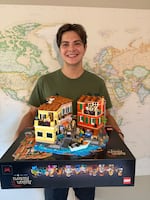
Alex Sahli is shown in this provided photo taken in July 2025 at his home in Portland posing with a LEGO set of the Italian Riviera that he designed and available to purchase starting in August 2025. Sahli designed the set, which has more than 3,200 pieces, in 2022 when he was a junior at Grant High School.
Courtesy Alex Sahli
While still a junior at Grant High School in 2022, Alex Sahli submitted a design for a LEGO set of the Italian Riviera. At 17 years old, he had already submitted five designs for sets to LEGO Ideas. That’s an online platform which allows fans of the iconic toy building blocks to upload a design of their own creation and win enough votes of support from fellow LEGO enthusiasts for the company to review it and possibly turn it into a mass produced set. Sahli’s submission of an Italian village scene featured, among other details, a Vespa scooter, fishing boat, gelato shop and brightly colored buildings with tiled roofs.
But it wasn’t until two years later, in 2024, when Sahli was a college freshman, that LEGO informed him that his design had been accepted for production. Later this month, the Italian Riviera set will go on sale, with more than 3,000 pieces and nine minifigures, including one immortalizing the designer himself as a camera-toting tourist.
Sahli joins us to talk about the experience of designing a LEGO set and his other original creations that are attracting a following on social media.
Note: The following transcript was transcribed digitally and validated for accuracy, readability and formatting by an OPB volunteer.
Dave Miller: This is Think Out Loud on OPB. I’m Dave Miller. A new LEGO set is going on sale this Sunday. It is a 3,200-piece village scene from the Italian Riviera, complete with a fishing boat, a seafood market, a gelato shop and some nonnas. There’s also a minifigure based on a young Oregonian, because that Oregonian, Alex Sahli, designed the set when he was a junior at Grant High School in 2022. Sahli is in college now. He joins us to talk about having his own design accepted by the LEGO company. Congratulations and welcome.
Alex Sahli: Thank you.
Miller: What made you want to make an Italian Riviera scene?
Sahli: Well over the years I’ve made all kinds of LEGO projects. And this one I made just because I love travel, I love architecture, and I just thought the colors of this region would translate so well into LEGO. I saw it and I had to do it.
Miller: Can you describe what it looks like?
Sahli: So it has three buildings perched on a cliffside by the ocean. It’s got a boat and a boat ramp. It’s all very colorful. It’s based on the Cinque Terre villages in Italy, on the Ligurian coast. It comes with 10 minifigures and it’s pretty decent size.
Miller: How different is the final design – the one that insiders apparently can buy tomorrow, the general public can buy on Sunday – from what you submitted?
Sahli: It’s a little hard without pictures. It’s very much the same model, but parts of it are built in different ways. In this program, the fan model always goes through some changes so it’s up to the same standards that other LEGO sets are at when they’re released. You have to take into account price, available pieces and what your audience is. So it goes through some changes, but it has all the same bones as the original and a lot of the same details that I included.
Miller: My understanding is that you’re allowed to put in little easter eggs, little things that’ll have special significance to you or people you know. Did you do that?
Sahli: I did, yeah.
Miller: Can you tell us what some of the Easter eggs are?
Sahli: I got quite a few of them in because it’s a big set. There’s a minifigure that looks like me, which is really fun. As a lifelong LEGO fan, seeing yourself as a minifigure, immortalized as a tiny little person, [is] kinda fun.
Miller: When you look at that minifigure, did you say “Ah, that’s me?”
Sahli: It does look like me. The hair is a little bit light just because of the pictures I sent in, but I think I’d just been out in the Italian sun for too long, it’s bleached it a little bit.
Miller: What is your mini figure doing?
Sahli: He has a camera. I’m a photographer, I like taking pictures, especially when I’m traveling to new places. So this guy is a tourist there and he’s getting pictures of all kinds of things. So it’s very on brand for me.
Miller: So that’s one. What else is there that’s sort of a special thing for the designer?
Sahli: There’s a bunch of other little ones. I have a little painting hanging up in one of the rooms in the LEGO set that’s based on one of my other Italian-themed LEGO projects that was almost picked but didn’t quite make it all the way. So that’s kind of a nod to that.
Miller: Wow, that is a deep cut. A tiny painting inside a room of your design that references an earlier LEGO design that was not a commercially available set.
Sahli: Yes, funny as it sounds, I’m not the first person to do that. A different designer did a similar Easter egg like that. But it actually fits really well. It’s a Tuscan villa, so it’s on brand with the Italian theme.
Miller: So we started near the end of your LEGO story, but let’s go back in time to the beginning of it. Do you remember the first LEGO set you ever got and put together?
Sahli: I was not very old, I was probably 2 or 3. And I had this old set from the 1980s. My grandparents gave it to me as a last-minute Christmas gift, after I’d already opened mine. I think I was still looking for one more. So they wrapped it up and they thought I was too little to play with it. But I was obsessed, I just kept putting it together. There were sort of instructions, but back then they were just basic pieces you could put together however you want. So over the years that set got so much use. They still have it, and I was recently gifted a copy of the same set by my grandparents to celebrate this.
Miller: Do you remember what you liked about LEGOs as a kid?
Sahli: It’s the same thing I like about them now. It’s an interesting medium to work with, it lets you really be creative. There’s not a lot of limits to it, it’s a very well-designed system. And it’s something that can grow with you as you become better at it and more advanced. There’s not really a cap. Little kids can put it together, adults can put it together. You can just keep getting more and more creative with it and do crazier things.
Miller: I think it’s pretty common for kids who like playing with LEGOs – and I was one and now I play with my kid who’s into LEGOs as well – to start making your own creations. It’s so easy. You build the thing maybe based on the directions and then as soon as you change one thing you’re sort of on your own a little bit. But what you’re doing is obviously way more elaborate and sort of more engineered than that. When did you start taking your own designs to that higher level?
Sahli: That was probably a few years ago. I’ve been doing LEGO my whole life. When I was little, I’d do this a lot, but to really start doing designs like this, I want to say I started at the beginning of 2021.
Miller: It actually hasn’t been that long then.
Sahli: It hasn’t, yeah, it’s been four, four-and-a-half years. I use a LEGO CAD software that lets you digitally build all this. And it’s great because it’s free and there’s unlimited pieces, and you don’t have to worry because LEGO is expensive – I’m sure you know that, it could be a lot. So having an unlimited sandbox is really great for this kind of thing.
Miller: You have an Instagram page with some fantastic creations on it. And it looks like, whether it’s a hut, a boat or other things, they look like real LEGOs. But are those just digitized versions of what you can do with this computer-aided drawing LEGO software?
Sahli: A lot of them are renders from the program. So once you design it, you can render it, and it looks just like a real picture. A lot of these I have built in real life also. It usually just comes down to money, and sometimes time and space, those are the three major concerns. I’m not able to purchase all of the projects I do just because it costs so much. But some of my favorites I’ve been able to build, including this one.
Miller: To me, LEGOs are so tactile, it seems very different to be building LEGOs on a computer. Do you miss the physical sensation ever?
Sahli: You can’t really beat physically putting pieces together. I do love that, that’s my favorite part. But there definitely a beauty to the digital design too, it’s just so much better at designing large scale projects. But sometimes when it comes down to a really fine detail or some finicky connection, I have to pull out real pieces and prototype it because you can’t match that with the software.
Miller: What’s the process like? So in this case, you made this Italian Riviera scene. What was the first step towards having it be commercially available?
Sahli: Well, it’s a whole process. So first you submit it to the LEGO Ideas website, and you are given a set timeframe to get support from the community. Other people saying, “Hey, I like this idea, I’d buy it as a set.” So you gather votes, and if you get 10,000 votes of support within that time frame, LEGO will do a review. They do these reviews a few times a year. They’ll look at your proposed set, look at all the little details, go over all their metrics and decide whether or not they make it into a real set.
So it’s definitely not a quick or easy process. Most projects don’t reach 10,000 supporters, and then of those who do, most are not approved. I’ve had four, including this one, reach 10,000 supporters. Then three of them were tossed out and this is the only one that made it.
Miller: What was it like to find out that it had been accepted?
Sahli: It was pretty surreal. It has always been a dream of mine. This program is actually what got me into designing my own projects. I immediately just started submitting them to this platform. So I’d always dreamed of doing this and I’d been so excited when I reached 10,000 supporters. But I was not fully expecting it to actually happen. It took a couple of days for it to sink in. I thought it was like some elaborate prank, but it was pretty incredible.
Miller: What advice do you have for would-be LEGO designers out there?
Sahli: I would say, if you want to submit to the LEGO Ideas program, find something that you’re really passionate about and either make it something that hasn’t been done before or put your own unique twist on it. Find something about it that will reach a wider audience and that will stand out. I would just say put your all into it. It probably won’t work the first time, but if you keep going you might get lucky.
Miller: Could you make a job out of this? Could you make a living as a for-hire LEGO designer for people who want to commemorate special events or special places?
Sahli: I’ve thought about it a little bit. There are some people who do that. I have done some commission projects over the years, I’m working on one right now. And it’s definitely something that could make you some extra money. I think making a full job out of it can be difficult, but people do it. I’m sure if you put in enough effort, you could make it work.
Miller: What are you excited to be working on right now or just on your own?
Sahli: I don’t have any current projects I’m working on just for myself. I’m doing a project with Stanford University right now where I’m doing a coral reef set, with the goal of educating people on different corals and the reef ecosystems through the building process. I was hired to do that, but I’m really having a fun time with it and loving that project.
Miller: It reminds me of some of the flowers that have become popular in recent years, but this is coral instead.
Sahli: Yeah, but very similar building techniques. The flowers are great because they reach so many people. I think coral could be the same.
Miller: Well, Alex congratulations and thanks so much.
Sahli: Thank you so much.
Miller: That’s Alex Sahli. He is a lifelong LEGO fan. His design of a village on the Italian Riviera is going to be released commercially to the entire public this coming Sunday.
“Think Out Loud®” broadcasts live at noon every day and rebroadcasts at 8 p.m.
If you’d like to comment on any of the topics in this show or suggest a topic of your own, please get in touch with us on Facebook, send an email to thinkoutloud@opb.org, or you can leave a voicemail for us at 503-293-1983.