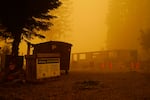
FILE - A sign advises to social distance at a marina building on Detroit Lake burned by the Beachie Creek Fire, Saturday, Sept. 12, 2020, in Detroit, Ore.
John Locher / AP
Nearly five years ago, a combination of dry conditions and heavy winds starting on Labor Day quickly accelerated the spread of multiple wildfires that had broken out in the Oregon Cascades.
Eleven people died in the Labor Day fires, which burned more than 1 million acres and destroyed more than 4,000 homes from Clackamas County to the California border.
As the fifth anniversary of the Labor Day fires approaches, we hear from survivors about their evacuations and efforts to rebuild their lives.
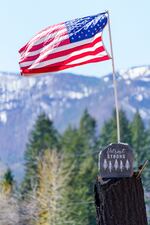
FILE - A sign and flag are posted atop a burnt-out tree stump, April 15, 2021, commemorating the devastation from the fires that ripped through Detroit in 2020.
Kristyna Wentz-Graff / OPB
They include Debra Bowman and Russ Boyd, residents of Detroit, a city southeast of Salem in eastern Marion County that is still struggling to rebuild after the fires.
Bowman is a retiree who evacuated the Beachie Creek and Lionshead fires in the early morning hours of Sept. 8, 2020, with her husband and pet dog.
Boyd also fled then, driving out of town with his wife and other relatives. Today, he is the co-owner of a mini-mart and bar in Detroit, while his wife and mother-in-law own a hamburger food cart on the same lot.
Bowman and Boyd join us to share their memories about the evacuation, returning to Detroit and how they’re doing today.
Note: The following transcript was transcribed digitally and validated for accuracy, readability and formatting by an OPB volunteer.
Dave Miller: From the Gert Boyle Studio at OPB, this is Think Out Loud. I’m Dave Miller. Nearly five years ago, a combination of dry conditions and heavy winds starting on Labor Day quickly accelerated the spread of multiple wildfires that had broken out in Oregon’s Western Cascades. Eleven people died in the Labor Day fires, which burned more than 1 million acres and destroyed more than 4,000 homes, from Clackamas County down to the California border.
We’re going to have a variety of conversations this week as the fifth anniversary of the deadliest wildfires in the state’s history approaches. We start today with survivors from the fires in the Santiam Canyon. Russ Boyd is a resident and business owner in Detroit. He joins us now.
Thanks very much for joining us on the show.
Russ Boyd: Yes, hello.
Miller: Where were you in the days leading up to Labor Day?
Boyd: Leading up to Labor Day, I was here, working in Detroit, at The Greener Side shop here in Detroit. And just basically maintaining our business here. And actually, about a week before the fires came through on Labor Day, we were noticing the different reports or whatnot going on and just keeping an eye on the Beachie Creek Fire that was really close to Detroit.
Miller: How much attention were you paying?
Boyd: Quite a bit. They had a fire board out there by Mountain High Grocery, a small store that is still there today. They usually had information and updates almost every day on their fire board, keeping us informed of what was going on over there and how big it was getting. And we were just maintaining, trying to stay informed about it. We didn’t realize how bad it was going to get though, very shortly.
Miller: When did you realize just how bad it was? I’m curious about the timing. I mean, this was super dry conditions. There were fires near you, but then everything seemed to have blown up so quickly. Where were you when you realized just how bad it was?
Boyd: I believe I was having lunch at my wife’s place of business, the Korner Post restaurant. And I was actually working doing some other side jobs, and I believe I was having lunch with my wife over there, and we noticed things were started getting a little more smoky and things like that. And by the time we got home, I got a report from a fellow volunteer firefighter, Don Tesdal and his wife Michelle Tesdal, letting me know that the fire jumped the highway, basically, and that we should start getting prepared and ready to go. That was probably around eight, nine o’clock at night. People started calling each other back and forth throughout the neighborhood or whatnot to see if we had more information of what was going on.
And then probably around midnight-ish, an officer made it a point to drive around the neighborhood with the sirens on telling everybody, “Now it’s time to get out.” So within a few hours from us getting off work or whatnot, from like six to eight o’clock, it seemed like it pretty much blew up really big. The wind started coming. And it was just about time for us to start packing up and get ready to go. And we didn’t realize how bad it actually was until we actually got on the road, seeing what was happening.
Miller: Can you describe what you saw on the road?
Boyd: Well, what we did at first, me and my wife got our go-bags ready to go, got our car packed up and got the rest of … my mother-in-law and my sister-in-law. Then we went to my wife’s side of the family. Their house is her grandmother and her uncle and stuff. We weren’t going to leave without the whole family. And you could just look down the road right above the bridge when you come into Detroit from Salem, right up the little mountain right there, you can see Beachie Creek Fire just coming. It almost looked like lava coming down the mountain, right there, on how bad or how fast it started growing.
So it started coming down a little spot right there by French Creek, pretty much looked like lava coming down there. It was starting to scare us quite a bit and we had to drive up to Idanha, which is about four miles, a little east of Detroit, to go pick up the rest of the family.
Miller: Which is, in a sense, the opposite direction, right? I mean, you would want to be escaping to the west, but to pick up your family, you had to go closer to the fire?
Boyd: Well, we went away from the fire at first, because we were going to try and escape that way, but we didn’t realize Lionshead Fire was coming towards us from that direction. We were always concerned with the Beachie Creek Fire ‘cause that was right next to our town. The way the wind was coming, it was blowing west, so westward, Lionshead Fire was coming towards us. So my wife’s grandmother and husband, they made it through to the junction, but then we had a couple friends come back through and we seen them in Idanha, and said that the trees fell down on the highway … on Highway 22 trying to go out that direction. So we had to turn back around and drive through Detroit.
And going through Gates, Mill City, it was just fire all long on the side of the highways, super smoky. Couldn’t see 20 feet in front of you. I’m originally from Miami, Florida and been through some Category 5 hurricanes, and that was the scariest situation I’ve ever been in.
Miller: Scarier than a Category 5 hurricane.
Boyd: Yes, even though it was only maybe a half hour to 45-minute drive through that type of situation, I never experienced anything like that. With a fire, you got to go. With a hurricane, you can kind of hunker down. I never experienced something like that with a fire and it was definitely traumatizing.
Miller: Where did you end up going to?
Boyd: Our game plan, to meet up at the Bi-Mart parking lot there in Stayton, and then we had quite a few other family and friends meet us there. We decided to … since my girl’s grandmother and husband made it through the junction, they had to drive all the way through that side through Albany, so we made a game plan to meet up in Salem at the Winco parking lot.
We ended up there and tried to decide what our game plan was. We didn’t know what to do, so we decided to try and start calling hotels or whatnot to see what was available, and everything started getting booked up. We actually found a hotel in Albany, so we had to drive that way and we got the family all set up with a couple of hotel rooms, and started from there to figure out what was still left of the town.
Miller: How many days did you spend in Albany?
Boyd: I want to say, we were there probably at least two weeks before my sister-in-law got us a camper … my business partner got me a camper. We stayed on her property where she had a horse farm at the time.
Miller: How long was it before you were able to find out what happened to your home and your family’s homes?
Boyd: Just probably 48 hours or so. We know some of the volunteer firefighters and the officers that came up here, and we got a couple of phone calls saying that the whole town pretty much burnt down. And then there was another person that got up here, took videos and stuff like that. We noticed that the family’s houses that they own, my girl’s uncle and grandmother’s house burned down, but the one that we rent actually made it.
So we are very thankful for that, but very sad that the houses that the family owned were lost, because so many family heirlooms and collections of stuff, it was just gone. That was their primary residence house, and a sad situation when we learned all that. It’s very tough dealing with those types of phone calls and looking at those videos when you couldn’t get to the town to see it for yourself, so that we were able to get back into the area.
Miller: What do you remember about the first time you went back to the area?
Boyd: Well, the first time we went back we had to do a little caravan. They only let us come back for a few hours to check up on a bunch of stuff. And like I said before, I’ve been through some pretty bad hurricanes and my biggest shock was things were just gone, burnt, ashes. Hurricane, you could kind of collect your stuff back up, everything’s scattered, things are destroyed in a hurricane. But in the fire, it was very shocking to realize everything was gone, burnt to ashes, basically. So it was very shocking for me.
And then I just had to be strong for my wife’s family side, to figure out what we had to do to keep moving forward, keep a roof over their heads and all that stuff. So it was just very, very shocking to see the destruction of a fire and how everything’s just gone.
Miller: Did you and your wife’s family consider not going back? They’d lost so much. I’m wondering if you’d said, “Well, let’s rebuild somewhere else.”
Boyd: We probably would have thought about going somewhere else, but my wife’s side of the family is from Detroit. Her grandmother is from Old Detroit, where the bottom of the lake is, when they built the dam, this and that. Her side of the family moved up here to New Detroit, so this is home for them, so we did what we could to help them come back and rebuild the community one day at a time, as we’re still doing to this day.
Miller: How would you say that’s going?
Boyd: Very difficult. There’s not as many old-time residents here anymore. It’s more of a vacation town now, different things like that. So a lot of other people have come into town, built their summer vacation homes, this and that, and there’s a lot of people here who live here year round, who work here. And it’s been very tough for the commercial district to rebuild, to recreate jobs and different things like that, with new rules and regulations and all that stuff from the county to the city. It’s been very tough, but we’re still trying to push forward one day at a time.
Miller: Do you feel more of a tension now between the year-rounders and the second-home or vacation-home crowd?
Boyd: Yeah, there’s a little bit of conflict or … I can’t think of the exact word for it, but there are some tensions back and forth. Some people still respect the area. Some people just want to treat it as their vacation home, this and that. There’s a lot of little politics going in and out, with all the new people coming in, I guess you can say, and what they want this town to be and what this town actually was. Only time will tell to see what the future holds for Detroit, but it’s been very difficult for businesses to rebuild.
Miller: Do you think the fire has changed you?
Boyd: It definitely has changed me, very more fire-wise now. I respect Mother Nature in that way, very deeply and how can I say this … We strive to stay together as a family unit because we know anything can happen at any moment. So, us as a family unit, we try and stick together and do a lot more things for each other, because through that experience, we never want any other family group or anything to deal with that type of situation.
Miller: When you say that, are you speaking literally, that you’re more likely to be near your wife or her parents or grandparents, or just in general, you like to look out for each other?
Boyd: Both. We generally like to look out for each other and just make sure everybody’s good these days, you know. We got separated after the fire and it’s more of a, what can we do for other people in need, because when we went through that, the Albany Fairgrounds took care of us. They gave us clothes, blankets, food, all kinds of stuff. So when we came back to Detroit, my wife and them and us, we volunteered as well to help out for the next needy person, different things like that. So we’re more conscious of people in need for different situations, so we do our best to help out the community any way we can, I guess you could say, in that fact.
Miller: You know, we could hear the emotion in your voice when you’re talking about fleeing, and you said it was only about 30 or 45 minutes, the drive. But that was the drive with fire on either side of a car for almost an hour. Do you relive those days?
Boyd: Every week, me and my wife gotta go shopping for our own business, and sometimes when I drive through the highway, I do have reflections of that night. Not that it really bothers me. It just makes me very thankful that we got through it, very thankful that we’re still here. It’s difficult to sometimes talk about, but I do have flashes sometimes at night of us driving through there and what could have happened if we didn’t leave, you know?
Miller: Russ Boyd, thanks so much for taking time to talk with us today. I really appreciate it and I wish you the best of luck.
Boyd: Thank you so much. And anytime you guys like to come out to Detroit and discuss what’s going on or anything else, or how we’re rebuilding, feel free to reach out to us.
Miller: I look forward to that. That’s Russ Boyd. He is one of the survivors of the Labor Day fires in the Santiam Canyon.
Debra Bowman joins us now. She, too, is a Detroit resident and a survivor of the fires that destroyed so much in the Santiam Canyon. Debra, welcome.
Debra Bowman: Thank you.
Miller: As we heard, there had already been fires burning the region in the lead up to the huge conflagration that’s the meeting of these various fires. How much attention had you been paying to the fires around you?
Bowman: We had been paying a lot of attention.
Miller: Did you have bags packed?
Bowman: Yes, yes. We were gathering things together Monday night and we were going to bring our trailer down and load everything in it on Tuesday morning and take off.
Miller: What happened in the end?
Bowman: Well, we didn’t make the trailer. The police came around to the neighborhoods. I’ll never forget the words, they said, “Leave now, take nothing.” So we piled into the pickup and left.
Miller: Leave now, take nothing. Did you take anything?
Bowman: We took a few things, yes.
Miller: What did you grab?
Bowman: Important papers.
Miller: Can you tell us what your evacuation was like?
Bowman: It was awful. When we were driving down the driveway, I looked up north and it was just a red glow. So I knew that the fire was coming over the ridge above us. And when we got down to town and crossed, we headed west and crossed the Breitenbush Bridge, looked up the Breitenbush Gorge, and all the trees were crowning out. I had never seen anything like that in person, only on TV. And we drove through fire on all sides of us. The side of the pickup got burned. We thought the tires were gonna burn off, but thank God they didn’t.
Miller: You were in a line of cars sort of creeping through the fire?
Bowman: We were about the only … I think we were one of the last to head west. And we couldn’t see anybody ahead of us because it was so smoky, but when we got to Mill City, that’s when the line started. And if anybody would have stopped, we all would have burned up.
Miller: When you say “we,” who was with you in the car?
Bowman: My husband and our dog.
Miller: Where did you end up going that first night?
Bowman: We went to our daughter’s in Salem. We stopped at Winco, because I knew we had to get water and dog food, so we did that and went to our daughter’s. She had already called a motel and made reservations for us, bless her heart.
Miller: Where was that hotel?
Bowman: Right across from Costco, which was quite convenient, the Best Western.
Miller: How long did you end up staying there?
Bowman: Seven-and-a-half months.
Miller: More than half a year. What kind of a community sprang up for seven-and-a-half months?
Bowman: I think the majority of that motel was full of Canyon residents. And in fact, one time when I was taking the dog out, a gal that I had worked with for many years, she was out there too, with her dog.
Miller: So there are some people you knew and others who, if you didn’t know them, you got to know them.
Bowman: Right, right.
Miller: I’m curious what you most remember from that first night.
Bowman: It was just kind of chaos. Both of our phones fried because people were calling and we were calling, so the next day we had to go and get new phones.
Miller: Well the phone stopped working, I’ve never heard of that, because so many calls came in? They didn’t just run out of batteries?
Bowman: Oh yeah, the batteries ran out. And I had forgotten my charger. Ed’s phone, he had to get a new phone. And I did too, because my other phone was so old. I had got it through EMS for emergencies and they didn’t even make them anymore.
Miller: When you were fleeing, as you say, with fire on all sides, what did you think was going to happen to your house?
Bowman: Oh, I thought it was gonna be gone.
Miller: How long was it before you found out what did happen?
Bowman: Two weeks.
Miller: Two weeks with no knowledge?
Bowman: Right, because we live up on the northeastern edge and they hadn’t been able to get up here. And finally, when they were able to get up here, they posted a picture, and our daughter came over and showed us the picture.
Miller: What did you see?
Bowman: Smoke, and the house still standing.
Miller: That must have been a huge surprise, then, if you thought it was going to burn up.
Bowman: It was.
Miller: Do you remember what went through your mind?
Bowman: We were just so happy.
Miller: What happened to your neighbors?
Bowman: Some of them, the ones down below, ‘cause it was just a summer place for them, they chose not to rebuild and to move back to Arizona. The others, same thing, a couple of them. They chose not to rebuild.
Miller: So some of your immediate neighbors, their houses burned, but yours didn’t.
Bowman: Right. The fire department and the hot shots literally saved it.
Miller: What have you heard about what they did?
Bowman: Well, Don Tesdal, I heard Russ mention him, I guess he was up here that night. In fact, he said, “We have to go get up there and save the old man’s place.” And it’s kind of funny ‘cause I never thought of my husband as old. But he said they couldn’t really see anything because of the smoke, the smoke was so thick, but they knew it was steep. We live on a ridge. And they had to cut trees down close to the house. It came within 10 feet of the house.
Miller: So, the fire is within 10 feet of your house. It didn’t burn down, but was it damaged by flames or smoke?
Bowman: Well, we didn’t really think so until I started to touch-up paint, and it had faded the paint on the house, so we had to paint the whole thing. And our walls are cedar in the living room. When I asked the cleaners how they were gonna clean without water – ‘cause they can’t use the water on the cedar – they have these big sponges. They started out as a light brown and they wiped down everything in the house, and when they were done, the sponges were black.
Miller: You said it was seven-and-a-half months that you were living in that Best Western, and then you moved back to your house?
Bowman: We did. We moved back when we got water on. It happened to be our anniversary, on April 12.
Miller: That’s what you had to wait for, because the water supply wasn’t working for more than half a year?
Bowman: Right, right.
Miller: What was it like to get back?
Bowman: It was wonderful. They were fantastic at the motel. They were absolutely fantastic, but nothing is like home.
Miller: Even though around you it was charred and many of your neighbors’ houses had burned, it was your home.
Bowman: Yes, yes.
Miller: What did it feel like, though, to go around this landscape that had been so transformed?
Bowman: It was bizarre, everything you looked at. We had a lot of old-growth, huge old-growth stumps on the property. And the fire just burned them down into the ground, just huge holes.
Miller: And many fewer neighbors.
Bowman: It was terrible losing our neighbors.
Miller: Because you’d mentioned some who had second homes, who decided not to rebuild, but others were like you, year-round residents who didn’t come back?
Bowman: The neighbors down below us, they were year-round and they came back, ’cause their house survived. Two doors down, their house survived also, and they came back, and they were year-round.
Miller: It does make me think that the year-rounders were, almost by definition, more invested in the community than people for whom it was a second home or a vacation place.
Bowman: Absolutely, yes.
Miller: Again, we heard a version of that from Russ, just before you. How do you think the fire has changed you?
Bowman: Well, every one of us who went through it have PTSD. And I am more grateful than I’ve ever been in my life. There were so many people helping us. It was just unbelievable.
Miller: What does resiliency mean to you now?
Bowman: It’s … hanging in there.
Miller: Can you tell us about a town meeting that you’ve organized?
Bowman: Yes, I read an article in Reader’s Digest about a town in Vermont that has a yearly town meeting and everybody gets to ask their questions, have their say. Then of course there was a potluck afterwards. And I was so impressed with the article. I decided that’s what we needed. Only instead of a town meeting, it’s going to be a community meeting with Idanha, also. And it’s gonna be in September – September 10 and 13. And we do have a couple of commissioners coming, and city council and everything, just so everybody can get on the same page as far as what’s going on with rebuilding, and just getting together.
Miller: If I understand you correctly, it seems like getting together is just as important as hearing about zoning or water systems. This is about building or maybe rebuilding community.
Bowman: Exactly, yes.
Miller: What’s been on your mind the most as this five-year anniversary has been approaching?
Bowman: Just how lucky we are.
Miller: Debra Bowman, thanks very much.
Bowman: Thank you.
Miller: Debra Bowman is a Detroit resident and one of the survivors of the Labor Day fires that burned through the Santiam Canyon just about five years ago.
“Think Out Loud®” broadcasts live at noon every weekday and rebroadcasts at 8 p.m.
If you’d like to comment on any of the topics in this show or suggest a topic of your own, please get in touch with us on Facebook, send an email to thinkoutloud@opb.org, or you can leave a voicemail for us at 503-293-1983.