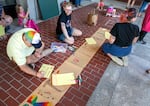
Portlanders opposing the proposal to change the tax structure of the Preschool for All program make signs to hold during the Multnomah County public hearing on the subject in the Multnomah County Board Room in Portland, Ore., Aug. 20, 2025. Preschool for All is a program in Multnomah County that provides universal preschool services to families in need of inexpensive childcare options.
Morgan Barnaby / OPB
After hours of public briefings, discussions and a public listening session, Multnomah County commissioners decided last week to pause a controversial move to change Preschool for All’s funding stream. Commissioners were meant to vote this week on an ordinance that would have adjusted the program’s income tax threshold based on inflation, something the governor asked them to do. Multnomah County Chair Jessica Vega Pederson joins us to discuss the current state of the county’s ambitious plan to achieve universal preschool, and gives us an update on drug treatment and deflection a year after the state ended its drug decriminalization experiment.
Note: The following transcript was transcribed digitally and validated for accuracy, readability and formatting by an OPB volunteer.
Dave Miller: This is Think Out Loud on OPB. I’m Dave Miller. Last week, Multnomah County commissioners decided to pause a controversial change to the county’s Preschool for All program. They had been set to vote this week on a proposal to change the way the tax on high earners is assessed. Meanwhile, we are also approaching the one year anniversary of the county’s deflection program, which was put in place after Oregon lawmakers recriminalized the possession of drugs. We wanted to know how the program has actually been working. Jessica Vega Pederson is the chair of the Multnomah County Board of Commissioners. She joins us to talk about all of this and more. Welcome back to the show.
Jessica Vega Pederson: Thank you, Dave. Good to be here.
Miller: I want to start with Preschool for All. The governor wrote a critical letter that got a lot of attention in Multnomah County and statewide in June. It had these lines: “It is breaking beneath its own weight,” meaning the program, “with at least $485 million in unspent funds, combined with spotty implementation, scope-creep, and a line of providers waiting on the other side of stacks of paperwork to serve families, while tax dollars continue to be collected.” What went through your mind when you read that letter?
Vega Pederson: I will say that the attack on the program itself was surprising. The governor, in conversations with me, had really been focused on the other side of the equation, which was the impact of the taxes. So to me, that letter was shifting and going after the program itself. I had a lot of disagreement with the way that the Preschool for All program was talked about in that letter.
First of all, I will say that from the beginning of the program, we knew that for it to be successful as a long-term program, there were going to be more dollars that were going to be collected in the early years of the tax as we were building up the program, but those dollars were going to be necessary in order to cover costs as the program reached universal. And that …
Miller: As there were there were more providers to pay in.
Vega Pederson: As there were more providers to pay, as there were seats available for 3- and 4-year-olds in Multnomah County. That’s the nature of getting a program off the ground. So it was a very planful and intentional way of doing it.
Miller: To the scale that it is now, of hundreds of millions of dollars in reserve in a sense … I mean, was that the plan all along?
Vega Pederson: We knew that we were going to be collecting much more money in the early years of the program as we were growing from zero Preschool for All seats to universal by 2030.
Miller: And now it’s going to be about 3,800, just to be clear, in the coming school year?
Vega Pederson: That’s exactly right. We have 3,800 children participating in Preschool for All starting this week, in fact. And that’s over 200 different providers all across Multnomah County. That number of 3,800 is actually a 70% increase in the number of seats just since last year. So the program has actually … Since we’ve updated the numbers because of post-COVID, we have exceeded the number of seats that were our goal every single year, and that’s going to be true in this upcoming year as well.
Miller: Nevertheless, the governor’s letter and the threat of legislative action, which we can talk about, did seem to galvanize action. For the last few months, an advisory committee has been meeting to talk about changes to the way the tax is assessed. There have been community meetings and a lot of talk about changes, in particular to the way the tax is assessed. The short version is that some county residents, at the lower end of what are considered high incomes, would no longer be subject to the tax if it were indexed to inflation. The highest earners still would.
There was going to be a vote, as I mentioned on this this week, but you and your fellow commissioners decided to delay it. Why?
Vega Pederson: For me, first of all, it was really important to move this conversation about Preschool for All from closed room, private conversations, out into the public. This is a measure that was passed by a 2-to-1 margin by voters in Multnomah County. So it was really important to me that we actually had this conversation in public. What we saw was really clear support for this program, and heard loud and clear all of the ways that the program has been benefiting children, families, providers and workers.
So the vote that we had last week, which we were considering indexing, was really to delay the conversation, to move the conversation until we can have a better process of having a deeper engagement with both the board and with the community, and understanding the full impacts of it.
I have said from the beginning, because indexing has come up before the board in the past and I voted against it there, is that we can’t be looking at things in silos with the program because any change that we make on one end of the equation is going to have impacts for the other side of the equation, which is serving kids and growing universal preschool. So I was happy to see that we are actually going to be moving that conversation so that we can think about things holistically and consider things holistically.
Miller: Are you considering other changes in addition to indexing the tax, which means bringing in a little bit less money every year?
Vega Pederson: The technical advisory group that is being convened is really looking at … that group is actually part of the measure itself and their main task in the measure is to look at the revenue that’s needed to make sure that Preschool for All has enough dollars to successfully get to universal access. They are also looking at, I think the deeper issues – who’s paying the tax, what does that base look like? Has it changed over the years? Demographics: how many 3- and 4-year-olds are there going to be in the future that we need to pay for?
We know that the cost of seats is actually one of the biggest drivers of cost for the program. So if that number changes, that’s going to have a big impact on the number of dollars we would need to fund universal access. All of those things will be part of the work that the TAG [Technical Advisory Group] is doing ...
Miller: I should say, they were split from their initial assessment. It was an even split saying, “yes, index,” “no, don’t index.”
Vega Pederson: And I think that shows, Dave, that this is a really complicated issue. It is not just an easy change to make, like a common sense change to make. There are really good reasons that people might want to consider it, but again, it’s always been my belief that we have to be looking at things holistically.
Miller: When the governor wrote that critical letter, she said she expects you to walk and chew gum at the same time, that you can do this fix while you’re making sure the program is working well. There was no explicit “or else,” but it seemed to be implied, and Democratic lawmakers did take up a bill that would have ended the Preschool for All program in two years. That did not go anywhere. But is that weighing on you right now? Do you feel like if you don’t make some changes, that a Democratically-controlled legislature will end this program?
Vega Pederson: It would be such a shame if they continued to move down that path, because what happened is that there were thousands and thousands and thousands of letters that were sent to the governor’s office, to legislators, about the need to continue Preschool for All; and really a huge pushback against what they were trying to do in a very rushed end-of-session process that didn’t have any kind of public input.
We have a really good system in place right now at the county to have a public conversation. All of our technical advisory group meetings are public. We’re having conversations in public hearings, in board meetings. This is where this conversation should be held, and that’s exactly what we’re doing. So I’m expecting recommendations to come back to the board in early spring of 2026 so that we can, again, think about the recommendations that are needed both to ensure that the revenue is going to have a positive effect in getting to universal preschool, that it’s not having a detrimental effect to the larger county.
This is so that we can have a full understanding of the economic benefits of universal preschool, which we saw in hearings earlier this month … that it was actually really powerful, and that anything that we do can really be considered with both potential impacts to the program and potential impacts to the tax mechanism itself.
Miller: When all this has been up in the air and being debated, news broke from Willamette Week that the now-former director of the program for the county collected over $800,000 from a state program and used that money to serve just nine children. How much did you know about all of that before Willamette Week broke the story?
Vega Pederson: I didn’t know any of that about the dollars or anything like that before we got a call. I think Willamette Week reached out to the county about that on a Monday, and it was news to me. It was news to a lot of us, that this was the case at all. So I immediately called for an investigation of, is she still the owner of the preschool, what did we know about her role in the preschool when she was first hired? It happened in 2021 and looking into this more.
Miller: Well, some of those answers, especially based on reporting from The Oregonian and Willamette Week … we have answers that county officials did know that she was an owner of a preschool. That ownership was not listed as a potential conflict of interest in the years after she was hired, and annual conflict of interest forms, that was not listed. How has this happened?
Vega Pederson: That is a really good question and that is part of the reason that we did an internal investigation into this specific case, but are also doing a larger, third-party investigation into all of the county’s policies around conflict of interest, around compliance with this, and looking at that from top to bottom.
I’m a direct manager of a few folks at the county. And every single year I receive conflict of interest statements saying, do you have outside income? Do you have any economic interest outside the county? Is this a conflict of interest? And I have to review those. So to me, it was a really important question about how did this happen and making sure that this is not something that is widespread at the county. So I’m really glad that we are moving towards that.
The first time that I saw the hiring letter for Ms. Barnes was actually, I think that Monday that the request came to the county from Willamette Week. And I was like, what did we know at that time? That’s when I saw the letter around that.
Miller: But The Oregonian has reported that in a statement about Leslee Barnes’s hiring, you said that her experience “as a preschool provider” made her qualified for the job. So you did know that she was a preschool provider.
Vega Pederson: Yeah, when Leslee was a participant on the Preschool for All task force, she was a preschool provider. That’s where she had come to us and had a lot of experience. Her job right previously before coming to the county was with the State of Oregon, she was working for the Early Learning Division then. But I was not aware that she continued to be an owner of a preschool, and again, didn’t know what the agreement was with her in terms of her ownership with the county. That was something that we discovered in her hiring letter that was, I think from like February or March of 2021.
Miller: I want to turn to the deflection program. This is the alternative to the criminal justice system that was implemented in most counties across the state when lawmakers recriminalized the possession of drugs. Multnomah County’s program has been up and running for nearly a year. Just to keep it simple first, do you think the program is working?
Vega Pederson: I think that we have had many people who have gone through deflection over the past almost 12 months, now, that we have been able to get connected to services and able to get connected to programs that they wouldn’t otherwise have been if this was just simply being taken to jail or booked and released.
I think that one of the things that we knew going in was that there was so much that we didn’t know about what deflection was going to look like. This was a brand new thing for the state of Oregon. The folks that were around the table as we were initiating this – myself, some of our county health providers, the District Attorney’s Office, law enforcement officers, the courts, public defenders – so many folks were sitting like, what does this need to look like for Multnomah County? We knew we were going to have the highest number of people eligible for the program.
I think what we’ve learned is that we have been able to grow this program and grow the number of people who are getting connected to services, who are opting in. I’ll give you a little preview. Our third quarter numbers are going to be coming out this Thursday. In that, we are actually seeing the number of referrals to deflection as well as the number of people who have successfully completed deflections are the highest that they’ve been since the start of the program.
Miller: How many?
Vega Pederson: The referrals to deflection were 203 individuals for that quarter. And the people who have successfully completed the deflection were 43 individuals over that time. A lot of it …
Miller: I should say, in case people may have the wrong idea of what the county means when they say “successfully completed deflection,” my understanding is the only requirement to be in that category is that you have accessed at least one referred service through this program.
So, someone says, “you need to take part in peer counseling.” You do that, you now are entered within a 30-day period, you’re now considered a successful completer of this program. I should say, to me it seems like a pretty low bar, to say you’ve completed a program taking part in one assessed service.
Vega Pederson: Well, I think part of this conversation about what deflection is supposed to be is really about trying to stop people’s engagement with our justice system, our public safety system, and really move them to a place where they can be on a path to recovery for an addiction that they have that’s more based in health and services. And the ability to access a service – whether it is detox, whether it is sobering, whether it is medical health care – that is really informed by the fact that recovery looks different for different people and different people approach that path in different ways.
One of the things, though, that we knew, again, was that we were going to have to learn from what was happening over the start of this new program and that’s exactly what’s happening. We have had a leadership team meeting just last week where I said, “Now, we’re a year into this program, let’s take a look at, as we said we were going to, about what constitutes successful completion of that, so that we have the accountability, so that now we know what services and programs people are interested in and most successful at. Let’s take a look at that, as well as let’s have that conversation about eligibility, who should be eligible for this program.”
That eligibility piece has been something that we’ve been having conversations about over this year. We’ve continued to expand eligibility to the program, for both who can access sobering. And in October, we’re starting two pilots to expand eligibility for deflection itself so that it’s not just law enforcement, but it’s first responders as well as providers who work with folks who are likely to be engaged in law enforcement.
Miller: One of the most surprising numbers that I saw, and this is from the most recent quarterly report that is available – so this was from the second quarter of this year, going up to June – was that for that entire three-month period, only one person accessed detox services. And that’s just one service among many that could put you in the category of having successfully completed diversion, but it’s a pretty important one. And I was surprised that, in the largest county in Oregon over a three month period, one person accessed detox. How do you explain that?
Vega Pederson: I think, again, it depends on how many people are being referred to that service. But I do think that that is something where, if we have good connections to detox, hopefully people are going to have an easier path. We actually know that sometimes it is a struggle for anyone to get access to detox …
Miller: I don’t have the numbers in front of me, but I think it was something like 17 or so were referred to detox and I think one said, “Yes, I will go.”
Vega Pederson: Yeah, or successfully completed the detox that they did. They may have successfully completed something else if they had multiple things. But I think for us and for the county, we want to lower the barriers of entry for folks getting into detox, for instance.
For a long time, the ability to get into detox, you had to go in the morning hours. Now, we have some arrangements with some of the detox providers that we can also have folks go in the afternoon hours, which gives a little more flexibility. If somebody’s coming in, is brought in by law enforcement to the deflection center, to the pathway center, and it’s noon, they’ve missed that morning hour. So we needed to expand access so that we could have the opportunity to get people connected right there, in that moment.
The county is working really hard with our partners in opening up a permanent sobering center and deflection center. And part of the reason that we’re doing that is that we’re going to be building in detox, or withdrawal management – which it is also known as – right into that same facility, which is going to make such an easier connection to people who need that specific service.
Miller: But isn’t that still years away?
Vega Pederson: It is a couple years away. I mean, we’ve got the building, we’re actively moving forward with the construction. So again, that is our goal, to have that more seamless connection there. And in the meantime, we are learning and working with partners to see how we can make those better connections for that system that we have now.
Miller: Jessica Vega Pederson, thanks very much.
Vega Pederson: Thank you.
Miller: Jessica Vega Pederson is the chair of Multnomah County.
“Think Out Loud®” broadcasts live at noon every weekday and rebroadcasts at 8 p.m.
If you’d like to comment on any of the topics in this show or suggest a topic of your own, please get in touch with us on Facebook, send an email to thinkoutloud@opb.org, or you can leave a voicemail for us at 503-293-1983.