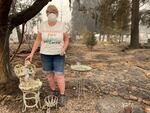
Sue McMillan's home in Phoenix burned in the Almeda fire which broke out near Ashland on Sept. 8, 2020. In March 2021, she left Oregon and moved to Northern California to be close to family.
Kim Lippi
Nearly five years ago, a combination of dry conditions and heavy winds starting on Labor Day quickly accelerated the spread of multiple wildfires that had broken out in the Oregon Cascades.
Eleven people died in the Labor Day fires, which burned more than 1 million acres and destroyed more than 4,000 homes from Clackamas County to the California border.
As the fifth anniversary of the deadliest fires in the state’s history approaches, we hear from two survivors who lived in Southern Oregon at the time.
We first spoke with retiree Sue McMillan less than two weeks after she evacuated her home in Phoenix, Oregon, with her pets and a few belongings to flee the Almeda Fire, which broke out near Ashland on Sept. 8, 2020.
The fire burned her home and her possessions and prompted McMillan to leave Oregon in March 2021. Today, she lives in Santa Rosa in Northern California to be close to her family, although she says she misses Oregon.
Misty Rose Muñoz was returning from an appointment in Ashland when the Almeda Fire broke out. As the highway filled with motorists, Muñoz was unable to return to her home in a mobile home park near Phoenix. She still managed to alert her neighbors and her daughter to evacuate.

FILE - This aerial image taken with a drone shows homes leveled by the Almeda Fire at Bear Lake Estates in Phoenix, Ore., on Tuesday, Sept. 15, 2020.
Noah Berger / AP
Even though Muñoz’s home didn’t burn down, the flames, smoke and ash caused irreparable damage and left it uninhabitable.
After leaving the Rogue Valley in Sep. 2023, Muñoz moved to Portland where she eventually found work as a school bus driver. After years of housing instability, in March, she bought a home in Ashland through a grant she received from a federally funded, state-administered program that helps wildfire victims repair or replace their homes.
McMillan and Muñoz join us to share their memories about surviving the Almeda Fire, what they lost and their yearslong journeys of recovery.
Note: The following transcript was transcribed digitally and validated for accuracy, readability and formatting by an OPB volunteer.
Dave Miller: This is Think Out Loud on OPB. I’m Dave Miller. We are commemorating the fifth anniversary of Oregon’s devastating Labor Day fires this week. As you might have heard, we talked to two survivors of the Santiam Canyon fires yesterday. We’re going to hear about the Almeda Fire in Jackson County today. It destroyed more than 2,600 homes, most of them in Talent and Phoenix. Misty Rose Muñoz is one of the survivors from that fire. She’d been living in a mobile home parked between Medford and Phoenix when the fire broke out, and she joins us now. Misty Rose, welcome to the show.
Misty Rose Muñoz: Hi, thank you so much for having me today.
Miller: Thanks for making time for us. Can you tell us about the house you were living in five years ago?
Muñoz: The house I was living in was a 40-year-old mobile home. Bought it on a credit card. It was affordable. It was a TLC fixer upper. I loved it, put a lot of money and love into it, bought it to raise my kid in it and to have my family there for several years.
Miller: What did that house mean to you?
Muñoz: It was my security. It was my first purchased home, my safety net, a place to create memories with my kid, raising her, and also a nest egg for a future stick built home.
Miller: Where were you when the fire really took off?
Muñoz: I was in Ashland. I was at an X-ray appointment. I actually drove by the fire, saw it when it was in its infancy, and actually called my daughter and let her know that we had a little grass fire. I’d be home shortly after, but I felt called to call her for some reason and I did.
Miller: At that time, am I right that you were used to fires here and there, so you didn’t think too much of it?
Muñoz: I did not think anything of it. We have fires all the time on the greenway in Jackson County, Bear Creek, in that corridor. It’s a common occurrence. We had a lot of homeless people that lived right on the creek there. I didn’t think much about it.
Miller: When did that change?
Muñoz: Well, I came out of my appointment and I noticed that the old Highway 99, which is the alternative to I-5, was completely gridlocked going north. So I went ahead and took a right, heading south into Ashland. I stopped and picked up a few drinks from a little raw drink establishment in Ashland. I went and visited a friend.
I let my kiddo know that I wasn’t going to be home. They were out of school for COVID. No thoughts at all. And that changed when a family member called me and asked me where I was and where my kid was, because they grabbed their cat and they saw planes, in a park, heading towards my house. That’s when I knew we were in trouble.
Miller: And to be clear, so that’s from just social connections as opposed to an official emergency notification?
Muñoz: There was zero emergency notification. It was all word of mouth, people getting out of that fire alive.
Miller: Were you able to get back to your home?
Muñoz: No, no, it seemed like a movie scene. I was on crutches. I got back in my car, drove to the south I-5 entrance. I was told by the officials there that there were burned cars on the freeway, there was no way that I would have entrance and that I would have to drive either through the country roads, on through the lakes and onto the other side to get to my house, or I would have to wait in the gridlock on 99.
And I will tell you it was a terrifying moment, knowing that my 13-year-old kid was at home and I had no way of getting to her at all. And at one point, I remember thinking this is what it feels like when people have loved ones on an airplane that is getting ready to crash. You have no control. It is completely out of my control, other than calling her, letting her know what was going on and urging her to leave immediately.
Miller: How were the two of you able to eventually reunite?
Muñoz: It was a couple days later when the roads opened I-5. [Highway] 99 wasn’t open for a long while, but the I-5 opened back up and she was able to come to where I was staying.
Miller: And before that, she had been with friends or family?
Muñoz: She was with my brother who lives right outside of Medford. So he was maybe a 15-minute drive away.
Miller: But still, it was a couple days before you could be together. How long was it before you found out what had happened to your home?
Muñoz: It didn’t take long. I was notified by the person I was living with at the time that he needed to go and pick up law enforcement equipment. It’s federally required for anybody who’s in law enforcement to pick up their duty items. And we didn’t know if we had lost our house or not, so we drove in and the house was still standing but with a lot of damage.
We were able to enter the home, but when we did, we were driving through what looked like a war zone. Stuff was still on fire, smoke was still smoldering, shards of glass, metal objects that we couldn’t even tell what the item was before the fire. It was pretty devastating.
Miller: The house was still standing, your home. But can you give us a sense for the extent of the damage?
Muñoz: Yes. We had huge burn holes in the roof of our home. The material is a thick plastic on mobile homes. It burned right through the brand new windows we had put in. The windows had popped out of their frame because our house was metal. It heated up so much more than a wood or composite home and it just popped all the windows.
We were also told that any insulation in our home would go from being long and flat, which is what keeps the heat in the home, to [looking] like lava inside of the house and would look like rocks down at the bottom of the inside of the home if you were to cut the wall out.
[There was] also unknown damage to electrical and plumbing. We were told that, at that point, our house would be a fire risk and also that we could experience pipe bursts from the pipes being compromised in the fire. So we could have floods in our home. The windows had smoke damage on them, so you couldn’t see into the home through the windows. Yeah, it was pretty bad.
Miller: I mean, what you’re describing seems like it was unlivable – standing, but no longer fit for habitation.
Muñoz: One hundred percent. Yeah, we had a 100% payout from our insurance company.
Miller: What was it like dealing with the insurance company?
Muñoz: I would have to say that we must have had a pack of angels on our side, because I basically told them that I would sue them if they didn’t pay me out 100%. I don’t know if the threat was it or it was just a miraculous moment. But the guy walked around and said, “Your home is totaled. You don’t actually have adequate insurance on your home. You’re underinsured, so we’re gonna pay you out the full amount.”
Miller: They paid you more than they had to pay based on the coverage you had been paying for?
Muñoz: It was a 100% payout based on the coverage that I had for a home that I had been fixing up. I didn’t know, as a homeowner, that I needed to increase my insurance policy as I made improvements. And that was true for a lot of people who lost their homes in this fire. They were underinsured because a lot of us didn’t know that we needed to do that.
Miller: So you were insured for the value of the home that you’d bought, but you’d made it more valuable with money and sweat equity. And you hadn’t increased the coverage for that increased value?
Muñoz: Correct.
Miller: Where did you live in the years following the fire?
Muñoz: I have had what feels like a pretty harrowing last five years. I was on disability for an injury that I had acquired 20 years ago and I was doing a lot of work to heal myself. And disability benefits definitely do not pay rent for a solo person. So I took the money that I got from the insurance, so I didn’t have enough money.
I got a family loan to purchase a motorhome, which I thought was a great idea to live in until something else was figured out next. So I took that motorhome and lived in it for a year in the Mojave Desert. I traveled to different states. That made the most sense because it was during winter. It’s a lot easier to live in a motorhome where there aren’t freezing temperatures and the possibility of mold growth. So I traveled around in the desert for a year, by myself with my dog.
I came home and then lived with a family member for one year and nine months, with the hopes of getting a new home through a federal grant that we thought would be rolling out around the spring of 2022. And like all other fire survivors, we were caught in the red tape of that money being released. It wasn’t until November of 2024 that we could actually start applying for that money. In the meantime, from 2023 to May of 2024, I lived in different homes.
Then I rented an apartment in Portland, not knowing that I was going to be dealing with a severe mold issue with that apartment. I have videos and footage of the mold that I was dealing with, but I had nowhere to go. I didn’t have the money, or even the rental history or the work history to be able to move myself out of that situation. So I was stuck in a moldy apartment until the HARP program [Homeowner Assistance and Reconstruction Program] came through. I quite literally moved my items out of that apartment straight into my home that now is in the Rogue Valley.
Miller: Am I right that you were able to actually close on a home, to buy a home in the Rogue Valley just this past spring?
Muñoz: That is correct.
Miller: What does it feel like to have a home in the Rogue Valley again?
Muñoz: It’s surreal. I had waited so long for that HARP program to happen that I didn’t actually believe that it was going to happen. So when it did happen and the process moved so quickly from November to March that it felt like a dream. I’m still pinching myself because it doesn’t even seem real still. The house is beautiful. And it meets my needs. We had a fire less than seven miles away that I could see from my mobile home And it was very scary.
So the idea of fire and loss again, after acquiring a home, is a very real fear and trauma for fire survivors. The [Neil Creek] Fire was actually closer to my home than the Almeda Fire [which] destroyed our home. So it shows that something that seems completely innocent and not a threat can become a threat very quickly. And I had my stuff ready to go in my new home in case that fire got out of hand. So that’s how it feels.
Miller: Misty Rose, thanks very much.
Muñoz: Thank you.
Miller: Misty Rose Muñoz is a survivor of the 2020 Almeda Fire.
I’m joined by another survivor now. Sue McMillan was living in Phoenix when the fire broke out. We first spoke less than two weeks after she had to evacuate her home with a bunch of her pets. She joins us once again now. Welcome back to the show.
Sue McMillan: Well, thank you. Thank you for thinking of me.
Miller: For folks who didn’t hear our conversation five years ago, can you remind us how you heard or realized that you needed to evacuate?
McMillan: As I recollect, it was just a beautiful, beautiful September day and it was very quiet. People were at work. And how did we kind of figure it out? Oh, it was windy. It was really, really windy and I had quite a few trees in my backyard. I asked my son, who was living with me at the time, I said, “If you go to work, keep your phone handy because I think these branches might fall on the roof.” So he had to go to work and he came right back. He said, “I can’t get over the pass.” He worked at Fairchild Hospital.
I said, “Why?” And he said, “Well, there’s a fire going on in Ashland and they’re stopping traffic.” We thought, “Oh, OK.” We just didn’t do much about it until smoke started coming in our direction. And there were no sirens, there was nothing, no warning or anything. It was just a very quiet day, but the wind and the smoke, that’s how we figured it out.
Miller: How did you decide what to take with you when you did evacuate?
McMillan: Well, don’t do what I did. [Laughs] I just realized that we gotta get out of here and my neighbor was out. He was gathering his family and he says, “It’s coming this way. It’s gone through Ashland, it’s going through Talent. It’s heading our direction and it’s really, really bad.” So I went back into my house. I just threw through a pair of, I don’t know, cutoffs, a t-shirt, dog food, a deck of cards and a bottle of wine, and zipped that up … and, oh, some papers. I gathered up some photographs of my family and threw those in there.
I gathered up all my beating hearts of my dogs. There’s my son’s dog, and I had two dogs and my cat. She ran off. We had to just dump over mattresses, futons and everything to finally get her cause she was really freaking out. I got her contained. Then we headed over to my friend Sharon’s place and stayed there for a while. When we were told to evacuate from her place, so we went to her grandson’s home in Central Point – his name was Slade – and spent the night.
In the morning, I was out on the porch, and my neighbor had snuck into the area and videotaped our neighborhood. And that’s when I knew I had lost my home.
Miller: That you’d lost everything?
McMillan: Yes.
Miller: About a month after the fire, you wrote a letter of gratitude to the people who had been helping you out and you included a paragraph about what you had lost. Do you mind reading some of those sentences to us?
McMillan: Oh, I’d be happy to. And this was as a result of my daughter kind of setting up a GoFundMe thing, which I didn’t really know much about, and people that I don’t even know. It was just an amazing situation. Kim just kept all the addresses, so I got that from her afterwards and this is what I wrote. This is part of what I wrote to them:
“A home is where you document your life. It contains framed photos of your family and ancestors, souvenirs collected from places you have been, cookbooks, travel books, history books, a foot imprint with the date of your grandchild, displayed proudly on a bookshelf. Photo albums, heirlooms, a ziplock bag that held the Christmas socks with your father’s scent still on them, or a delicately etched pink glass cake plate bought by my mom and her brother John when they were children, costing 25 cents and purchased at Woolworth’s in Modesto to give to my grandma Nana on her birthday (I had that heirloom). Handmade quilts, Christmas decorations collected over the years, snippets of hair from your children’s first haircuts.
“So it’s not just stuff, is it? And this is what hurts. As time passed, it hurts when your home becomes known as a ‘stick dwelling’ and is referred to as toxic waste to be disposed of. And it hurts to drive through towns to run errands and see so much devastation and familiar landmarks that are not recognizable anymore.”
That was part of it.
Miller: Sue, we heard from Misty Rose that she had … actually she said there must have been angels looking after her, that she had a good experience with her insurance company. What about you?
McMillan: That’s a hard question for me to answer. I’m still dealing with them and I think if I could give advice to anybody who’s listening to this, it would be to be prepared, have a plan and a go-bag, a real one. I mean, look it up online. [Ask] your grandchild, if you don’t want to do that, who’s 10. They can figure it out. Follow the instructions from your firemen and your policemen. That’s something I really stress. But what was the question?
Miller: What was it like to deal with the insurance company?
McMillan: The insurance company was great. I stayed in Medford for a while in the Pioneer home that my friend Lynn and her husband Steve had loaned me for the time. So they paid for all of that. They paid for my time when I moved to Capitola to try and get my bearings there. That’s an area that I’m familiar with in California.
And when I finally found a home in Sonoma County, where I’m living now, in Santa Rosa, dealing with them to replace things that I had is kind of a hassle that you have to go through. I’ve downsized, so I wrote to them several times up the ladder and let them know that I just would prefer that they send me the money. I don’t need the things. I don’t need stuff that I had before.
Miller: I’m curious, in addition to the stuff you had before, where you ended up? As you said, you’re in Sonoma County now. You’re in Santa Rosa in Northern California. Did you consider staying in Southern Oregon in Jackson County?
McMillan: I thought about it. It was such a different landscape. It was like a war zone, as Misty explained, it looked like that. I think the people that I know who stayed in my neighborhood had deep family roots. And they stayed and rebuilt. My family roots are in California and my daughter said to me, “We’d like you to come home, Mom. We miss you. You’re missing out on a lot of stuff.” And it had gotten to be a bridge too far to go from Oakland up to where I lived. It’s about a six hour drive. Not an easy one when you have to go through the pass, especially during the winter.
So I gave that a lot of thought and that’s what I ended up doing. California is where I’m from. I have roots there and that’s where I’m at now. I’m very happy here and I’ve rebuilt a life. I volunteer and I do some wonderful things for this community that I live in. I’m just delighted with the way things have gone.
Miller: I’m happy to hear that. I’m curious how much you’ve kept in touch with people back in Jackson County?
McMillan: I have kept in touch with two women I met. I talk to one friend and her name is Lynn. I stayed at her home. We talk every day at 8 o’clock in the morning.
Miller: You have a standing 8 a.m. phone date with her every single day?
McMillan: Every single day.
Miller: What kinds of things do you talk about?
McMillan: Just could be anything. We usually end up laughing about something. I don’t even know how I can explain that. And then my other friend Sharon, I talked to her last night. I talked to her about once a week. Both of these ladies, I stayed at their homes and so did my son when we had to evacuate. And they keep in touch. I mean, I love both of them. I love my family here and I’m just blessed to have a constellation of family and friends that means so much to me. I love them and they love me back.
Miller: Do you think the fire has changed you?
McMillan: Oh yeah.
Miller: In what ways?
McMillan: Oh boy. That’s a hard one. That’s a hard one to answer. I have much more empathy for people who are going through hard times. I volunteer at an agency where it took five months of training to do this – it’s called the Law Enforcement Chaplaincy of Sonoma County.
And what that involves is if there’s a death in Sonoma County and if we’re on call for that particular day, and law enforcement calls needing a chaplain, we go out and we tend to the people of the loved one. The police and/or firemen tend to the deceased person and we help with the family. That’s something that I do very well.
Miller: And what kinds of situations might you respond to?
McMillan: It could be anything. I’ve responded to suicides and sometimes it’s just the death with somebody dies in the middle of the night. I go in to comfort and give information to the people that are surviving. There are a lot of aspects to it.
Miller: Do you think you would have done that volunteer work if you hadn’t, yourself, survived the fire?
McMillan: I don’t think so. I would have probably been working like I first did with horses. I’m gonna be transitioning to working at the Charles Schulz Museum here in Santa Rosa, a very famous museum. I’ll be doing some volunteering for that.
Miller: But it sounds like … You’re not a firefighter who’s running into the fire. But you are now going towards the human trauma and doing your best to help people who are, I assume, some of them living the worst days of their lives.
McMillan: It is the worst day of their lives. Yes, that’s what I’m doing.
Miller: How much do you relive the day of the fire?
McMillan: I have to say pretty often. There’s always something that comes up. And lately there’s a fire here. The last few days there have been planes flying over my house to send help and equipment over to the fire that’s not gonna be a threat to us, but we’re in a fire zone. So, I don’t know, it’s just an event that brings heartache to me a lot when I think about it and the loss. And it just, it’s changed me.
Miller: What do you think people who have not been through a devastating fire just don’t understand or maybe can’t know about the experience?
McMillan: I have friends ... I think that deep down inside all of us there is such a strong human connection that comes out in people, whether they’ve experienced anything like this or not. There’s just a depth of perception that I think all of us have inside of our heart. I really do. And I think it comes out in them, to me.
Miller: Sue McMillan, thank you very much. I wish you the best in your new life.
McMillan: Thank you so much for having me.
Miller: Sue McMillan survived the Almeda Fire in Jackson County in Oregon. She now lives in Santa Rosa, California.
“Think Out Loud®” broadcasts live at noon every day and rebroadcasts at 8 p.m.
If you’d like to comment on any of the topics in this show or suggest a topic of your own, please get in touch with us on Facebook, send an email to thinkoutloud@opb.org, or you can leave a voicemail for us at 503-293-1983.