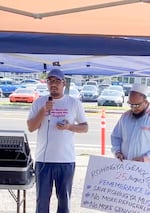
Nurul Haque, a Rohingya refugee in Portland, speaks at an event he helped organize at Masjid Omar Farooq in Portland on Aug. 24, 2025 to commemorate the 8-year anniversary of the Rohingya genocide by the military in Myanmar. The Rohingya are a persecuted Muslim ethnic minority, more than 700,000 of whom fled to Bangladesh to escape the genocide which broke out on Aug. 25, 2017.
Courtesy Lauren Fortgang
Eight years ago, the military in Myanmar launched a weekslong campaign of genocide against the Rohingya, a persecuted Muslim ethnic minority. Investigators from the United Nations documented the scale of the “extreme violence” they found: the killing of thousands of civilians; mass rapes of “hundreds, possibly thousands” of women and girls; nearly 400 villages burned to the ground. More than 700,000 Rohingya fled to neighboring Bangladesh, where they live in squalid conditions in the world’s largest refugee camp.
Nurul Haque was born and raised in that refugee camp. About a decade ago, he started the Bangladesh Rohingya Student Union, an organization that helps expand educational and leadership opportunities for youth in the camp and advocates to stop child labor and human trafficking by criminal gangs. After being kidnapped, beaten and threatened with death by armed gang members, Haque successfully applied for refugee status in the U.S. for himself, his wife and his young son. In December 2023, he and his family arrived in Portland, which he chose for resettlement because a relative lived there.
Haque joins us to share what his life is like today and his continued advocacy for Rohingya communities here and abroad.
Note: The following transcript was transcribed digitally and validated for accuracy, readability and formatting by an OPB volunteer.
Dave Miller: From the Gert Boyle Studio at OPB, this is Think Out Loud. I’m Dave Miller. Nurul Haque arrived with his wife and young son as refugees in Portland, about two years ago. They are Rohingya, a long persecuted Muslim ethnic minority from Myanmar. But Nurul wasn’t born in Myanmar. He grew up in neighboring Bangladesh, in the world’s largest refugee camp. It was already a sprawling camp before the Myanmar military launched a genocidal campaign against Rohingyas in 2017.
Before we go further, and in case you are around sensitive listeners right now, you should know that we will hear about some of the gruesome reality of genocide in this conversation. Investigators from the United Nations documented the scale of the extreme violence they found – mass killing, mass rape and the destruction of entire villages. More than 700,000 Rohingya fled to neighboring Bangladesh.
Nurul Haque joins us now on the eighth anniversary of that genocidal campaign. Thank you so much for coming in.
Nurul Haque: You’re welcome and thank you so much for having me here today.
Miller: Can you remind us what happened in Myanmar in 2017?
Haque: On 2017, 25 August around 4 a.m., the Myanmar junta government started the attack on Rohingya, innocent people who are still sleeping – children and women, elderly people. On 25 August, the genocide, we say genocide happened on Rohingya Muslim minority in Rakhine state.
As I’m a Rohingya, 25 August is not just a date on a calendar. It is a painful reminder of the darkest chapter in our history. On this day in 2017, the Myanmar military carried out a campaign of masculines, sexual violence and forced displacement against our people in Rakhine state. Entire villages were burned, burned to the ground, families were torn apart and hundreds of thousands of Rohingya were forced to flee for their lives across the border into Bangladesh.
On this day, the Myanmar junta government killed children in front of the mom and father. Daughter, teenage daughters were raped in front of the mom. Her husband was killed in front of the wife. And fires were done on all the houses. The children under age of 2 years, infants included, were thrown to the fire, on the fire. We are the experiences of that happening to the Rohingya on 25 August. As I said at the beginning, around 4 a.m. the night. Still people are sleeping and with the helicopter throwing the launcher, on Rohingya people.
Miller: I want to go back a number of decades, because as I mentioned in my introduction, these attacks were not the beginning of repression or violence against Rohingya in Myanmar. They were a continuation of decades of earlier actions. And as I noted, you were born in a refugee camp in Bangladesh in the early 1990s. What led your parents to flee their home?
Haque: My parents are originally from Sittwe, which [was] called Akyab. They have been living for decades and decades in Sittwe. They’re natives and their origin of Rakhine in Myanmar, I mean, the Rohingya Muslim. So in 1919, 1978, 1987 and then 1990 the continuous persecutions were going on of Rohingya people. In 1990, the violence took place again in the Rohingya Muslim community, the one of my family. They fled, they decided. It was hard to make the decision to leave their beautiful home and the cities where they born.
The country was where they belonged for years, for years. My father, along with my two elder brothers, decided to flee to Bangladesh, seeking safety and security. They decided, because they have been continuously facing the discrimination, and they have been facing the systematic violences and denying the citizenship free movement and their identity. And the most important thing is that every time the junta government comes to the house in the name of checking the people. And every time, they are taking out all the necessary documents from our parents.
My father was a small business person in Sittwe. He used to run a small shop. But my father was, again and again, fined and attacked, due to being in a Rohingya Muslim community. And then my father couldn’t tolerate it. Along with others, they decided to flee to Bangladesh.
Miller: What was your childhood like in this refugee camp that in recent years, it’s been called the largest refugee camp in the world? And obviously, we can talk more about how much it grew in 2017. But in the 1990s or when you were a kid growing up there, what was it like?
Haque: Right after my family arrived in 1991, and then the end of 1991 and 1992 beginning, they resisted and settled in a refugee camp under the UNHCR and Bangladesh government. And they’d say that right after they settled in a small shelter, which is very small, I was born. And my father said, I was born in a small house, and then I have been growing up there.
The life was not easy for us growing up in the camp. All the time we have been faced with difficulties. We have been growing up for the last 32 years in a refugee camp. More than 30 years, I have spent my life without basic rights. I have only the primary rights, primary services, primary health care, primary food, primary shelter, family, livelihood, primary clothing, no secondary. We never enjoyed the secondary life, facilities in our 32 years of life.
Miller: You were born in Bangladesh. Were you a Bangladeshi citizen?
Haque: No, I was born in a refugee camp. But I grew up there and then I never feel the citizenship, although I’m the witness of celebrating the Independence Day. I’m the witness of the celebrating there a lot of days.
Miller: You would see these national holidays of independence in Bangladesh, but you didn’t experience that yourself?
Haque: Never, but I just cry when I see the flag of Bangladesh. I cry because of being a refugee. I cannot be part of the celebration ever. So I spent my life in a small shelter, 8 by 10 feet. That’s where we, nine people, lived. In a small house, 8 by 10 feet, in a refugee camp.
Miller: What opportunities were there for education or employment?
Haque: Well, in refugee camp, there was only grade 5. That was the facilities for education and it is not even formal. It is informal education. Like a learning center, pre-primary learning center like this. They’re run by UNICEF and UNHCR, founded by local NGOs. So in this school, the interesting thing is, I completed class five three times in the refugee camp. But I had never had a chance to go to the high school for classes six or seven. But it was a really challenging life for us, growing up in the camp.
Miller: The refugee camp was already very large before the Myanmar military junta started massacring and pushing out Rohingya in terrifying numbers in 2017. How much did those camps grow after that?
Haque: There are more than 27 super refugee camps under one district. So, 27 refugee camps separately.
Miller: So all together are known as the largest refugee camp in the world?
Haque: It takes you about one hour from beginning to end by driving.
Miller: I’ve read that there are now estimated to be more than 900,000 people living there?
Haque: Right now, there is 1.5 million Rohingya remaining trapped in refugee camp in Bangladesh.
Miller: 1.5 million?
Haque: 1.5 million. Recently, the Arakan Army, another group that after the 2020 coup in Myanmar, the Arakan Army has been fighting. And then recently, they have been taking on Rohingya civilians again. They have also been forcing the people to flee to Bangladesh. They are also banning … They are also committing the similar things to what happened by the junta military in 2017. The Arakan Army also is committing the similar things and taking actions on Rohingya. People are not getting rights to go outside on their free land for cultivation. People are not allowed to go to the fishing river for fishing to survive their lives. So people are not allowed to go to the market. School has been stopped. There are no humanitarian organizations. [They] are not getting access to go there.
So people are facing another second wave of genocide there. They have killed a lot of people. Recently, the human WHR and 45 rights [organizations] based in Asia, have released a couple of reports that found evidence of mass killing, grab and committed by the Arakan Army. So that is continuously happening. And when I spoke with one of my relatives the day before yesterday, they said that even they cannot even go outside from the home. Right after they found the Arakan Army members, they are being arrested and taken away. The family doesn’t know and sometimes they’ve killed the people. So this is, again, the atrocities being committed again, under the Arakan Army.
Miller: What led you to seek refugee status in the U.S.?
Haque: We’ve been living in [the camp since] 1992, we had been deprived of all the rights, [so] we created a civil organization called Bangladesh Rohingya Student Union. I’m one of the founders of that organization. We started working to promote education, to counsel the people, parents about child labor, and also child and early marriage, livelihood activities, and also female youth and female leadership in the camps. But some of the armed groups are not taking it positively.
Miller: Armed groups within the camp, the fellow Rohingya members didn’t like the social work you were doing?
Haque: Yes, so they are not allowed the Rohingya women outside for work, helping their families economically. And they are not allowing girls under in the age of 13, not allowed. So they are doing this, restricting the people, but we are raising our voices against them. Why aren’t women or girls allowed to go? Girls have the right to go to get education. For education, we have been facing the genocide and systematic discrimination, and the violence and persecution. So why are you guys stopping here? For that reason, I’ve also been collecting the reports.
I used to work for the Office of the High Commissioner for Human Rights. My job was monitoring, helping the office to monitor the political and human rights situation in Rakhine, as well as in the Bangladesh refugee camp. So I reported also some other nonprofit organization. One of my reports had been leaked, against those armed groups. They found and then with this, they abducted me.
Then they kidnapped me and then took me away, a group of Arakan Rohingya Salvation Army, for about two hours, tortured me mentally and physically. And finally they decided to take me away to be killed. And still they are asking me, “Why you report this? Why you report this?” I say I never report against any armed groups here. I never do. I’m just helping the media and other human rights officers to monitor, to collect the evidence and report it. But they denied me. They said, “You wrote this report to have the evidence.”
One of my colleagues, also a Rohingya, but I never knew of his involvement with the armed groups, he leaked this report. Then after they tortured me, in December 2020, after their continuous torture, I later on apologize and I said I never did. I denying that continuously. After [that], one of them became kind to me and then said, “OK, this is the last chance for you and last warning. So if you try to do anything against us, we will not consider you twice. You will be killed.” After that, I was quite silent. I never share it and they told me, “If you share anybody, we will not only kill you, even your family.”
Then after, I fled and I sought protections. I told everything to the UNHCR and they investigated. They found that it’s valid and then they requested to the U.S. Embassy in Dhaka, and then they filed. And then I got the chance here. So yeah, that’s the process.
Miller: What has it been like to make a home in Oregon?
Haque: As I said, as a refugee, as a displaced, as a genocide survivors, we never feel a home belong where even though we had a country. But we never had the chance to go there. I had never been there. I had never home. I never belonged to a home.
Miller: Do you feel like you belong to a home now?
Haque: Yeah, so in Oregon, right after I landed here, I feel like this is my home. I’m set up here and I’m feeling it is my home now. It is like a home.
Miller: Between the war in Ukraine and the war in Gaza, it seems like there’s very little international attention being focused on the plight of Rohingya people. What do you want your new fellow Oregonians or people around the world to know about what’s happening right now?
Haque: Yeah, this is one of the very important things that we need the attentions of the international community, including my fellow Oregonians. The Oregonians are very kind and they are very supportive, and we want their support more. We need their attention more in Rakhine in Southeast Asia, in Rakhine to Myanmar, what’s happening. And we need their support. We need the support of the involvement of the United States of America, as it already consider recognized it is genocideand and war against humanity, and genocide on Rohingya. So we need their support to help the ICJ and ICC investigation in ICC court, to ensure that the punishment of those criminals, those who committed genocide, and who are still committing the second wave of genocide, to ensure their punishment in international court. So we need their support.
Also, we need the humanitarian assistance, humanitarian support for those who are still driving in Rakhine or still remaining in Rakhine state who are facing difficulties to get food and other services. We need the immediate actions, immediate support from international community.
Miller: Nurul, thanks very much.
Haque: You’re welcome.
Miller: Nurul Haque is a Rohingya refugee living in Portland. He’s been here for about two years now. We have been talking, to mark the eighth anniversary of the Myanmar military’s genocidal campaign against the long-persecuted Muslim ethnic minority.
“Think Out Loud®” broadcasts live at noon every day and rebroadcasts at 8 p.m.
If you’d like to comment on any of the topics in this show or suggest a topic of your own, please get in touch with us on Facebook, send an email to thinkoutloud@opb.org, or you can leave a voicemail for us at 503-293-1983.