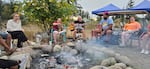
In this provided photo, a volunteer at the Upward Bound camp in Gates plays the guitar while seated at a campfire, surrounded by camp counselors and campers during one of the summer session activities held in June 2025. Upward Bound is a faith-based camp started in 1978 for pre-teens and adults with disabilities.
Courtesy Upward Bound
Upward Bound is a faith-based camp that opened in 1978 for pre-teens and adults with disabilities to experience traditional camp activities, from making s’mores around a campfire to hiking, fishing or playing outdoor games. In 2014, the camp bought an 18-acre property in Gates in Linn County that included an elementary school, a gymnasium and a high school building. Classrooms were converted into bunks for campers to stay in, along with other modifications made to allow for year-round programming and activities.
Although the camp was able to successfully pivot when the pandemic broke out, with individual tents for campers to stay in and other precautions taken, tragedy struck on Labor Day in 2020. As the Beachie Creek fire tore through the Santiam Canyon, Upward Bound executive director Diane Turnbull and her staff evacuated the camp. When Turnbull returned two weeks later, many of the structures had burned, including the elementary school where campers stayed.
Turnbull, with the support of Upward Bound’s board, decided to keep the camp going, with outdoor bell tents that counselors and campers now stay in. The camp recently ended its summer session and has since expanded its programming to include activities like archery, theater and music performances. Turnbull joins us to talk about the camp’s recovery efforts, including working with FEMA to rebuild structures lost in the fire that would allow the camp to expand access to people who are visually impaired or require other physical accommodations. Also joining us is Misael Pujols, a camp counselor from the Dominican Republic who recently completed his third summer working at Upward Bound.
Note: The following transcript was transcribed digitally and validated for accuracy, readability and formatting by an OPB volunteer.
Dave Miller: From the Gert Boyle Studio at OPB, this is Think Out Loud. I’m Dave Miller. We got an email this week from Diane Turnbull, the executive director of Upward Bound. It’s a camp that’s been serving teens and adults with developmental and physical disabilities since 1978. Diane heard our recent coverage about resilience and recovery after the Labor Day fires and said that she had a story to share. Upward Bound, which is now based in Gates, lost almost all of its physical structures in the Beechie Creek Fire. But they pivoted and found a way to continue serving campers. In fact, they have not missed a summer session since the fire.
Diane joins us now, along with Misael Pujols, who has been a counselor for the last three years. Welcome to you both.
Diane Turnbull: Thank you.
Misael Pujols: Thank you so much.
Miller: Diane, how do you describe Upward Bound?
Turnbull: Well, if it wasn’t already taken, I would say “the happiest place on earth.” We really bring in people who need a break, just like any of us do. Whether or not you have a disability, you need a vacation sometimes. And our campers love to come to camp. So they get to come here, and they get to participate in all kinds of different activities: music, drama, fishing, archery. They choose what they want to do, for the most part. Some of these folks have been coming for more than 40 years. We are truly their summer vacation opportunity.
Miller: That does make it very different than I think what most people think of as a camp, which is for kids, maybe for teens. Maybe by the time you get to your late teens, you’re a counselor-in-training or you stopped going to camp. But this is for all ages 12 and up and up and up.
Turnbull: And up and up and up, that’s exactly right.
Miller: What made you want to take part that very first year? Am I right that you were a counselor there in 1978?
Turnbull: That’s exactly right.
Miller: How old were you then?
Turnbull: I was 16 years old.
Miller: Why did you want to do it?
Turnbull: Well, I have a couple of cousins who had developmental and physical disabilities. So when I was younger, I would go on vacation to my grandparents’ house and they’d be hanging out there, and we just always had a really good time. And it never occurred to me that they were any different from anybody else, except they couldn’t walk very well or couldn’t talk very well. And then when I was about 15 or 16, I read this book called “The Acorn People” and it was about a camp for kids with disabilities, and I was like, “Hey, I wanna do that.”
I applied at a kids’ camp in Oregon to volunteer in 1978, and they’d already filled all their volunteer slots. So they sent my application to a person who was opening up a new camp for people with disabilities – and they hired me. I was gonna go for a couple of weeks and ended up staying for four summers.
Miller: What do you remember about that first year when you were 16 and this camp was just starting out?
Turnbull: Wow. We were located at a very, very primitive site. So no electricity, no running water, pit toilets and bathing in the river. We also had three-sided sleeping bunkhouses that opened to the river.
Miller: Like lean-tos?
Turnbull: Yeah, lean-tos. This would never fly now, we have so many regulations. But at the time I was like, “This is so beautiful!”
And then I started thinking about, well, what if people can’t walk very well? How’s that gonna work? Your brain starts considering what could be the barriers, but what also is the joy that can be found here?
Miller: So even then, even as a 16-year-old, you were thinking about accessibility? This is before the ADA as well.
Turnbull: Exactly. But it was amazing. People came and they weren’t even fazed by the lack of electricity, or pit toilets, or bathing in the river. They just took it on, and it was amazing. I still look back on that time as some of the happiest summers of my life.
Miller: And as you’d said, you thought you’d do that for a summer, but you did that for the next four summers. What exactly was it that made you want to come back and to keep doing it?
Turnbull: Well, as I mentioned before, some of the campers would come back every single summer just like kids would. But I sort of developed these relationships with folks. And I looked forward to seeing them every year.
The other thing that we did was we served people from Fairview Institution, so that was before deinstitutionalization. And it was interesting because I had ideas about what life in an institution would be like – very regimented and things like that. And again, even those folks who lived in that kind of an environment just took it on. What’s really interesting is there are still several of those folks who are coming today and have moved out of the institution and live in group homes or with family members. And it’s just been fascinating to come back to it and see that trajectory of their life.
Miller: Let’s zoom forward a little bit. So something like 40 years went by. How much did you think about Upward Bound over the course of your life? After the four formative summers, ending when you were 20, and then decades went by, would you still think about Upward Bound?
Turnbull: Most of my life after that was working with people who had disabilities. I majored in theater in college. I went to New York and lived in New York for a while, which was super fun. But when I graduated, I was like, “OK, now what am I gonna do with a bachelor’s degree in theater?” So I just got back into working with people with disabilities and I’ve never stopped since then.
Miller: What was it like when you got back as executive director? You returned in 2018, 2019.
Turnbull: I made a call to the camp. I’d driven by the road that went up to the camp at that time, and I would think about that when I would drive by on my way to Portland from Bend, which is where I went to high school. I would think about them, so I called them in 2017, and I said, “Hey, what’s going on? You guys still doing camp? What’s happening up there? Can I come visit?” And they were like, “Sure!” So I went and started volunteering on the weekends, helping get ready for camp and things like that. And then I came for the end of a camp one year and there were people there that I remembered from the ‘70s.
Miller: And they remembered you?
Turnbull: Some of them did and some of them did not. [Laughs] But it was just like, whoa, this is so, so cool. And I happened to be in a job that I loved, but I don’t know, I just thought, “This is really neat.” And then the executive director, who was the founding executive director, said that she was looking to retire and maybe I could be the person that took over. So long story short, that’s what happened.
Miller: When you came back, the board had already purchased a property in Gates something like four or five years before but hadn’t done the move yet. Can you describe the property where the camp is now?
Turnbull: It’s pretty cool actually. Most camps are kind of out in the woods and things like that, but we’re in the middle of Gates, which is a tiny town, 565 people or something. And it was an old elementary school, so there’s a 1923 building on the campus, which was the old high school, the original high school in Gates. An elementary school that they built later as the community grew, and a beautiful old gymnasium that the high school students decided they needed after practicing basketball in the cafeteria, which I go in there and I go, “How could you even do that? The ceilings are so low!” But it inspired them to get with the community and build this beautiful gym.
And then some outbuildings for storage and a house. So that’s what the campus looked like at the time.
Miller: So you had most of two summers, if my math is right, at that new site. And then Labor Day 2020 arrived. When did you first realize that the camp might be in serious danger?
Turnbull: That night. I really never expected the fire from Beechie Creek to come down to our part of the canyon. We were housing the wildland firefighters, it was their incident command post. Obviously, we knew it was nearby. And that day in particular, there was a lot of smoke that was blowing down from the North Fork, and the wind was just really high, and it was very, very, very hot.
I kept thinking, “They’ve got to turn off the power at some point.” But they didn’t, and I’m still thinking we’re nowhere near getting burned out. But a tree fell down on a power pole and the transformer came down on the fence and lit up the fence that surrounded the camp. And it was pretty dramatic to see this fence just burning red hot. I got a call from another staff person who was on the campus, and he said, “The camp is on fire,” and I was like, “What!?” I look out my window, and the camp wasn’t on fire yet, but clearly the fence was.
And then we called the local firefighters who came from Mill City and Lyons, I think. I’m not sure where the Gates folks were, but they were somewhere probably up near the North Fork. They got the fence fire out. That was probably about 9:30 they came. During the time that they were there, once they got the fence fire out, they had to go fight fires at people’s homes. And usually when a fire happens, the firefighters go into the buildings, check them. Everything was fine at that point, they didn’t have time to go in and check.
Miller: I should have said earlier, the camp was not in session at this point. There were no campers there, no kids or adults.
Turnbull: No, thank you for saying that. We actually were supposed to have campers that weekend because we always have a Labor Day and a Memorial Day camp, or did at that time. And when the firefighters asked if they could use our site as the incident command post, we just had a few campers signed up, so I said it’s great, we need to support the community in this way. So, thank heavens that they weren’t out there.
Miller: But in the end, am I right that everything but one old school building burned down?
Turnbull: Not everything. We lost 30,000 square feet of buildings and storage, and some of that was the elementary school, the beautiful old gym, and then all of our storage areas where we had our van and our lawn equipment and that all left. But what was remaining were four structures: a house with a metal roof, a wooden pavilion with a metal roof that the fire burned right up to and did not burn down, a metal pavilion, again with the metal roof, and the 1923 school building which also had a metal roof. The fire burned right up to the foundation of that building and just melted the paint right off the side of it, but it did not burn. There were metal blinds in the windows of the upper story, and they melted, but the glass did not break.
It was incredible. I mean, I could not believe that it was still there when I went back.
Miller: Did you consider stopping the camp, not operating it the following season after that devastation?
Turnbull: It was brought up. But I said we’ve got to figure this out, we have to do this, this is just so important to our people.
So I prayed about it. I said, “OK God, if you want to do this, then you’re gonna have to help me figure it out.” And a plan sort of formalized – you need to feed people, you need to house them, and you need to have places for them to recreate and have fun activities. I’m like, “OK, I can do this.” When it sort of broke down into those four areas, it seemed very clear, “Oh yes, we can do this.”
I mean, it wasn’t just like magic. We got several grants and things to get tents. But it worked. And usually we start in June; we started in July that year after and it was amazing.
Miller: Misael, how much experience did you have working with people with disabilities before you came to camp in 2023?
Pujols: I actually didn’t have any experience. Even having a sister who is deaf/mute, I never saw it like that. She’s pretty smart, she was able to read my lips when we get to chat. But I didn’t have any experience before coming here for the first time.
Miller: What made you want to be a counselor at this camp?
Pujols: At the beginning, I wanted to come to Oregon. I’m from the Dominican Republic and I knew about Oregon. It’s always raining, I love the rain so much. One of my friends, the one who invited me to participate in this program, said, “Oh, you gotta come to New York, there is this camp here, it’s a lot of fun.” And I was like, “OK, OK, I just want to do something meaningful. I wanna be able to help people.” I got to the website, and I was looking for camp to serve people who have disabilities. And I just found out this camp that was located in Oregon and was also a camp [that works] with people who have disabilities
Miller: What do you remember about that first year?
Pujols: Many things. I remember the first year there was a family who has a camper who speak a little bit of English. And they really wanted to have these kids come and spend like a week at camp. I remember that I helped a little bit to fill out the application, actually, because they couldn’t speak English properly.
Miller: And they spoke some Spanish.
Pujols: Yeah, they speak Spanish. This is my native language, Spanish. And the kid came to camp. He was very shy at the beginning, he wasn’t able to speak, he wasn’t able to say anything. New experience, far from home. And then I went, “Hey, I understand this is new for you, but I’m your friend and I just want you to have fun here.”
And after one day, he just up and out, he was laughing, just singing. Everyone was surprised. I love that experience so much.
Miller: What do you think you’ve learned from being a counselor at the camp?
Pujols: Well, I have learned many things, actually. It’s just incredible being on a place who supports people who have disability. It helped me learn the importance of inclusion and also having empathy after just being such a great place like this.
Miller: Diane, you described the pit toilets and the very rustic version of camp at the very beginning, when you were 16, and those first couple of years when it was at some forest service land. Am I right in thinking that the last couple years have been maybe more like that than the intervening four decades?
Turnbull: Yes, very much so. And I hadn’t really put all that together, but it makes me think that it felt possible because I knew that we had done that before. Yeah, I like that! [Laughs] Let’s go with it!
Miller: What is an average day at camp like right now? Misael, let me ask you that first.
Pujols: It’s just a lot of fun, a lot of fun. We wake up, we have breakfast and then we have chores. We have to clean out the table where we have breakfast, we have to go out and feed the animals, stuff like that. And then we just jump to a skit that we do every day, we plan this for this summer, like a little play.
After that we have a bunch of activities like archery. We go down to the river. Just a lot of fun, just a lot of fun.
Miller: Diane, I’m curious what lessons you’ve taken from the aftermath of the fire?
Turnbull: I have to tell you, right after the fire, I was very focused on just making camp happen. But always to the side of that was, even if we make it happen now, we still have to rebuild or find a way to have bunk houses and things like that. And the reason that that’s important is because we have campers who have mobility challenges, very difficult to maneuver the property as it is right now. We have a few campers that have been coming for many years. I’ll call them up and say, “Are you coming to camp this year?” And they don’t feel safe yet.
Miller: Because of the physical reality of the land or the lack of buildings, sleeping in a tent, it doesn’t work for them right now?
Turnbull: Right. And that breaks my heart. And similarly, some of these folks who are elderly, sleeping in a tent is just not a possibility. They may have a huge wheelchair that we can’t even get into the tent. Those are some of the people who have been coming for so long. My heart just goes out to them because they may never get to come back if we don’t get rebuilt.
It’s wonderful we get new campers every year. But those folks who have been coming for such a huge part of their lives, it makes me sad to think they might not ever have that final, last year to come and see. I hope that they’ll be able to see the beautiful new buildings that we’ve designed for them and things like that. But we’ll see what happens.
Miller: Diane and Misael, thanks so much for contacting us and for coming in. I appreciate it.
Turnbull: Oh, it was so great. Thank you.
Pujols: Thank you so much.
Miller: Diane Turnbull is the executive director of Upward Bound. Misael Pujols has been a camp counselor at the camp for the last three summers.
“Think Out Loud®” broadcasts live at noon every day and rebroadcasts at 8 p.m.
If you’d like to comment on any of the topics in this show or suggest a topic of your own, please get in touch with us on Facebook, send an email to thinkoutloud@opb.org, or you can leave a voicemail for us at 503-293-1983.