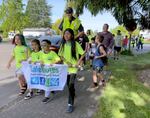
Students lead a "walking bus" with Salem-Keizer's Safe Routes to School program on May 15, 2024. The group walked from Claggett Creek Park to Kennedy Elementary School in Keizer, Ore.
Natalie Pate / OPB
The new school year means that once again some kids are walking or biking through neighborhoods and on busy streets to get to class. Safe Routes to School is a nationwide, federally funded initiative that works to educate and encourage students to bike and walk to school safely. There are Safe Routes to School programs across Oregon, including one serving students in the Salem-Keizer School District.
The Salem-Keizer Safe Routes to School program started five years ago, but because of the pandemic and the inability to reach students in schools, it didn’t really take off until fall 2022, when Beth Schmidt was hired to lead it. Since then, Schmidt has worked with the district and other partners to teach bus, pedestrian and bike safety, including PE classes that started last year in partnership with Cycle Oregon to help kids learn how to ride bikes and follow the rules of the road.
Next month, the Portland-based nonprofit The Street Trust will be giving Schmidt an award for her efforts to advocate for the successful passage of SB 450, which Gov. Tina Kotek signed into law in June. It designates Nov. 14 as Ruby Bridges Walk to School Day in Oregon to honor Bridges’ courage in helping end school segregation in the U.S. Schmidt joins us to talk about her work in Salem and Keizer to make streets safer for students.
Note: The following transcript was transcribed digitally and validated for accuracy, readability and formatting by an OPB volunteer.
Dave Miller: This is Think Out Loud on OPB. I’m Dave Miller. Last school year, three Salem-Keizer students were hit by vehicles before or after school. Two more were hit the year before. With school back in session, Beth Schmidt is once again trying to bring those numbers to zero. Schmidt is the program coordinator of Salem-Keizer Safe Routes to School. It is her job to encourage kids to walk, bike or roll to school and to teach them how to do so safely. She’ll be getting an award from the Portland-based nonprofit The Street Trust next month, and she joins us now. Beth, welcome to the show.
Beth Schmidt: Hey Dave, thanks for having me.
Miller: Thanks for joining us. How did you get into this work?
Schmidt: You know, I had no idea what Safe Routes to School was. I was just a substitute teacher, I have three children. This came about and someone said, “Hey, what do you think about this work?” And I thought that sounds like fun and it turns out to be the greatest joy I have ever had. It’s been a wonderful opportunity. We were sort of late to the party here in Salem and Keizer, but I like to say we saved the best for last.
Miller: Why has it been a joy?
Schmidt: Oh gosh. Well, I still get to work with students. My greatest enjoyment always is that I get to be in the schools and I get to work with students. I also have enjoyed getting to know my community partners, everyone who is involved in the community that really, truly values our schools, our students and how they’re transported on our streets, roads and sidewalks.
Miller: I mentioned that five students have been hit by cars before or after school in recent years. Have any patterns emerged?
Schmidt: Last year, we had six actually in Salem and Keizer.
Miller: Six?
Schmidt: Yeah and I am working with the school district and the city of Salem, the city of Keizer, and our police agencies to sort of really begin to acknowledge those and have the awareness. We are all very committed to that and putting an end to that. So that’s a really, really important topic for me right now. The biggest thing I can do, though, is … while we acknowledge that, also work proactively on educating our students on how to safely get themselves transported to and from school, the park, the library or anywhere, so that they can have those tools and skills, and then they can do it on their own and be independent. So, yeah, it’s an ongoing conversation.
Miller: I want to hear about those educational efforts, but could you tell us about your decision to put on a chicken costume last year?
Schmidt: I knew I was going to get this question. [Laughter]
Miller: Yeah, it’s inevitable.
Schmidt: OK, you liked it that much. Anyway, OK, well, I had been given this article from the San Francisco Chronicle about the San Francisco Police that were really working to achieve Vision Zero, which is zero traffic fatalities in their city. And they had repeated pedestrian fatalities at certain intersections in San Francisco. So in an effort to get drivers’ attention, they went to these intersections and kind of like a sting, they wore a blow up chicken costume or a blow up unicorn costume. They tried to get drivers’ attention to stop for them, but they didn’t. So those people were pulled over, and reminded it’s a crosswalk and you have to stop for pedestrians.
I kind of was like, I could do that. And I wanted to try it out and go cross the street with students during school time. So I talked to the police agency, because I was sure I would get phone calls with people calling the police and saying there was a chicken crossing the street with students, and I didn’t want to get in trouble. I let the school district know, hey, I’m gonna do this. And it was really kind of a last minute thing because, I don’t know, I just felt like the students deserved the attention.
Miller: Right, it’s sort of like the first part is a joke, but the second part is not. Why did the chicken cross the road? Answer: So kids wouldn’t be killed by distracted drivers.
Schmidt: Right. It was like the kids … The first school I went to was a high school where a high school student was hit in the crosswalk that morning on his way to school. And I felt really bad for him, so I wanted to sort of highlight and go, “No, you deserve every right to cross the street safely. We care about you and we want you to be able to do that, and here we are.”
Those kids, they had just got off the bus and they’re crossing a huge street in South Salem. They’re looking at me and they’re taking their AirPods out or their headphones off. And I’m like, “Hey, you want to cross the street with me?” I’m sure that was an interesting time for them. But the elementary school kids that I went with, they loved it and they were hugging me. Then a student asked me if I was going to Kentucky Fried Chicken later on. I mean, they’re funny. They get it. [Laughter]
Miller: I mentioned in my intro that you’re gonna be getting an award from The Street Trust next month. It’s for your work on the Ruby Bridges Walk. What is this now annual event?
Schmidt: I’m so excited we get to talk about this. I am very humbled and honored from The Street Trust for recognizing me. Ruby Bridges Walk to School Day is an event that started in California from students that wanted to honor Ruby Bridges. She was just a 6-year-old little girl in 1960 that walked into school on November 14, into an all-white school that ended segregation. And they wanted to honor her.
So when I first started this job in 2022, I was amazed that this was a Safe Routes to School event and I was so excited. I grew up in Northeast Oregon and I’d never heard about Ruby Bridges, but I heard about it one day when my own son came home from school when he was 6-years-old and he told me about her. I was just really, really excited and, fortunately, I had a school principal who agreed and took it on. She did a fabulous job at her school, Bush Elementary.
We took the whole student body out and we walked. Those students, they got the opportunity to have pre-education and learn about who Ruby Bridges was. What did she do and why were we walking? And the whole point about it was just to have what Ruby Bridges asks for, [which is] a day of dialogue in which we talk about anti-racism and anti-bullying. We get to talk about how courageous she was and what we’re doing here to continue that conversation with students so they understand the importance of it.
Miller: Is there a connection between this civil rights icon and everything we’ve been talking about before about road and traffic safety? I ask because they do seem like different spheres.
Schmidt: Totally, but here’s the thing … When we’re talking about Safe Routes to School, one of our E’s is Equity. And we should be talking about these areas of our cities or our state that aren’t necessarily equitable to everyone who’s traveling them. And you might look at a certain area and say, hmm, that neighborhood, it just doesn’t seem very safe. Maybe it doesn’t have a lot of sidewalks, maybe it doesn’t have a lot of street lights. What does the infrastructure look like? And then sometimes, yeah, you can look at those neighborhoods and maybe there’s a higher percentage of the BIPOC community that live there. These things are correlated and it’s not always equitable. So it’s something that is valuable and we should talk about.
I would also like to say that it matters to people like the superintendent here, who is very invested in Safe Routes to School, and Senator Deb Patterson, who took the time to meet with me and then carry this bill for us. The community cares about our students and cares about change, and that’s a really, really big deal around here now.
Miller: Can you give us a sense for the actual educational components of the program. If you go into a school, what are examples of what you’re teaching kids?
Schmidt: I’d be happy to. When I first started the job, I got to go to PE. There’s a curriculum for pedestrian safety education and there’s a curriculum provided for bicycle safety education, which I’m going to talk a little bit about. But first, I got to go and really teach these students the skills. How do you cross the street? Would you put your body in front of a car, in front of a driver, if you didn’t know they were gonna stop for you? Just basic skills. Those might seem mundane to some people, but they’re really quite vital to helping our students just know what’s expected and how to navigate getting to and from school.
So there’s a curriculum [where] you go over things like how to make eye contact, look both ways, things like that, and how to use crosswalk, even if it’s marked or unmarked. Things that are like that are pretty simple. The bicycle safety education is very fun. I mean, who doesn’t love bikes in PE? That is also very different, but a lot of it, what we teach right now, bicycle safety education is third through fifth grade. In our schools, we do a tiny bit of learning to ride, which is kindergarten through second grade.
These PE teachers this year all took the training again so that they could teach the curriculum in their PE classes. And we come in and we support it. But they get skills … like if they haven’t learned how to ride a bike, they can learn how to ride a bike at school, or control of their brakes and how do you shift the gears. And then we learn skills, like if you’re at an intersection and arm signals, and the rules of the road. That also helps our students because the goal is, when they’re out and they’re independent, they will be safer, they’ll understand the law and how to ride safely on the road.
Miller: Do you ever hear from parents something like, “Sure, I’d love to have my kids be able to walk or bike to school and I’m glad you’re giving them these skills, but the roads, everything else around them, the drivers, they’re just not safe?”
Schmidt: Of course, I hear it regularly. I hear it from everybody in the community, everywhere. And I think that if I didn’t talk about that a little bit, I’d be sort of just numb to it – and I can’t be. Everybody is out here trying to navigate our streets and roads in Salem and Keizer. The reality is that we are breaking records [as] traffic fatalities rise in our area. It just has great value, not only for our students but for parents, families and community members. So getting out and talking about it, I feel is probably the greatest thing I could do to hopefully increase the chances that our children can get safely into and out of school.
Miller: I’m just wondering what you see as ways to reach the drivers of cars. You’re focused, for understandable reasons, on educating kids on what they can do to keep themselves safe. Is there any equivalent educational component for people behind the wheel of cars and trucks?
Schmidt: You mean for adults?
Miller: Yeah.
Schmidt: Sure, ODOT provides a lot of courses and that kind of thing – Oregon Safe Driver. They do provide a lot of things that help people and you can take these classes if you choose. I think that they are also very proactive in trying to educate and promote awareness for drivers.
I just think that one thing that’s interesting to me is that anybody who’s a road user, a sidewalk user or just whatever, everyone has their own feelings or opinions about how they should use the roads, right? So if you’re driving, you kind of feel like you own the road and it’s your road. If you’re walking, you might feel like you own the sidewalk or the street to cross. And I think that unfortunately, the community could grow just kind of agitated with one another and not really care. I think that’s unfortunate because we’re all using the same streets and roads, and we’re all trying to navigate them safely. But being in a hurry, or distracted, or entitled, or angry, it isn’t helping anyone.
So you got to slow down a little bit, you have to not be as distracted and you have to just care for the fellow human that’s also trying to navigate their world. They’re taking the bus, they’re crossing the street, we’re riding a bike. We’re all doing the same things. So just take maybe a couple extra seconds to slow down and look out for each other. And that consideration can go really far in my opinion. So I do talk a lot about that in a way that I would encourage everyone to slow down and especially look out for children first and foremost.
Miller: What are the educational or social benefits of active transportation for kids going to school?
Schmidt: There are so many. But first, I’m going to just acknowledge that it increases attendance. So far, in Salem-Keizer School District, they have found that with those students that were chronically absent, those bikes were in PE, those kids wanted to get up, they wanted to come to school and they wanted to ride bikes. And who wouldn’t? If you had to have bikes in school, that’d be pretty fun, right? So the first thing is fun stuff like bikes. And even though we’re teaching them these skills, they’re having a good time. They want to come to school and be a part of it. So it increases attendance, which is a really big deal right now in schools, making sure that our kids can make it to school and be there for their education.
I think the other part is just acknowledging that the community really cares about how the children are being educated and what’s taking place. This kind of a ripple effect – if you go out and you walk to school and you spend 20 minutes and we’re all together, we can be social and talk. If the mayor comes, if the police chief comes, if the fire chief comes, and definitely the superintendent, just people who you might not normally have interaction with are social and they show their involvement and their commitment to it. It’s an opportunity for schools, community members and parents. We can walk together and talk, and then we can show the children how to safely get to and from school.
There are many levels to it, but I find it to be really the most beautiful opportunity right now to be able to engage with your community is to be out, listening, looking, smelling. You’re part of the street or the road, you see more than when you sit in your car, and just go there, drop your kid off and drive away.
Miller: Beth, thanks very much and congratulations.
Schmidt: Thank you.
Miller: Beth Schmidt is a program coordinator of Salem-Keizer Safe Routes to School.
“Think Out Loud®” broadcasts live at noon every day and rebroadcasts at 8 p.m.
If you’d like to comment on any of the topics in this show or suggest a topic of your own, please get in touch with us on Facebook, send an email to thinkoutloud@opb.org, or you can leave a voicemail for us at 503-293-1983.