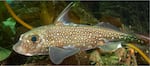
This undated, provided photo shows a male spotted ratfish swimming in its natural habitat. University of Washington scientists recently discovered that a structure males use for mating that is located in their foreheads is lined with teeth that grow outside of the jaw.
Tiare Boyes / University of Washington
To say spotted ratfish are unusual is an understatement. Related to sharks, they abound in the inky dark depths of the Puget Sound. Armed with a venomous fin, they swim gracefully along the sea floor trailing a long, pointed tail half the length of their bodies, with green, glowing eyes hunting for mates or prey to crack open with their beak-like mouths.
And if all that wasn’t weird enough, they are now the first animal documented to have teeth growing outside of the jaw, according to new research led by a team of scientists at the University of Washington.
Scientists have known for some time that male spotted ratfish have a club-like, barbed structure between their foreheads they use during mating to grasp females and intimidate reproductive rivals. But they didn’t know if the sharp barbs that ring this structure were actually teeth or denticles, tiny, rough projections that cover sharks’ skin. So they caught hundreds of specimens to study them at various stages of development, from embryos to adulthood and used 3D X-ray imaging to solve this mystery.
Karly Cohen is a post-doctoral researcher at Friday Harbor Labs at the University of Washington and lead author of the recently published paper documenting this research. She joins us to share her findings and how they might expand our understanding of the evolution of teeth, and their purpose, to not only feed but to mate.
Note: The following transcript was transcribed digitally and validated for accuracy, readability and formatting by an OPB volunteer.
Dave Miller: From the Gert Boyle Studio at OPB, this is Think Out Loud. I’m Dave Miller. We turn now to a fascinating fish that lives in the dark depths of the Puget Sound. Spotted ratfish have venomous fins, glowing green eyes and pointy tails. Males also have a club-like structure on their foreheads. Until recently, scientists did not know if the sharp barbs that ring this structure. were teeth or something called denticles, like the tiny, rough projections that cover shark’s skin. But now they have the answer – they are, in fact, teeth.
What does this mean? Karly Cohen joins us to answer that and more. She’s a postdoctoral researcher at the University of Washington’s Friday Harbor Labs and the lead author of this new paper. Welcome to Think Out Loud.
Karly Cohen: Hi, thanks for having me.
Miller: What is a spotted ratfish?
Cohen: A spotted ratfish is a local fish here in the Pacific Northwest. It’s a cousin of sharks and rays, but they diverged from that group about 400 million years ago. So they’ve been on their own trajectory ever since.
Miller: Why are they called ratfish?
Cohen: They’re called ratfish for a few reasons. I think you also called them ghost sharks, which is another great name for them. But they share some rat-like features. They’ve got this nice fused beak, which kind of looks like those ever growing incisors that you see in rats, and they’ve got this long whip-like tail that also rats have.
Miller: How did you get interested in these fish?
Cohen: I started my PhD at the University of Washington in 2018 and was lucky enough to see them in person then, and they’re just so spooky. I grew up on the East Coast. I had never seen a ratfish before and this was just such a bizarre creature to me. As I became more and more interested in the tools that organisms use when they swim around their environments foraging and things like that, the ratfish became more and more interesting, especially when you look at that large, venomous spine and this weird tenaculum on their foreheads.
Miller: Tenaculum. OK, what is a tenaculum? What does it look like, first of all?
Cohen: It’s like this giant club that sticks out of their forehead and it’s covered in teeth that look like cat claws. When they’re little though, it just looks like a pimple on their forehead, like a little whitehead that just won’t go away. And it grows into this much bigger structure.
Miller: Before you did this research, how much did scientists know about these structures, these tenacula? Is it tenacula or tenaculums?
Cohen: Oh, I think it’s tenacula. I think that’s the proper way to say that. So ratfish are really deep, and deep sea sharks and deep sea fishes in general are hard to study. We don’t get access to them so easily. It’s hard to view them in their environment and it’s really hard to get them from when they’re really small to really large.
But here in the San Juan Islands, we actually have a really rare opportunity. Because the ratfish comes into the shallow waters of the channel to lay their eggs. So through trawling and things like that, we were able to see and study them really up close for the first time. And that’s how we found this really important discovery that what’s adorning their forehead aren’t just denticles, like any other shark, but they’re teeth.
Miller: What’s the difference between a denticle and teeth?
Cohen: It’s a great question and one that I think many of my colleagues will ponder as we keep going forward. But denticles are like those small tooth-like structures on the backs of sharks. They’re toothlike, but they’re not quite teeth. Because what teeth need is a dental lamina or some sort of source that’s letting them regenerate. So we have our baby teeth and they fall out, and they’re replaced with our big teeth. And those adult teeth are brought in by the dental lamina in part.
And sharks have a continuous dental lamina. It allows them to churn out hundreds of teeth over their lifetime. The sea floor is literally littered with the teeth of fishes and sharks that lived millions of years ago. That’s how important the dental lamina is to having these kinds of structures. And what we found in the ratfish head was that the tenaculum wasn’t just in their jaws, but the dental lamina was on their forehead.
Miller: Am I right it’s just a male ratfish that has these?
Cohen: Yeah, it’s just the males. They use it actually in mating. So sharks have claspers on their pelvic fins that are their reproductive organs and they’re often covered in denticles. But the male ratfish has this clasper that he basically uses as a love bite to kind of latch and grab on to females as he’s mating.
Miller: So how did you do this work? You said, first of all, you were helped by the fact that in the shallower Salish Sea, you were able to actually get access to these fish. What did you do?
Cohen: We go out trawling to catch them. And we’re able to catch them from when they’re very small, even in their egg sacs, all the way up to being very, very large. And then, to look at the tenaculum, we had to use some tools that let us actually see inside the fish.
So one of those is micro CT scanning. It’s very similar to a CT scan that you might have gotten at a doctor’s appointment at one point. It basically takes a series of X-rays and makes a three dimensional image that lets us see into the fish itself, rather than having to dissect things away and kind of destroy the sample.
We also looked at the gene expression at different stages and we even toyed with some ROVs, some remotely operated vehicles, to try to find the earliest sizes of these ratfish.
Miller: And all of that together told you that these are in fact teeth and not the denticles?
Cohen: Yeah, all of that information let us kind of discern different bits of information. The CT scans really showed us how the teeth grew into that club-like structure. Sharks are kind of known for this big grin of teeth and they’re replaced almost like on a conveyor belt. They’re just constantly turning them out, these individual sharp, great white jawed looking teeth that have this weird overlapping structure. And you can see the scars of that conveyor belt and the CT scans let us see the same thing. It saw that conveyor belt of teeth coming around and building through.
Then the gene experiments let us connect these structures to this wider variety of teeth. When we think about key innovations or structures that vertebrates have for navigating the world around them, teeth is one of the most important. Our molars allow us to chew things more efficiently. And because teeth are so important, it actually has turned out that they’re united by this genetic toolbox. So the same kinds of teeth that are in snake fangs, that make our molars, and now the teeth on the ratfish, are the same.
Miller: So it’s really as opposed to like parallel evolutionary processes that led to something similar, even though they’re different chemically. You’re saying my tooth is not that different than a shark’s tooth or a snake’s fang?
Cohen: No, it’s not. It’s actually developed using this very conserved genetic toolbox.
Miller: Are there other examples of animals that have teeth growing outside of their jaws?
Cohen: No. This is the first time we’ve been able to record something like this, period, where it’s true teeth outside of their jaws.
Miller: So, what do you see as the evolutionary significance of this finding?
Cohen: We were lucky enough to take a look at some fossils. One of my collaborators, Michael Coates, who’s an author on the paper, has the Helodus simplex fossil. We were able to see just how it looked in evolutionary history. It looked more like shark teeth. And so did the jaws, too. They all had these individual tooth-like units. And the modern ratfish obviously has a beak and this very separate sharp barb-looking tenaculum.
So I think what it tells us, evolutionarily, is just how flexible something so important can be. These teeth that are so crucial for feeding can, over eons, evolve and adapt into this reproductive structure that they’re now using for mating.
Miller: What are the populations like right now of these fish? I’m so used to hearing about threatened or endangered species. What about these spotted ratfish?
Cohen: For a shark, and just in general, they’re doing quite well. They’re one of the most abundant species we have in the Pacific Northwest, specifically up in Washington. You can look back at NOAA databases and you’ll see that they pull them up in the tens of thousands. Divers and fishermen will always tell you just how frequently they encounter them or they’re snagged in nets just because they are so spiky and so sharp.
So their populations are doing quite well, which also gives us kind of a rare opportunity. In terms of sharks and shark species, we not only get to see a deep sea one, but we get to study one that’s population is doing quite well.
Miller: Why is it doing so well?
Cohen: That’s a great question. For a fish that’s really abundant and has been around for a while, we don’t have a great understanding of their natural history yet. But it’s something that we’re working on. With money funded from the Save Our Seas Foundation, we’ve actually been looking into their population dynamics, and trying to figure out where they’re breeding, making their babies and laying their eggs.
Miller: What else do you want to learn next about these fish that have so captured your attention?
Cohen: We’ve given a lot of attention to the males because they have that prominent tenaculum structure. But one of the weirdest things we saw in the study was that females sometimes have a little tenaculum too. We noticed it first while fishing out on trawling vessels, that some of these females would have a pimple on their forehead. But it never turns into anything else.
You can see it in museum collections and even in old aquarium databases. When aquarists were writing down notes, females will develop just a little bit of a tenaculum. So I’m very curious how this structure that seems to be almost like sexually derived towards males, helping for mating, would show up even a little bit in the females and what’s going on with them there.
Miller: Do you want to try to see if you can induce that by giving male ratfish hormones to female ratfish?
Cohen: It would be a very interesting thing to do. I think we’d first have to see how the tenaculum responds to hormonal growth. We have some idea that it might. It seems to grow more with other reproductive structures, but it definitely would be fun to see if we could make a female ratfish have a male tenaculum. It would be interesting.
Miller: Karly Cohen, thanks so much.
Cohen: Yeah, thanks for having me.
Miller: Karly Cohen is a postdoctoral researcher at the Friday Harbor Labs at the University of Washington. She joined us to talk about the new paper she was the lead author of that found that these spotted ratfish have teeth growing on their foreheads.
“Think Out Loud®” broadcasts live at noon every day and rebroadcasts at 8 p.m.
If you’d like to comment on any of the topics in this show or suggest a topic of your own, please get in touch with us on Facebook, send an email to thinkoutloud@opb.org, or you can leave a voicemail for us at 503-293-1983.