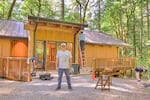
The nonprofit Friends of Tryon Creek is opening on Sep. 20, 2025 a new education pavilion to provide year-round programming, including field trips, day camps and community events at the Tryon Creek State Natural Area in SW Portland. Friends of Tryon Creek executive director Gabe Sheoships poses for a portrait on Sep. 13, 2025, outside of the new pavilion which features a design based on traditional plankhouses used by Indigenous Northwest tribes for potlatches, ceremonies and other events.
Sheraz Sadiq / OPB
As first reported by Oregon ArtsWatch, a new education pavilion is opening on Sep. 20 at Tryon Creek State Natural Area, located in Southwest Portland, near Lake Oswego. The new education center allows the nonprofit Friends of Tryon Creek to hold community events and educational programming year-round for students to gather for classes, day camps and field trips inside the roughly 660-acre day use area.
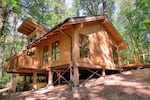
The nonprofit Friends of Tryon Creek is opening on Sep. 20, 2025 a new education pavilion to provide year-round programming, including field trips, day camps and community events at the Tryon Creek State Natural Area in SW Portland. This photo taken on Sep. 13, 2025, shows a view of the pavilion which was built to resemble plankhouses used by Northwest Indigenous tribes. A total of six western red cedar lodge poles were used to build the roughly 2,900-square-foot structure.
Sheraz Sadiq / OPB
Friends of Tryon Creek is also leading the fundraising and construction of the $2.6 million education pavilion, which was built on the forest floor and features a design based on traditional plankhouses used by Indigenous Northwest tribes as communal gathering spaces for ceremonies, potlatches and other events. Four Indigenous Northwest artists have also been commissioned to create artwork that will be put on permanent display inside the pavilion. Six western red cedar lodgepoles were sustainably harvested from local forests and used for the new construction, along with bluestone that was used for the interior hallway to represent Columbia River basalt preserved in the landscape.
Friends of Tryon Creek executive director Gabe Sheoships is Cayuse and Walla Walla and a citizen of the Confederated Tribes of the Umatilla Indian Reservation. Artist Shirod Younker is Coos, Miluk, Umpqua and a citizen of the Coquille Indian Tribe. They join us to share how they hope the new education pavilion will help students and visitors appreciate the pre-colonial history of Tryon Creek and the surrounding region.
Note: The following transcript was transcribed digitally and validated for accuracy, readability and formatting by an OPB volunteer.
Dave Miller: From the Gert Boyle Studio at OPB, this is Think Out Loud. I’m Dave Miller. Tryon Creek State Natural Area in Southwest Portland is about to debut a new building. The grand opening for the Education Pavilion is this Saturday. Its design is based on traditional plankhouses used by Indigenous Northwest tribes as communal gathering spaces. It’ll feature work from four Native artists. The project was led not by the state but by the nonprofit Friends of Tryon Creek, which will now be able to expand its educational programming for students and community members.
We went to the park earlier this week for a preview. Gabe Sheoships met us inside the new pavilion. He is the executive director of Friends of Tryon Creek and a citizen of the Confederated Tribes of the Umatilla Indian Reservation. I’d seen Gabe describe the new building as a living land acknowledgement, a phrase I don’t think I had seen before. I asked him what it means.
Gabe Sheoships: So in our education, we often start with the land acknowledgement or ground in the land acknowledgement, and we work with thousands of kids every year. And sometimes we see this not being translated as easy working with youth. We’re talking about histories of colonization, of change, adaptation. So this building represents the original architecture of Western Oregon, with similar materials in a similar plankhouse design for the cedar exterior, but also with lawn house elements related to the roof. And then the arts and the fireplace are all interconnected as cultural aesthetics that will add to kind of telling the story of the original peoples of this area.
Miller: I want to hear a lot more about this building, why it’s here and your hopes for it, but maybe we can start by hearing about this land itself. For people who have not been to this land, it’s now called Tryon Creek State Natural Area. Can you describe it?
Sheoships: Yeah, great question. I think the Tryon Creek State Natural Area, as the land is now known, is really representative of a temperate rainforest in the, I think, lower Willamette Valley. So land, now, of diverse peoples, diverse Indigenous peoples, but really Chinookan land, Clackamas Chinook and whose descendants are in a few different tribes.
But just in our work with our tribal artists and partners, I think just recognizing the long history of trade in the Portland metropolitan area and that’s kind of the theme for this space: tribes coming together, trading. We have four artists that each represent different tribal nations. And the classrooms themselves are pointed at one another to kind of represent two tribes trading.
But our forest now is lush and beautiful …
Miller: As you describe that, can we walk out because we’re in this vestibule with the classrooms on either side, but then through this door here, we can come out to this patio overlooking the gorgeous woods. So I mean, what do you see here?
Sheoships: So I see a very young, mixed forest, this space, but also a temperate rainforest with connections up north and a little bit south of us. I think fir-dominant. This was once old-growth Douglas fir, Western red cedar, which is a cultural keystone of this area. We have a lot of big leaf maple now and a fairly healthy forest understory, kind of large mature trees. And these trees in the human scope are fairly young, probably 100 years or less. We have some smaller trees that are both younger and then some trees, like vine maple and hazel, that don’t get super big anyway. They’re kind of considered smaller trees.
And then we have a lot of native plants at the shrub level: sword fern, Oregon grape, different red huckleberries, thimble berries, service berry, elderberry. And at the ground level, we have some Pacific water leaf. But in contemporary times this forest is mixed with non-native visitors, so plants that come from different areas that have hitched a ride or been brought here intentionally by European settlers and do quite well in the Willamette Valley. So a part of our community ties and our legacy here is we have an active community of land stewards that come and tend to land, pull and remove English ivy, remove Himalayan blackberry, things like garlic mustard – very common non-native plants in this area that really just kind of thrive and do their thing.
In this area in particular, I don’t see a whole lot of this has been a focus of restoration efforts. So what we’re looking at is a lot of Native understory and a lot of plants that are still valuable to tribes today. Western red cedar, which is kind of a cultural keystone, from what I’ve been told for Western Oregon tribes, clothing, tools and very importantly, travel canoes. So my peoples – the Cayuse and Walla Walla of the Confederate Tribes of Umatilla – were horse peoples. [They] had adapted to using horses and traded with the Spanish, starting in the 16th century, and still have a long culture of navigating and transport through using the horse … in Western Oregon, predominantly canoe.
Miller: What does it mean that this natural area, this park is, we’re not in the middle of Portland, but we’re absolutely in the middle of the Portland metropolitan area, and yet it’s here, hundreds and hundreds of acres?
Sheoships: That’s the beautiful thing and that’s why it’s such a special place. It’s an urban state park completely surrounded by roads and residences, but you can get lost in the park, in the forest and find yourself feeling like you’re in the gorge or in the coast range, or in another place that is relatively intact and you’re able to look up into a forest, into a tree canopy and just feel completely surrounded by all living plant relations.
It’s really beautiful and it’s becoming more accessible through transportation, through the TriMet bus system, but we really believe everybody should have access to a space like this, just numerous health benefits. The Japanese call it forest bathing, just recognizing your stress levels reducing, just walking, breathing fresh air, thinking about things like no noise pollution – all elements that I think the modern, urban life you know really throws at you.
Miller: What was here before this new pavilion?
Sheoships: Our new pavilion is built on top of a 1975 era, a wooden shelter, kind of a gazebo that was named after Glenn Jackson, who was an important state official, Oregon Department of Transportation, and who actually worked with the founders of our Friends group, Lucille Beck and Jean Sidal. [They] led a group of about 300 women, who worked to prevent this place from being developed.
So they went door to door, they did, very 1969, 1970 era fundraising tactics, going door to door asking for donations, things like bake sales and ended up raising about $27,000. They then partnered with the state – Glenn Jackson was at a table – to create this as the only urban state park. So it was really born from the Friends group and this group of 300 women from the neighborhood who stood up and didn’t want to see this place be developed, in the late 1960s.
Miller: You said it was a gazebo. That makes me think that it was just fully open, a roof but no walls?
Sheoships: It was fully open and it was Douglas fir. It was pretty well made, but it was a gathering space, a program space for students. It was just this being a pretty intense forest with, there’s a few open areas, parking lots, a few buildings, mostly [it] being trees and trails. It was kind of a hub, it was a place you could access. At most times, it was a public place, completely open.
Miller: What are you gonna be able to do now that you couldn’t do before?
Sheoships: So now we’ll be able to serve youth and families, really year-round. And we’ll be able to do more programming, engage folks with cultural environmental education here. We have a lot of camps, so nature day camps, that we’ll be able to have a climate-controlled facility with modern AV and teaching tools. But we also have a vast field trip program where we serve mostly K-5 students from all over the region. And those are pretty limited to when it’s fairly decent weather, which obviously here in Portland, there’s quite a bit of precipitation, some really hot days in the summer.
So this is completely protected from the weather and will allow us to do more programming throughout the year, where folks will be able to observe seasonal changes and allow us to do more repeated programming. So bringing students back at different times throughout the year to kind of ask them how to observe the changes and to think about how the forest looks at different times in the year, and why that is so.
Miller: What was the design process like? I mean, how did you all figure out what was most important to include in this new building?
Sheoships: That’s a great question. So it was a kind of a design build. It was a little bit of a more open process. We went to many of the communities we served and kind of asked what folks were looking for. We serve a lot of groups that don’t come from the immediate area. We do serve plenty of our neighborhood folks, plenty of our neighbors, but we serve the whole metro area. So school groups that are coming from East Portland, from Beaverton, Hillsboro, Canby, Wilsonville.
They generally want a place to have lunch, a place where students can sit down and rest a little bit, and have lunch when it’s raining. This space will provide for that. We heard a lot that folks want to … as folks are traveling, as this is the only urban state park, having a place with some inside amenities, but it was also easily accessible to the forest was something that folks desired.
And then we really heard from tribes, tribal partners. And had this opportunity to represent the Indigenous architecture of the space, so a plankhouse with cedar planks, having mature Western red cedar logs as kind of the backbone of the structure. Prior, we had one classroom space, it’s a little bit small. I mean, we’ve been able to make do, but it houses about 23 kids comfortably. So this will triple our space.
Miller: What were the challenges of just physically building this?
Sheoships: Oh, great question. I think, from monetary resources to fundraising from scratch to build this, from inflation … But also, we set out to build this with the forest in mind, so protecting tree roots. We removed over 100 native plants. They’re sitting in storage right now, they’re going to come back to the space. So building with respect to the space, building around mature trees, around their roots, around small shrubs.
Several times during the building process, we’d have nesting birds kind of move in pretty quickly, but I think the sound and the noise, they soon found their way out. So we’re building in a living, intact ecosystem and we’re not kind of conquering it, we’re not bulldozing our way through, but we made a very strategic effort to build within the forest. And the wooden materials will represent the living forest that will obviously grow up around us.
So this building is really meant to complement the forest base and not to kind of stand out or take precedence over it. I think that just kind of aligned with our organizational mission, also our cultural values. The space, for example, the foundation is pretty minimal. We’re using a lot of wooden decking that stands above the soil, doing a lot of remediation and care of the soil, planning for the rain and how to work with that, and to push all the rainwater into the creek where it belongs. It’ll also be, along the way, kind of filtered through the forest itself.
So we took a lot of steps there, and worked with the government and different municipalities to make that happen. The cedar siding became an issue at one point and that’s kind of a cultural aesthetic that we couldn’t really budge on. I think at one point we were propositioned we should do it as kind of a shed-like siding and that’s more of the integrity of the building. So we kind of stood our ground there and found a compromise.
Miller: We’re in the middle of this state’s natural era, but am I right that public money was not the main funding for this project, that two-point something million but mainly privately raised?
Sheoships: Yeah, $2.6 million. And we as the Friends group, myself and our team raised that money. But we got a mix of private and public grants. Individuals, family foundations all came together. We had initial funding from the American Recovery Act in 2021 and that was kind of our first initial funding that set us off to get started. And like everything else, costs increased and we ended up needing to raise about 10 times what the initial amount was.
But I think the architecture team, the design team, the construction team, our team of tribal artists, captured this space [and it] came out amazingly well, as really as well as it could have been, and far nicer than we imagined with the modern interior, with the cultural touches.
Miller: My understanding is you have four different Native artists who are all contributing different components to this building. And one of them, I think, is working beneath us right now. Can we go find him?
Sheoships: Let’s go. Yeah, he’s, his Coquille name means “Sasquatch In The Forest,” I believe.
Miller: Hi there.
Sheoships: Shirod, this is Dave Miller. This is Shirod Younker.
Miller: Good to meet you. So what are you doing today?
Shirod Younker: Well, other than … well, I’m trying to carve, right? I’m trying to carve to what I have in my head, which is probably not great. So that’s a struggle.
Miller: What are you trying to carve?
Younker: There’s what I draw on paper, what I have in my head and then there’s what I can do, right? Sometimes my ambition is a little more than my ability. So I’m trying to get it to where it’s acceptable to me. I’m just taking off wood and hoping I don’t take off too much, so I can get to where it looks good, at least to myself.
Miller: There’s something terrifying to me ... I mean, when I cut things, it’s digital. It’s all reversible, but you’re working by subtraction and if you cut something, it’s gone.
Younker: Yeah, that’s exactly it. So you start second guessing all your cuts. And then sometimes you take off too much, and then you figuratively carve yourself into a corner and got to figure out how to make it, I guess palatable for yourself and potentially the audience that will see it.
Miller: We jumped right up into the nitty gritty of the craft here, of the work, but what’s your vision? What do you want people who come here in the coming years to see?
Younker: Most importantly, not so much my artwork, but the space in itself is the most important thing. And for people to be able to go into that space and be inspired by the building, so that they’ll wanna make art or want to learn about the environment, which at least an hour away. Our art informs us of what those values are and what our foundation is, which is the environment. You can’t be inspired by nature and not put in work to take care of it, right?
So I make art when I can and I use materials that are natural when I can, but I also have to remember that, hey, I’ve got to make sure that we still have this stuff. We still have these materials, we’re still taking care of this stuff and follow through with the covenant that our ancestors made with the environment. And so our artwork is supposed to inform our population of that, so that we can continue to live here.
Miller: Why did you want to be a part of this overall project?
Younker: Oh, just, I love this space. I don’t live too far down the road, but when my daughter was younger, we used to go on walks and hikes and take our dogs through here, and it’s a wonderful space in the city. So of course, when Gabe asked if I wanted to contribute to this, I wanted to. I mean, what a fun project to be a part of.
Miller: My understanding is that you’re making what’s called a house post for the south side of this pavilion. What is a house post?
Younker: So the interiors of our plankhouses or longhouses would usually have the carvings, if there were any at all, not necessarily the exterior, like up north. So sometimes a house post would be carved with designs or sometimes it would be plain, but a house post is something that holds up, like the ridge pole that holds up the roof or hold up other beams that you can set the sides on. So house posts are pretty important. There’s usually two main ones that are on the opposite ends of the building and sometimes those would be carved, and that’s what I’m trying to do here.
My tribes are from the south. So I’m originally from Coos Bay and I’m enrolled with the Coquille Indian Tribe, but I’m also Coos and Umpqua. We’re gonna put this on the south side of the building and then the other artist, Greg Robinson, his piece will be on the north side of the building. He’s from a tribe north of here. He’s Chinook. So the idea is that there will be a conversation between the two pieces and kind of a nice metaphor for what the building hopefully will be, where people from different backgrounds and ethnicities can come in and exchange ideas, but make and learn all together as a collaborative.
Miller: I like the idea that the work will be in conversation. Have you been in conversation with Greg, as artists, as you’ve been working on this?
Younker: No, absolutely not! No way. [Laughter] No, no, I mean, we see each other, but we’re not … I mean, other than asking how tall our pieces are gonna be so we can make ours just a little bit taller than the other one … But no, no, no, no. So I think that’s the fun part. You don’t know.
Miller: Oh, I thought you were kidding. You really haven’t been comparing notes or saying, this is what I am doing?
Younker: No, no, no. I told him mine was going to be 8 feet tall, so he said his was going to be 8 feet, 2 inches.
Miller: How tall is yours actually gonna be? He’s not going to hear this.
Younker: I have no idea.
Miller: Really?
Younker: Well, I know that roughly it’s 8 feet.
Miller: Right.
Younker: But if it’s off by a couple inches, I don’t know. I don’t actually know, we’re joking around. So I’m not exactly sure what Greg’s inspiration was for his piece, but we didn’t look at each other’s pieces before we started. We just know it was like, you do a house post, I’ll do a house post.
Miller: And what are your particular inspirations?
Younker: I like the idea of trade. So like, if my people were up here, they were either up here to trade or they were the trade item themselves – which is pretty scary, but that’s the concept. So it’s a figurative piece, but it’s got pieces in it that will represent obsidian, as well as the currency in which we use, or traditionally had used, like a long shell. It’s called a dentelium, which is a white shell that, for whatever reason … it’s everywhere in the world, but only the tribe off of West Vancouver Island had figured out how to gather it. So it became this kind of currency in which you could trade, or used to purchase things via its size.
Of course, the smaller it is, the less it’s worth. And the bigger it is, the more it’s worth. So all the way down to Northern California, all the way up in Canada and inland too, in Montana, it was used as a currency. So that’s gonna be a leg on the piece here. And then on the other side the half will be the essence of obsidian wealth blade or a ceremonial blade that most of the tribes here in Western Oregon used.
That’s the idea. So hopefully, that’s what people will see. And if not, then I’ll have to change my story. If the carving is horrible, then I’ll figure it out. [Laughter]
Miller: It was always meant to be something else.
Younker: Yes, yes, exactly. That’s what the wood will tell me it wants to be, right?
Miller: We’re talking on Tuesday. The opening ceremony is Saturday. Are you ready?
Younker: Oh no.
Miller: Will you be ready?
Younker: Absolutely not. Nope. I know Gabe is pushing me to be ready, but no, no, I will not. The closer you get to finishing, the slower it becomes. So, I’ll have a little piece up there, a small piece, a proxy piece just sitting up there, but I’ll be probably working on this for a while, until I can get it right. I think the most important thing is that I get it right as opposed to have something up there and show how bad a carver I am.
Miller: Well, that also makes sense that this is not about Saturday. This is about the years or decades to come. What are you hoping that this new building will mean for people in the coming years?
Younker: I hope that young people will come here and will be able to express what we want them to know about this environment, so that they’ll begin to love it. And that being said, when they love it, then they’ll want to protect it or take care of it. That’s what I would like to see happen, so that it’s just more than a building that a few artists got to put their artwork up in. Cause it’s really not about us or the artwork, it’s really about the next generations or the people that are going to be using it, right?
Miller: And Gabe, what about you? I mean, if you close your eyes and you imagine what this building will mean to people, will put out into the world in the coming decades, what do you see?
Sheoships: Yeah, similarly, I think the more people that are able to access this place, I think more people will care about this forest, then go on to wherever they journey in life and have a connection with the natural world, with first foods, with trees, with plants, with all living things. And ultimately, kind of come back and wherever your life takes you, as you have that connection, you’re able to maybe make better decisions on behalf of the environment.
As Shirod alluded to, this is a responsibility, a covenant or a promise, however you wanna put it, that’s bestowed on everybody to care for places like this. This building will give a space for gathering, a space for communion, a space for playing, a space for making friends, a space of connection that would then be a gateway to this larger forest, and many others throughout the region and really the world.
Miller: Gabe and Shirod, thanks very much.
Younker: All right, thank you.
Sheoships: Thank you.
Miller: Gabe Sheoships is the executive director of Friends of Tryon Creek. Shirod Younker is a Coquille, Coos, Umpqua artist and educator.
“Think Out Loud®” broadcasts live at noon every day and rebroadcasts at 8 p.m.
If you’d like to comment on any of the topics in this show or suggest a topic of your own, please get in touch with us on Facebook, send an email to thinkoutloud@opb.org, or you can leave a voicemail for us at 503-293-1983.