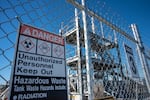
Caution signs warn of radioactive materials at the Tank-Side Cesium Removal (TSCR) System process enclosure outside AP Tank Farm on the Hanford Nuclear Reservation, in this photo on September 24, 2024. The Tank Farm will be used as a staging place for the all the tank waste that will be fed into the Waste Treatment and Immobilization Plant for vitrification; it will be the last farm cleaned up at the end of the tank farm cleanup mission.
Courtesy Annie Warren/NWPB
The Hanford nuclear reservation in Southeastern Washington was the epicenter of plutonium enrichment during WW II and through the Cold War. For more than 20 years, an effort to safely dispose and store 56 million gallons of radioactive waste stored at the site has been in the works. The vitrification plant would turn some of that waste into glass logs. The opening of that waste processing facility -— which has now cost $30 billion — was thrown into doubt earlier this month, but the Department of Energy is now allowing the project to move forward and the first glass logs are expected to roll out as soon as next week, ahead of the October 15 deadline. We get the latest from Anna King, correspondent for Northwest Public Broadcasting and the Northwest News Network, who’s been covering Hanford for the last 20 years.
Note: The following transcript was transcribed digitally and validated for accuracy, readability and formatting by an OPB volunteer.
Dave Miller: This is Think Out Loud on OPB. I’m Dave Miller. The Hanford Nuclear Reservation in Southeastern Washington was the epicenter of our country’s plutonium production during World War II and the Cold War. Then in 1989, its mission changed from enrichment to cleanup. Part of that cleanup involves something known as the vitrification plant, which is supposed to turn millions of gallons of radioactive waste into glass logs. The opening of that waste processing facility, which has now cost $30 billion, has been delayed time and time again, but it seems like it is finally about to happen.
Anna King is a correspondent for Northwest Public Broadcasting and the Northwest News Network. She has been covering Hanford for the last 20 years, and she joins us now with an update. Anna, it’s great to have you back.
Anna King: Good morning, Dave. Great to be here.
Miller: There were some just confusing couple of days earlier this month. With the planned start of this plant right around the corner, news broke that the Trump administration was going to go in a different direction. And then right after that came opposite news that the Vit Plant was, in fact, still on. So what happened?
King: Yeah, so Washington Senator Democrat Patty Murray basically sounded the alarm a couple weeks ago and then she said that the head of the Federal Energy Department was casting doubt as if the massive plant would ever go live. And this could have ended in a $30 billion boondoggle, Dave. Most of Washington’s U.S. senators spoke publicly about their alarm over this. This is Senator Maria Cantwell on the Senate floor:
Senator Maria Cantwell [recording]: I know that we must continue our obligations at the facility. I know that we can’t walk away from this commitment. I know that the vitrification process has been proven scientifically, and unless there is a problem at this plant, we need to move forward with the production that people have been counting on for years.
King: Again, that was Maria Cantwell. And she, along with Washington’s governor, was also threatening legal action at a press conference in the Tri-Cities on September 12. But then the Energy Department seemed to change course and say that the plant was still going to go on in some terse written statements after these events.
Miller: Well, after all these delays in the past, does it seem like this is finally for real?
King: Dave, it’s almost countdown time and in less than 20 days, we’re going to know whether it went live or not. If it meets the legal deadlines called the Consent Decree, that new version of that document is what used to be called the Tri-Party Agreement, they’re going to have to start hot commissioning on October 12.
Miller: Can you put this in perspective? I mean, how significant is it that this plant is finally about to open?
King: And I’m sorry, I misspoke. That was October 15, but to answer your question that you just asked, I’m just like a small player in this whole story. But Dave, I’ve reported on this for 20 years. It’s nearly 20 years of my life that I’ve watched the major twists and turns of this plant. And through countless meetings on nuclear waste and seeing high-level federal hearings on this plant, it just definitely feels like a moment right now.
Miller: Can you remind us what this low-level vitrification plant is actually going to do?
King: This plant is mammoth. Dave, think about downtown Portland buildings and then think about that this plant spans city blocks. The whole campus is 65 acres. It just feels like a downtown city when you’re there, but it’s all in the middle of sagebrush and Washington’s desert. It’s gonna pipe in low level waste from tanks and then pour it into a melter, heat it up into a big goo, add glass material in there, stir it all up, and then pour it off onto these containers of waste that are more than 7 feet tall and 4 feet wide.
Miller: I should say, as a little teaser, that this coming Tuesday we are going to …
[Dog howling in the background. Dave laughs.]
King: I’m sorry.
Miller: Is that a dog?
King: Yeah, I’m sorry, that’s my Aussie. She’s supposed to be quiet.
Miller: Dogs are excited about the vitrification plant, too. I do not blame your dog.
But I was just saying that on this coming Tuesday, we are going to be listening back to some of the conversations that we had almost exactly a year ago when we took a tour of the vitrification plant to talk to the then leader for the DOE of cleanup efforts, along with other folks.
What’s the timeline now for completing the transformation of 56 million gallons of tank waste into glass logs or other things?
King: Some of that waste will be bound up with what’s called grout. It’s kind of a concrete-type material. And then some of the waste will be bound up in what are these glass logs, and they’ll be stored at Hanford forever in these metal canisters. Some waste will be vitrified later and that is called the high-level radioactive waste plant. That plant is not online yet. This is all going to take about 40 years. The high-level plant is supposed to be ready in less than 10 more years – that’s 2033. It’s all a very big project, Dave. It just takes a long time to do this work.
Miller: Now, the glass logs that could start any day now, they’re still going to be radioactive. Where are they going to be stored?
King: These glass logs are really radioactive and they’ll be stored in a secure facility, and that’s called the Integrated Disposal Facility on the Central Plateau of Hanford. That just means in the middle of the Hanford site. The high-level waste was supposed to go into Yucca Mountain and that’s defunct now. So there’s no national repository at this point to accept that higher level waste.
Miller: OK, so this current Vit Plant is only going to be for lower level waste.
King: Yeah, that’s correct. So that will be the bulk of the 56 million gallons of radioactive sludge and waste held in underground aging tanks at Hanford. That’s the bulk of it, but this high-level waste, which does have more radioactive constituents in it, that waste is not going to be treated quite yet.
Miller: Right. As you said, that would be sometime after 2033. This plant alone, though, costs $30 billion. What’s the current estimate for the comprehensive cleanup cost?
King: The whole cleanup cost for all of Hanford is $360 billion with a “B,” or it could cost as much as $589 billion on the high end.
Miller: More than half a trillion dollars. Do you have any sense for the current congressional appetite to keep that money flowing?
King: I know through their statements and through their staff that Senators Murray, Maria Cantwell and U.S. Representative Dan Newhouse all think Hanford is a really top priority. But the trouble is they have to keep telling that story over and over again to new administrations and to the new congressional members who also have other high priorities in their states. So it’s kind of a fight to tell the story, really, to keep Hanford on the top of the list for federal funding.
Miller: Can you give us a sense for what this soon-to-be operational plant means for the local economy and for jobs in Richland?
King: OK, so there’s like 3,200 people working on the waste treatment plant that we’re speaking about. A thousand of those are union craft professionals like contractors, operators, maintenance people, really high paying jobs. And then every day, just a little ways from my house, there’s this eight-lane highway, Dave. It’s called the bypass out here and it has four lanes going toward Hanford. Those four lanes look like I-5 rush hour and that happens at like 4:00 to 5:00 and 6:00 in the morning. All the workers get to work at 6:00 or 6:30 in the morning and that’s 30 minutes outside of Richland, so they have to get started early.
And then more office workers drive in from across the region to federal buildings and contractors in North Richland and across Central Richland. Then, Hanford as a whole employs 10,000 people. And these are all highly paid executive or union jobs and all these people eat, all these people might have to dry cleaning, watch movies, hire plumbers. So although the Tri-Cities has a large diversity of jobs in agriculture and the trades, Hanford still makes this town go.
Miller: A huge infrastructure of federally-funded scientific research has been built up in Richland and in Hanford over about 70 years. A lot of the folks that you’re talking about there, these are their jobs. And it’s more than just plutonium enrichment, once upon a time or cleanup now, there’s also the Pacific Northwest National Laboratory, the LIGO Observatory. Have federal research cuts had an impact on the Tri-cities?
King: They certainly have. I did call the Pacific Northwest National Laboratory for you and LIGO, and I tried to get a little bit more information here for you. Unfortunately, all the lab would tell me is, yes, there have been voluntary retirements and there have been voluntary people giving up their jobs at the lab. They also did involuntary cuts in the last couple weeks here, but they wouldn’t tell me numbers. So I’m sorry I can’t bring more to the discussion for you, but this is having an impact and these are some of the largest employers in the Tri-Cities. The Northwest National Laboratory employs thousands of scientists, high-level people, and to have that all go a little bit shaky is pretty scary in this town.
Miller: The deadline for the start of production at this low-level vitrification plant is October 15, so a little more than two weeks away. Will officials wait that long?
King: You know, the 15th is the legal deadline set out by the Consent Decree. Again, that’s that legal agreement that used to be called the Tri-Party Agreement between the state, the EPA and DOE. But now, the Department of Energy actually has to start vitrifying waste ahead of that deadline to meet the deadline and say, OK, now we’ve vitrified the waste. So we expect that plant to flip on any day now. It could even happen next week or the week after.
Miller: The timing is interesting because this thing might turn on when big parts of the federal government might turn off. Would a federal government shutdown affect the vitrification plant operation or other aspects of Hanford cleanup?
King: It very well could. In federal shutdowns before we’ve seen different things happen at DOE. A lot of times, a lot of the operations at DOE are critical operations that won’t shut down in a government shutdown, but you don’t know how this administration might carry that forward. And I asked Senator Murray, I got no response. I asked the governor of Washington and got no response. As for DOE, I got no response, Dave, so I wish I could bring more to the discussion, but I did my homework for you.
Miller: So what are you watching for next?
King: Dave, I’m on first-baby glass log watch. Like I am on this.
Miller: First radioactive baby glass log watch. [Laughter]
King: Yeah, this is going to be a 7-foot-tall by 4-foot-wide glass baby coming off the edge of that plant and delivered to the repository at Hanford. It’s going to be a big day. This is something that I’ve watched for 20 years. I am not going to miss it. Ecology says they’re going to have a cake and invite all their retirees to come back and celebrate with them. Bechtel, which is the company that builds this plant, says they’re going to have Spudnuts, which is a local doughnut here made of potato flour. It’s a really hot spot in the Tri-Cities. If you ever come through, you should go to Spudnuts. And this plant has outlasted many careers, but not mine, Dave.
Miller: Anna, it’s always great to talk to you. Thanks very much.
King: Have a good one.
Miller: That is Anna King. She is a correspondent for Northwest Public Broadcasting and the Northwest News Network. She joined us to talk about the news that any day now, the long awaited and $30 billion low-level radioactive vitrification plant is going to start operating.
“Think Out Loud®” broadcasts live at noon every day and rebroadcasts at 8 p.m.
If you’d like to comment on any of the topics in this show or suggest a topic of your own, please get in touch with us on Facebook, send an email to thinkoutloud@opb.org, or you can leave a voicemail for us at 503-293-1983.