
Each year, Sept. 30 marks Orange Shirt Day, a day when people wear the color in remembrance of federal Native American boarding school policies that forced thousands of children from their homes.
The day began in Canada to honor Indigenous children sent to residential schools. In recent years, American Indian and Alaska Native communities in the United States have also recognized the day in solidarity.

This undated image shows Native American children standing at attention in the Chemawa boys' dormitory.
Courtesy of the National Archives
Boarding schools in Oregon
Federal boarding schools were part of U.S. policy for well over a century. For generations, hundreds of boarding schools across the country housed tens of thousands of children.
These schools removed children from their families and worked to suppress their languages, religions and cultural practices in an official policy of forced assimilation.

This undated image is listed as students from the Umatilla Indian Boarding School.
Courtesy of the University of Oregon Library and Archive
In 2024, the U.S. Department of the Interior released a report identifying 417 federal boarding schools and over 1,000 additional affiliated institutions used to educate and assimilate Native American children.
The report identified 10 schools in Oregon. Some schools went by different names over the years.
- Chemawa Indian Training School (1885-present)
- Forest Grove Indian Training School (1880-1885)
- Grand Ronde Boarding School (1862-1908)
- Kate Drexel Mission Boarding School, Pendleton (1887-1937)
- Klamath Agency Boarding School (1873-1928)
- Siletz Boarding School (1873-1919)
- Simnasho Boarding School (1880-1895)
- Umatilla Boarding School (1882-1918)
- Warm Springs Boarding School (1882-1935)
- Yainax Indian Boarding School (1882-1916)

This undated image is labeled as students and nuns at the Grand Ronde Indian School.
Courtesy University of Oregon Library and Archive
Affiliated boarding schools include at least two early religious institutions operated by missionaries with federal support, including the Mission Bottom Manual Labor Training School and the Indian Manual Labor Training School, both located in Salem. The city of Salem’s public archaeology project is currently doing ongoing research into those sites.
The National Native American Boarding School Healing Coalition has compiled a more comprehensive list and an interactive map showing 526 schools across the country.
Where were the children?
A deep dive into federal reports found many other unlisted schools, often run by churches with government support.
A review of Southern Oregon’s Klamath Indian Reservation’s annual school census reports from 1930-1931 gives some specific numbers and insight.

This document shows one page of the 1930-31 Klamath Tribes student enrollments in religious boarding schools. The document has been altered for privacy.
Courtesy of the National Archives
The report states that for that school year, 56 children attended religious boarding schools, including Sacred Heart Academy in Klamath Falls, where the youngest Klamath student was just 4 years old.
Other students attended St. Mary’s Academy in Albany. In a pamphlet printed in 1971 to celebrate that church’s 85th Jubilee, it describes the boarding school’s history:
“Many of the children were Indians sent to the Academy by the United States Government, from the Southern Oregon Reservations.”
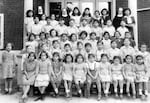
This image, circa 1940s, shows a class of Native American students at the St. Mary's Academy in Albany, Oregon. Several members of the Klamath Tribes attended this boarding school.
Courtesy of Gabriann Hall
Throughout the 1930s, Klamath Tribes students attended Catholic boarding schools in Mount Angel, Medford, Salem and Portland.

This image, circa 1900, shows St. Mary's Home for Boys, in Beaverton, Ore. Several boys from Native American tribes attended this school for "abandoned and wayward" children.
Washington County Museum
The report also includes children placed in alternative schools. Five boys, aged 8, 9 and 11 years old, were sent to St. Mary’s Home in Beaverton, a place for “abandoned and wayward” children. Another list shows three teenage boys attending a reform school in Portland.
A decade later, the 1940 report shows 45 students attending St. Mary’s Academy in Albany, including two 3-year-old girls. That same year, a 4-year-old joined six other Klamath children at Sisters of St. Mary in Tillamook.
Throughout the years, reports show that children attended Oregon School for the Deaf, the Fairview Training Center for people with developmental disabilities, and a sanitarium in Pyramid Lake, Nevada.
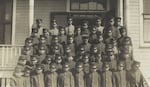
This undated image is listed as students at the Warm Springs Indian School.
Courtesy of Columbia University

Behind the scenes
This article is part of an ongoing series on “Uncovering Boarding Schools: Stories of Resistance and Resilience” airing Monday, Nov. 3, 2025, at 9 p.m.
Please visit our website for more information on the full documentary and additional resources.
