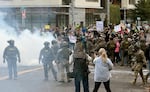
Gas is deployed at the U.S. Immigration and Customs Enforcement facility, Portland, Ore., Oct. 4, 2025.
Alejandro Figueroa / OPB
An unprecedented weekend put Portland at the center of national headlines, as President Trump continued his push to deploy National Guard members into the city over the objections of city and state elected officials and a federal judge. After his order for an Oregon National Guard deployment was blocked, Trump turned to the National Guard in California and Texas for hundreds of federal troops he could send to Portland. Late Sunday, U.S. District Court Judge Karin Immergut again sided with the state of Oregon. OPB reporter Troy Brynelson joins us to catch us up.
Note: The following transcript was transcribed digitally and validated for accuracy, readability and formatting by an OPB volunteer.
Dave Miller: This is Think Out Loud on OPB. I’m Dave Miller. We start today with a recap of a busy weekend of news that once again put Portland at the center of national headlines. On Saturday, federal agents tear-gassed peaceful protesters near the ICE building. That was after a federal judge blocked the administration from sending in the Oregon National Guard. So the administration pivoted and sent the California National Guard to the state instead, and ordered Texas troops as well. That prompted an emergency hearing last night and a new broader temporary restraining order from Judge Karin Immergut. She wrote, “I am certainly troubled by hearing that both California and Texas are being sent to Oregon, which does appear to be in direct contradiction of my order.”
OPB public safety reporter Troy Brynelson was on hand on Saturday. He’s been covering these protests for months, and he joins us now. It’s good to have you back on the show.
Troy Brynelson: Thanks for having me.
Miller: So much happened this weekend. I think we should just go in chronological order. So let’s start with the protest at the South Waterfront on Saturday. Who was in the crowd? What was the makeup of the crowd?
Brynelson: I would say Saturday was, just to be clear, pretty much an all-day affair. In the morning, you had a protest at a park nearby, and this is very much like an everyday Portlander type of crowd. And there was a slow march from the park, less than half a mile, to the ICE Facility. Then pretty quickly thereafter, federal law enforcement started trying to disperse the crowd. So that was the first instance of them using tear gas that day, pepper balls, and making some arrests.
Later, there was another show of force around 8 o’clock. For those who don’t know, typically, when a lot of the actual confrontations are happening between protesters and federal law enforcement there, it’s usually around these armed escorts that happens. A bunch of law enforcement will come out of this gated building, try to escort a car, just to come and go. In this case, rather than just try to clear the driveway – which they did initially – they also started expanding that boundary, pretty methodically.
So it was strange. It was something we had not seen before. A lot of confusion was created by this. And just to describe it, there were these lines of federal law enforcement. They would tell you to back up and then wait maybe 10-15 seconds and then they would push you down another 10 or 15 feet. So it was all the way, this methodical march down. And then once they really couldn’t push protesters very much further, that’s when they started releasing munitions once again. That was the gist of the whole event.
Miller: What was precipitating the projectiles, whether it was pepper balls or something else, or tear gas?
Brynelson: I mean, it was me and another reporter who were on scene. We couldn’t see a very clear instance that provoked this response. I think that there’s certainly an element of just general crowd dispersal, but that second one that I just described, where they were marching people down, I only noted one arrest that whole time. And that occurred before they started doing that, so we don’t fully know what provoked that.
Miller: Just to be clear, this is a really important point. From your perspective as a reporter on the scene, you were seeing federal law enforcement tear-gassing people who didn’t appear to be doing anything violent, anything wrong, following directions – they’d moved back and then they were tear-gassed.
Brynelson: Yeah, exactly. From a reporter’s standpoint, we were hearing a lot of people in the crowd just wondering what they were doing. If they were trying to provoke them into doing something, just a general large amount of confusion. And meanwhile, the Portland Police Bureau was also there, sort of just watching everything unfold.
Miller: Saturday was a critical day because basically at the same time that that was happening, there was a federal judge – appointed by President Trump in his first term, it’s worth pointing out – who ruled against the Trump administration, temporarily blocking it from sending in the Oregon National Guard. Can you give us the short version of Karin Immergut’s Saturday ruling?
Brynelson: I guess just to back up very quickly, the whole point of the Saturday ruling was about what are the conditions in Portland and whether or not they necessitate federal intervention. So we had all this conversation about, is Portland really as in disrepair as what the Trump administration is saying? Immergut’s point was that it wasn’t, more or less. The Department of Justice attorneys hadn’t really convinced her that what was playing out on the streets did meet this standard. She didn’t necessarily disagree that the Trump administration has … and there’s a lot of executive authority around National Guard deployment, but the facts on the ground didn’t meet that standard.
Miller: How did local and state officials in Portland, and in the state as a whole, respond to that ruling on Saturday?
Brynelson: There seemed to be a pretty consensus support of the judge’s decision. We saw a lot of people come out, especially those who initially were making the case when they were hearing about the Trump administration’s plans, to say this doesn’t meet the standard. We think that this is federal overreach. They were celebrating, very clearly, that the judge seemed to agree with them.
Miller: What about the Trump administration?
Brynelson: Yeah, Trump reacted pretty negatively. We saw him outside of a helicopter recently, saying that he disagreed, first of all, with the federal judge and seemed to be still using some sort of imagery that is convincing him that this is necessary. He also, I think it’s worth pointing out, didn’t fully seem to even be aware of Immergut, misidentified her, even though she is a Trump appointee from his first term.
Miller: Said something like, yeah, the people who vetted my judges didn’t do a good job. Essentially, if one of the judges I put in ruled against me, clearly that the vetters made some mistakes, except kept saying “him” instead of “her.”
Brynelson: That’s right.
Miller: So that was Saturday afternoon. And then, yesterday, there was yet another huge development. California Governor Gavin Newsom announced, and then Oregon Governor Tina Kotek affirmed, that the Trump administration had deployed the California National Guard in Oregon. What were they doing?
Brynelson: Well, “they” being …
Miller: “They” being the California National Guard. It hasn’t been clear to me if they ever arrived in Portland streets.
Brynelson: Right. The memo for them right now seems to be the same, where they’re saying, “The National Guard is needed to defend this building, defend personnel.” That is the best sort of indication that we have about what their duties will be. And we also do know that at least 100 California National Guard members are in Oregon right now. I believe … our reporting is that they are stationed at the Oregon Military Department in Clackamas County, Camp Withycombe. But they have not yet been seen actually at the federal building.
Miller: I mentioned one of the notable lines from Federal Judge Karin Immergut’s ruling last night, basically saying – I mean, judges don’t talk this way, but the way I saw it is – “Yo, I told you not to send in the Oregon National Guard. You can’t just go around that by sending in the California National Guard. I thought I was pretty clear.”
So that’s the layperson’s rewriting of her order. What are the possible repercussions? I mean, what happens if a federal judge holds the administration in contempt?
Brynelson: I think that’s a fantastic question. I would tell you we don’t fully know. I don’t think we’re there yet, but like many of these things regarding the National Guard deployment in U.S. cities, it seems to be uncharted territory. I know that our reporters are working on answering that question. And I think, to your point, it’s a good question to ask, because the judge was incensed, I would say.
On Sunday, after spending so much time putting together this Saturday ruling, to then have to throw together a hasty emergency hearing on Sunday night and to ask the Department of Justice attorneys again, “You’re an officer of the court. Do you think that the facts have changed in Portland?” Like the basis of the ruling was about the state of Oregon and Portland, to then think that troops from elsewhere could be sent. It’s an interesting question.
Miller: Troy, thanks very much.
Brynelson: Thank you.
Miller: Troy Brynelson is public safety reporter for OPB.
“Think Out Loud®” broadcasts live at noon every day and rebroadcasts at 8 p.m.
If you’d like to comment on any of the topics in this show or suggest a topic of your own, please get in touch with us on Facebook, send an email to thinkoutloud@opb.org, or you can leave a voicemail for us at 503-293-1983.