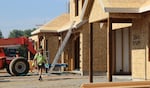
FILE - A new neighborhood is under construction in Bend, Ore., on Oct. 10, 2022.
Joni Land / OPB
Bend, a former mill town of about 20,000 people in the 1990s, grew to around 100,000 by 2025. Income inequality has also “surged” since 2019, according to Jonathan Taylor, the Central Oregon city’s urban renewal manager.
Taylor authored two City of Bend reports on housing and the economy that the city released on Oct. 3. They show a city that is losing low- to moderate-income earners, while the wealthiest residents make an outsized share of earnings. That’s happening amidst a backdrop of pervasive housing unaffordability that has metastasized in Bend.
This year, a state report found that Bend needs to build more than 15,700 homes in the next eight years to address its housing shortfall. Almost half of that needs to be affordable housing, according to the analysis from the state Department of Land Conservation and Development.
Bend’s own report shows that it needs to build housing at a higher rate than it currently does to meet state goals.
“The underproduction that occurred in housing between 2010 and 2020 set us back and we will be climbing out of that hole,” said Racheal Baker, Bend’s housing division manager, “until we really amp up our housing production.”
Growth projections
The city projects its population will increase by 30,000 people in the next 10 years.
Taylor said during an economic development meeting in August that Bend was the most popular destination in Oregon for people moving from other states, according to U-Haul data. The most instate migration came from the Portland metro area.
The growth has also driven the household median income up, as more people earning upwards of $100,000 move to the high desert town.
According to the state, about a third of the housing that needs to be built would meet demand from Bend’s wealthiest residents.
80% AMI and below earners shrink
The number of households earning 80% of, or 20% below the area median income or less, shrank, according to Taylor’s findings.
This year, Bend’s area median income is $123,500 for a household of four, an increase from last year’s AMI of $105,100.
The Bend City Council worked to pass an urban growth boundary expansion last winter, before the start of the new year, citing a number of concerns — one of them being that if they waited too long to approve the UGB expansions, the city could no longer qualify due to losing too many low-income residents.
UGB expansions are a tool used to build more housing. Last year the state allowed a one-time expansion for cities that met certain criteria and promised to ensure 30% of homes built in the expansion were affordable, allowing them to expand beyond the regulated boundaries. Bend approved and chose a site in late 2024.
When Taylor presented in August, he said, “more wealthy people are moving into the community and more less wealthy people are moving out of the community.”
Related: Deschutes County approves RV rentals amid Central Oregon housing shortage
5% of households make 24% of city’s aggregate income
Taylor said the biggest takeaway from the data for him was, “the top 5% of our households earn 24% of the total aggregate income in the city of Bend.” That means, of all the money earned in Bend from employers anywhere, the highest-earning households are taking home a quarter of it.
Taylor said there are about 43,000 households in Bend.
Bend’s median household income increased overall, largely driven by households making $100,000 or more. According to the report, the number of households earning $200,000 or more grew by 154%.
Given the growth in high earners, a modest increase in income for middle-class earners and the drop in low-income earners, income inequality has increased at a higher rate in Bend, than the state of Oregon and nationally.
Taylor said income inequality is rising across the country, so Bend isn’t an outlier, but called it an “issue” for the Central Oregon community.
Related: Bend needs more housing, but for some it can’t come fast enough
Housing unaffordability grows for renters, especially for large families
According to the city report, almost half of Bend’s renters are cost-burdened, meaning they spend more than 30% of their income on rent. And though wages have increased, they haven’t kept up with the cost of living.
Renters in Bend earn $66,000 per year on average, not enough to comfortably pay for an average apartment or own a home in the city.
The city tracked almost 500 affordable housing units built from 2020 to 2025, and a total of 1,260 since 2007. But despite the push to build more affordable housing, a little over half of the city’s neighborhoods were unaffordable last year.
Currently, Bend doesn’t have enough housing, costs to build housing are increasing and many people aren’t making enough to rent or buy a home.
“We’ve been in a bad place for a while and we’re still just trying to dig out,” Baker said.
She pointed to subsidies and incentives and called on area residents to support affordable housing projects and developer incentives in the hopes that new home prices stabilize and people needing low-income housing can afford to stay.