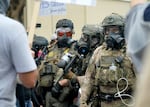
Federal officers confront protesters at the U.S. Immigration and Customs Enforcement facility, Portland, Ore., Oct. 4, 2025. President Trump has attempted to send the National Guard troops to the city over protests at the ICE facility.
Eden McCall / OPB
A panel of federal judges heard arguments Thursday over whether the Trump administration can send federal troops to Portland.
Last Saturday, a federal judge temporarily blocked the president from mobilizing 200 federalized Oregon National Guard troops. The same judge issued another order a day later barring the president from sending any federalized National Guard members to Portland after he signaled he would send troops from California and Texas.
The administration appealed the first decision to the U.S. 9th Circuit Court of Appeals. OPB legal affairs reporter Conrad Wilson watched the hearing and joins us with more details.
Note: The following transcript was transcribed digitally and validated for accuracy, readability and formatting by an OPB volunteer.
Dave Miller: This is Think Out Loud on OPB. I’m Dave Miller. We start today with a recap of the momentous hearing this morning at the 9th Circuit Court of Appeals. The central question before a three-judge panel was whether or not to lift a lower court’s order and let the president send troops into Portland. As a reminder, last Saturday, U.S. District Court Judge Karin Immergut temporarily blocked the administration from sending 200 federalized Oregon National Guard troops to the city.
A day later, after the president said he would send in National Guard members from California and Texas, that same judge barred the deployment of any National Guard members to the city. The Trump administration appealed just that first order, and this morning the three-judge panel questioned lawyers from both the federal government and the state of Oregon. OPB legal affairs reporter Conrad Wilson watched the hearing with me. When it ended, I asked him what stood out to him.
Conrad Wilson: I mean, I think we heard two judges – two judges who were appointed by Trump to the 9th Circuit during his first term – that were very skeptical of the city and the state’s arguments, really deferential to the presidential authority and seemed to be questioning – this is more than a headline – but seemed to be questioning really whether or not, really whether this is something that can even be blocked by a district court or the court should be considering. If the president needs to do something and thinks that the president needs to do something, the presidency, who are the courts to question, is kind of what we heard from at least two of those judges.
Miller: Let’s get into some of the details here, starting with questions about details and the dates of what happened. That took up a biggish chunk of the questions for lawyers from both sides, for the administration and from the state of Oregon. What were judges asking about there?
Wilson: So, you heard judges… So just to kind of recap on who the judges were, there’s Susan Graber, and she was a former Oregon Supreme Court justice appointed by President Clinton to the 9th Circuit. Ryan Nelson, a former corporate attorney and a government lawyer from Idaho who was appointed by Trump in 2018, and then Bridget Bade, a former federal magistrate in Arizona appointed by Trump in 2019. You’d asked about the timing, right?
Miller: Yeah.
Wilson: So, there was a sense that you heard the government, the U.S. Department of Justice, arguing that the president has this authority. And even though yes, some of the more spirited protests, bigger protests, but more violence occurred in June over a short period of time, that if the president decides that in September that they want to, that the president wants to authorize the National Guard, send in the National Guard, federalize the National Guard, he is entitled to do so.
And you heard attorneys for, the attorney for the state and the city, Oregon and the city of Portland saying that is, you really need to be looking at the factors on the ground – just like the district court did, just like Judge Karin Immergut did – in determining whether or not the factors at the time in which you’re federalizing the National Guard, because it is an awesome power, that is something that needs to be taken into consideration. And there was a lot of tension over that point.
Miller: What did you hear from the judges in their questions and their comments? There were a lot of comments. Sometimes you can listen or watch an appellate proceeding and the judges or the justices seem to be holding their cards very close to their chests. This one wasn’t like that.
Wilson: No, no.
Miller: What did you hear from the judges about this question of the calendar and the dates?
Wilson: Oh yeah, so I mean, what I heard is a great deal of skepticism, right? I mean, just over the arguments from the city and the state in particular, it seemed as though Judge Nelson in particular, was almost making some comments, as opposed to posing questions, that really seemed to suggest that he was very skeptical of the arguments that are being made by the city and the state. Was there anything that stood out to you?
Miller: Well, I mean, just that he was explicitly saying, ‘why shouldn’t we look at June? Isn’t June really relevant?’ How did the lawyer for the state, Stacy Chaffin, respond to that? In general, what was her argument for why it’s truly important to focus on say the month leading up to the attempted deployment?
Wilson: Because she said this, there’s a lot of what’s happening out there. The vast majority is a First Amendment protected protest. People are, yes, some of these people out there are very vehemently upset with the president’s immigration policies, but that is something that the president, that is something that the First Amendment protects, right? And to send in the military for incidents that are largely being controlled by the Federal Protective Service, by being controlled by Portland police, is just such an overreach, she was arguing.
Miller: Then though, so there were those back and forth, a lot of them about the range of dates and of incidents that should be considered.
Wilson: Right.
Miller: But then Judge Nelson made a broader point that that you were getting to, but it seems like one of the most telling and important parts of this/ He was basically talking, he was asking how much deference we should give the president and and essentially saying, shouldn’t we… Is it appropriate for a district court judge to take issue with a president’s decisions since we don’t know the the totality of their behind the scenes decisions? He was essentially saying, shouldn’t we give presidents a huge amount of deference instead of questioning their decisions?
Wilson: Yes, and was saying that when it comes to… We, you don’t know, basically he was telling Stacy Chaffin from the state of Oregon, you don’t know what’s happening behind the scenes. You don’t know. You have the president being told, according to the declarations, according to the court record from the Federal Protective Service, from other federal law enforcement, our resources are stretched very thin. We’re sending so many people to Portland. It’s kind of, we can’t keep doing this, day in, day out, week after week, month after month. You don’t know all the factors at play. And I think he said something to the point of, ‘isn’t it within the president’s authority to say, enough is enough? I’m calling the National Guard to basically back up federal resources and protect the facility.’
Miller: I want to turn to something that had been confusing me in the lead up to this hearing and was addressed, but it’s worth talking about here. So as we have mentioned in the past, Judge Immergut put out two temporary restraining orders last weekend. The first one, this was on Saturday, prohibited the deployment of the Oregon National Guard. The second prohibited the deployment of any federalized guard troops. That was obviously after the administration said, ‘oh, we can’t have the Oregon National Guard, then we’ll send in California and Texas.’
Wilson: Because they’re already federalized.
Miller: Right. The administration, though, the Trump administration has only appealed the first restraining order, the one that when you look at it is less broad. It is only about the Oregon National Guard. So the question I’d had is, let’s say that the administration ran into a very favorable three-panel, the three-judge panel, which actually it seems like they did, as we’ve been talking about.
Wilson: Yes.
Miller: And let’s say that in the coming days, this panel says, ‘all right, the hold is over, the Oregon National Guard can go in.’ The second temporary restraining order is still in effect and no federalized National Guard can be deployed. So, how was that addressed in the hearing today?
Wilson: Right. So, the Department of Justice, as you pointed out, has only appealed that this 30-ish page written ruling that came out on Saturday by Judge Immergut, and they basically said that since the second temporary restraining order – that’s the one that blocks any federalized National Guard from coming to Oregon, from being deployed by the president to Oregon – that because it relies on that first written order, we would basically tell the district court judge, ‘hey, you need to vacate this second temporary restraining order because it’s relying on the one that the 9th Circuit just shut down.’
Miller: In other words, the reasoning is so tied together that if judges, if you say, yeah, ‘we’re going to get rid of this first temporary restraining order, then naturally it would follow, you would also on your own, get rid of the second?’
Wilson: Exactly.
Miller: And then if they don’t, then the administration said that then we will file a whole new appeal to the second temporary restraining order.
Wilson: Yes, and you’re right. I mean, you did hear the judges sort of saying, ‘why didn’t you appeal the second one? What are we supposed to do? We’re so confused. What’s going on here?’ And then that was their response.
Miller: Almost every state in the country, red and blue, has now filed – this happened just yesterday afternoon – a friend of the court brief, in support of either the administration in the case of red states or on the side of Oregon, in the case obviously of blue states. Why? What’s at stake in this case nationally?
Wilson: So, I think in talking to a lot of legal experts and in reading a lot of the opinions that have been filed, these amicus briefs, what we’re talking about is, really what is the authority the president has to federalize National Guard members, essentially make them the equivalent of active duty troops, over the objections of a governor? And when can that happen? What are the factors on the ground? Historically, there isn’t a lot of precedent, which is something that Immergut kind of pointed to, others have pointed to, and folks say that there’s really good reason for that, right?
I mean, and that this just is sort of an extreme thing for the president to co-opt, or federalize National Guard members. It’s a pretty awesome authority and it should only happen under certain circumstances: a foreign invasion, the inability to exercise federal law, or rebellion or a threat of a rebellion, right? I mean, that’s… But you know, and Judge Immergut found in her ruling that none of those factors are at play at the time, in September, when the president authorized federalized National Guard members.
So, I think for other states, the question is, well, can the president do this in other places, because this is now sort of answering a question that has not, has sort of been in a legal gray area, right? And it’s sort of, as it’s been explained to me by professors, law professors who know the law far better than I do, this is how they’re pushing, just how far can they go? Where is this line, before we cross it? And today’s hearing, this case is going to, however it comes down will be in establishing a precedent.
So California, the Trump administration was allowed to federalize California Guard members back in June. That stood, and actually the thing that the district court kind of said was unlawful, ultimately, last month was that you can federalize them, but they can’t act like law enforcement officers. They can, this California judge said, they can stand outside a federal building. They can stand there, but they can’t act like cops. It’s a violation of the Posse Comitatus Act.
Miller: And in fact, the judges did reference that, in a skeptical way, that again seems like it falls on the side of the administration. They basically said, as I heard it and correct me if I’m wrong, I’m curious how you heard this. They said, ‘why should we prevent these troops from coming in now? The administration has said they’re going to guard the federal building. If they do that, fine, and if they do things that go against federal law after they’ve been deployed, then we’ll have a problem and then come back to us and we’ll deal with it.’ That’s, that was what I read from some of the questions, slash, comments from the two Trump appointed judges. I’m curious how it hit you.
Wilson: Yeah, I mean, I heard Judge Nelson say something to the effect of, ‘I am very aware of the slippery slope argument that’s being made. I’m very aware that this is something that could go too far. But is it really our job as the members of the court to tell the president you can’t do something?’ And of course, the state of Oregon, the city of Portland said, ‘absolutely, it’s when it comes to something like deploying the military for what what they describe as largely a First Amendment protest with yes, some sporadic incidents of violence, and some of the most extreme violence, being back in June.’
Miller: What is the potential timing on a ruling right now from this hearing for this particular temporary restraining order?
Wilson: Right. I mean, that’s a good question. They talked about that a little bit, because Judge Immergut is having a hearing next week. And so the appeals court judges were asking, ‘they got this hearing coming up. Do we need to rule before then?’ They said they’d get things done as quickly as they could.
The thing that I was really struck [by] is just there was still this discussion about what is happening outside the facility. It seemed to be, and that’s literally from the beginning, something that I think has been talked about. It’s like a Rorschach test or whatever, right? And that’s like, what do you see? Do you see the tear gas, the minutes of tear gas and flash bangs are used during some of the protests? And kind of that, or do you see the hours of people dancing or protesting or holding signs? Do you see members of clergy or legal observers standing out there as they’re kind of checking folks in going in and out of the ICE facility? Like, there’s a lot happening down there. It is all very small, as Portland police have pointed out, this is one city block in a much larger city, right?
Miller: Conrad, thanks very much.
Wilson: You’re welcome, Dave.
Miller: OPB’s Conrad Wilson covers criminal justice and legal affairs for OPB.
“Think Out Loud®” broadcasts live at noon every day and rebroadcasts at 8 p.m.
If you’d like to comment on any of the topics in this show or suggest a topic of your own, please get in touch with us on Facebook, send an email to thinkoutloud@opb.org, or you can leave a voicemail for us at 503-293-1983.