Officials in Oregon first found out on Sept. 26 that a surge of troops could be coming to Portland. Still awaiting clarity, the city has become an eccentric flashpoint in the national discourse on how the president can use the National Guard.
A lot has happened — legally, politically and on the ground in Portland — since President Donald Trump announced he’d be sending National Guard troops to address perceived unrest in the city.
Here’s a quick look at how things have progressed and what’s still ahead.
Friday, Sept. 26: An anticipated surge in federal forces
People in Portland started hearing reports of a surge in the number of federal law enforcement present in the city.
After multiple sightings of armored cars coming and going from the Immigration and Customs Enforcement facility in Portland, local elected officials held a press conference urging Portlanders to stay calm and not “take the bait” from the Trump administration’s show of force.
Saturday, Sept. 27: Trump calls in the National Guard
President Trump announced in a post on Truth Social that he was ordering federal troops to “protect War ravaged Portland.”
Oregon Gov. Tina Kotek and Portland Mayor Keith Wilson urged Trump to take back his order, stating that the number of troops needed in Portland is zero, and that the president’s idea of the city as war-ravaged is wholly inaccurate.
Police records show that at this time, protests at the ICE facility had been consistently small and uneventful for more than a month.
Saturday, Oct. 4: US District Court halts Trump’s deployment
U.S. District Court Judge Karin Immergut granted Oregon and Portland a temporary restraining order, halting Trump’s deployment at least through Oct. 17.
Immergut, a Trump appointee in 2019, took over the case after Judge Michael Simon recused himself. Simon is married to Oregon Rep. Suzanne Bonamici, a Democrat who has opposed Trump’s troop deployment.
Hours after Immergut ruled against Trump’s deployment, federal officers at the ICE facility escalated the crowd control tactics they were using on protesters.
Protesters recover after gas is deployed at the U.S. Immigration and Customs Enforcement facility, Portland, Ore., Oct. 4, 2025.
Alejandro Figueroa / OPB
Protesters recover after gas is deployed at the U.S. Immigration and Customs Enforcement facility, Portland, Ore., Oct. 4, 2025.
Eden McCall / OPB
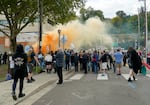
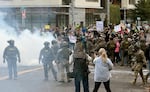
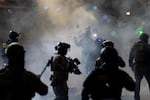
Tear gas is deployed at the U.S. Immigration and Customs Enforcement facility, Portland, Ore., Oct. 4, 2025.
Eden McCall / OPB
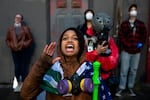
Protesters react after smoke and tear gas are deployed at the U.S. Immigration and Customs Enforcement facility, Portland, Ore., Oct. 4, 2025.
Alejandro Figueroa / OPB
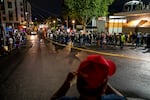
Crowds assemble at the U.S. Immigration and Customs Enforcement facility, Portland, Ore., Oct. 4, 2025.
Alejandro Figueroa / OPB
Protesters recover after gas is deployed at the U.S. Immigration and Customs Enforcement facility, Portland, Ore., Oct. 4, 2025.
Eden McCall / OPB
Tear gas is deployed at the U.S. Immigration and Customs Enforcement facility, Portland, Ore., Oct. 4, 2025.
Eden McCall / OPB
Gas is deployed at the U.S. Immigration and Customs Enforcement facility, Portland, Ore., Oct. 4, 2025.
Eden McCall / OPB
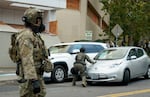
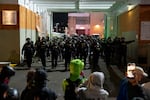
Federal officers keep watch at the U.S. Immigration and Customs Enforcement facility, Portland, Ore., Oct. 4, 2025.
Eden McCall / OPB
Gas is deployed at the U.S. Immigration and Customs Enforcement facility, Portland, Ore., Oct. 4, 2025.
Alejandro Figueroa / OPB
Protesters react after tear gas is deployed at the U.S. Immigration and Customs Enforcement facility, Portland, Ore., Oct. 4, 2025.
Eden McCall / OPB
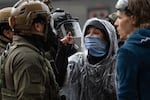
Federal officers confront protesters at the U.S. Immigration and Customs Enforcement facility, Portland, Ore., Oct. 4, 2025.
Eden McCall / OPB
Officers confront protesters at the U.S. Immigration and Customs Enforcement facility, Portland, Ore., Oct. 4, 2025.
Eden McCall / OPB
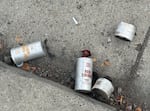
Empty canisters of colored smoke used for crowd control at the U.S. Immigration and Customs Enforcement facility, Portland, Ore., Oct. 4, 2025.
Alejandro Figueroa / OPB
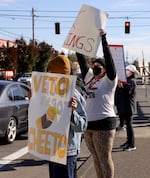
Counter protesters, left, and opponents stand on the protest line at the U.S. Immigration and Customs Enforcement facility, Portland, Ore., Oct. 4, 2025.
Eden McCall / OPB
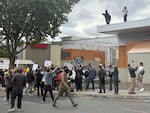
Pictures of President Donald Trump and Jeffrey Epstein are posted to a building near the U.S. Immigration and Customs Enforcement facility, Portland, Ore., Oct. 4, 2025.
Eden McCall / OPB
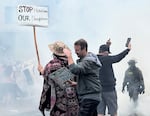
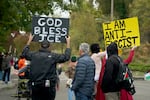
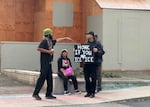
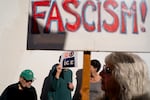
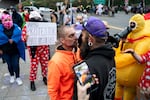
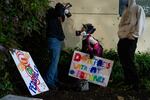
A man confronts a trio of people with signs that read “Honk if you love ICE” and “God Bless ICE,” outside of U.S. Immigration and Customs Enforcement facility in Portland, Ore., Oct. 4, 2024.
Alejandro Figueroa / OPB
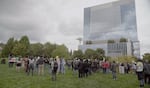
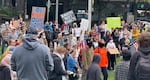
Crowds assemble at Elizabeth Caruthers Park in Portland, Ore., for a rally and march to the U.S. Immigration and Customs Enforcement facility, Oct. 4, 2025.
Eden McCall / OPB
Crowds assemble at Elizabeth Caruthers Park in Portland, Ore., for a rally and march to the U.S. Immigration and Customs Enforcement facility, Oct. 4, 2025.
Alejandro Figueroa / OPB
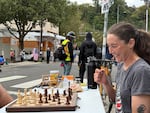
Angela Barns plays chess near the U.S. Immigration and Customs Enforcement facility, Portland, Ore., Oct. 4, 2025.
Sunday, Oct. 5: Trump circumvents the judge, who blocks him again
In an early morning interview with reporters on the White House lawn, Trump criticized Immergut over her ruling. He appeared not to know who she was, mistakenly referring to her multiple times as a male judge.
Following that District Court ruling blocking his deployment of the Oregon National Guard, Trump instead ordered 300 troops from the California National Guard and 400 additional troops from Texas, which he’d already brought under federal command.
Immergut swiftly held another hearing and issued another ruling temporarily blocking those deployments. She told attorneys for the Trump administration she was “troubled” by the deployment of the guard from two other states, saying it “does appear to be in direct contradiction of my order.”
In the midst of ongoing tensions between local leaders and the Trump administration, U.S. Department of Homeland Security Secretary Kristi Noem visited Portland’s ICE facility and met with Gov. Kotek.
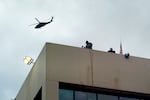
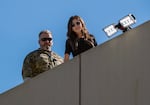
U.S. Department of Homeland Security Secretary Kristi Noem stands on the roof of the U.S. Immigration and Customs Enforcement building in South Portland on Tuesday, Oct. 7, 2025.
Kristyna Wentz-Graff / OPB
Her visit followed an effort by the Trump administration to portray the city as chaotic and in need of federal troops. Noem was flanked for much of her visit by right-wing media influencers who have been a frequent presence at the ICE protests.
This is part of a pattern OPB documented of right-wing media influencers being welcomed into the federal government to promote its messages. This kind of media access shows a deepening alliance between the administration and an online world willing to represent information toward furthering Trump’s political goals.
Thursday, Oct. 9: American citizen sues over ICE arrest in Portland
Milwaukie resident Francisco Miranda, who was born in California, sent a tort claim to the Department of Homeland Security alleging he was wrongfully arrested by ICE agents at his place of work, a metal fabricator near the airport.
Miranda said he was accused of being in the country illegally, threatened with a dog attack if he didn’t comply, struck from behind and put into a van.
He was driven to the Portland ICE facility, the site of the ongoing protests, and held for several hours. He claimed he was later returned to his work and released “without being given any legitimate reason for his abduction.”
Appeals court skeptical of judge’s order blocking Trump
Also on Oct. 9, U.S. Court of Appeals for the 9th Circuit heard arguments over the Trump administration’s attempt to reverse Judge Immergut’s temporary restraining order blocking the troop deployment.
They indicated in their questioning that the president has sweeping authorities over law enforcement. They also questioned whether the judiciary has the authority to put limitations on National Guard deployments if the president believes it is necessary.
As residents awaited word on whether the National Guard would be deployed in the city’s streets, Portland did what some say it does best at: to keep being weird.
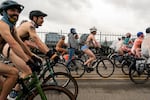
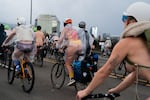
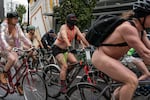
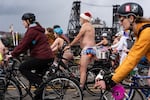
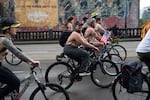
The weekend after Noem’s visit was marked by occasional clashes with law enforcement, frequent dancing in the street and nudity in the cold, as hundreds of people took to two wheels for what organizers called an “emergency” World Naked Bike Ride.
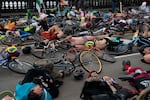
Cyclists participate in a die-in on the Burnside Bridge in Portland, Ore. on Sunday, Oct. 12, 2025. Hundreds participated in the event, which began at the Convention Center Plaza and eventually made its way to the ICE building.
Saskia Hatvany / OPB
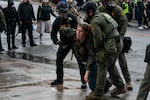
A person is detained at the U.S. Immigration and Customs Enforcement in Portland, Ore. on Sunday, Oct. 12, 2025.
Saskia Hatvany / OPB
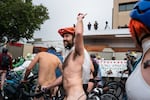
People participating in a naked bike ride protest in front of the U.S. Immigration and Customs Enforcement in Portland, Ore. on Sunday, Oct. 12, 2025. Hundreds participated in the event, which began at the Convention Center Plaza and eventually made its way to the ICE building.
Saskia Hatvany / OPB
Protesters participate in a naked bike ride in Portland, Ore. on Sunday, Oct. 12, 2025. Hundreds participated in the event, which began at the Convention Center Plaza and eventually made its way to the ICE building.
Saskia Hatvany / OPB
Cyclists bike across the Burnside Bridge during a naked bike ride in Portland, Ore. on Sunday, Oct. 12, 2025.
Saskia Hatvany / OPB
People get ready for a naked bike ride on Sunday, Oct. 12, 2025 in Portland, Ore.
Saskia Hatvany / OPB
Cyclists bike across the Burnside Bridge during a naked bike ride in Portland, Ore. on Sunday, Oct. 12, 2025. Hundreds participated in the event, which began at the Convention Center Plaza and eventually made its way to the ICE building.
Saskia Hatvany / OPB
Protesters participate in a naked bike ride in Portland, Ore. on Sunday, Oct. 12, 2025.
Saskia Hatvany / OPB
Cyclists bike across the Burnside Bridge during a naked bike ride in Portland, Ore. on Sunday, Oct. 12, 2025. Hundreds participated in the event, which began at the Convention Center Plaza and eventually made its way to the ICE building.
Saskia Hatvany / OPB
Protesters participate in a naked bike ride in Portland, Ore. on Sunday, Oct. 12, 2025. Hundreds participated in the event, which began at the Convention Center Plaza and eventually made its way to the ICE building.
Saskia Hatvany / OPB
A mother, who asked not to be named, participates in a naked bike ride with her kids on Sunday, Oct. 12, 2025 in Portland, Ore. Hundreds participated in the event, which began at the Convention Center Plaza and eventually made its way to the ICE building.
Saskia Hatvany / OPB
A person is detained at the U.S. Immigration and Customs Enforcement in Portland, Ore. on Sunday, Oct. 12, 2025.
Saskia Hatvany / OPB
Protesters confront agents in front of the Immigration and Customs Enforcement in Portland, Ore. on Sunday, Oct. 12, 2025.
Saskia Hatvany / OPB
Cyclists, including families, participate in a naked bike ride on Sunday, Oct. 12, 2025 in Portland, Ore.
Saskia Hatvany / OPB
Even government officials joined in on the demonstration, with council heads of Metro, the regional government of Portland area, baring their shoulders on social media as they asked demonstrators to stay safe.
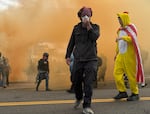
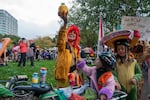
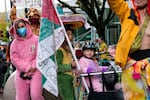
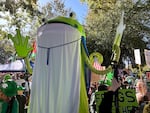
Hallmarks of the Portland protests leading up to that weekend had been the increasing numbers of inflatable costumes, particularly frogs, as well as a puppy parade and a man in a chicken suit.
U.S. District Court Judge Immergut extended the temporary rulings blocking the Trump administration from federalizing and deploying members of the National Guard to Portland.
The temporary restraining orders were set to expire on Oct. 17, but Immergut extended them for another 14 days.
The largely procedural decision maintained the status quo, as the Trump administration, the states of California and Oregon, and the city of Portland were still awaiting a ruling from the 9th Circuit Court of Appeals.
Some of the most powerful judges in the U.S. continued to weigh whether federal buildings and staff in Portland need National Guard troops to protect them from protesters.
Attorneys for the U.S. Department of Justice believe the answer is yes. A primary data point in their argument: The U.S. Immigration and Customs Enforcement’s Portland building closed for 22 days over the summer.
And the U.S. Appeals Court for the 9th Circuit was heavily weighing that point.
But data reviewed by OPB shows any assertion that the building has been out of commission is inaccurate.
During the time period in question, ICE officers still detained people in the Portland facility. Bookings dipped compared to May, but the closure may not be to blame; every processing center in the Northwest had fewer bookings in June and July.
Saturday, Oct. 18: Peaceful protests and a show of force in Portland
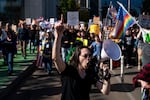
A brief but substantial show of force from federal officers in Portland in the evening ended a day that had been full of peaceful No Kings protests across Oregon.
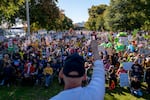
Protesters cheer as they listen to a speaker at the “No Kings 2.0” rally in Tom McCall Waterfront Park in Portland, Ore., Oct. 18, 2025.
Eli Imadali / OPB
Malcolm Gregory Scott, one of the “No Kings 2.0” rally organizers, speaks to the crowd at Tom McCall Waterfront Park in Portland, Ore., Oct. 18, 2025.
Eli Imadali / OPB
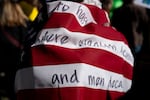
An Oliver Goldsmith quote that says, “Ill fares the land, to hastening ills a prey, where wealth accumulates and men decay,” is written on an American flag draped over a protester at the “No Kings 2.0” rally at McCall Waterfront Park in Portland, Ore., Oct. 18, 2025.
Eli Imadali / OPB
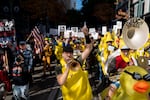
Miles Thompson, a trumpeter in the "Unprecedented Brass Band” marches with thousands at the “No Kings 2.0” protest and march, beginning at Pioneer Courthouse Square in Southwest Portland, Ore., Oct. 18, 2025.
Eli Imadali / OPB
Betti Mags, left, joins thousands at a “No Kings 2.0” protest and march starting at Pioneer Courthouse Square in Southwest Portland, Oct. 18, 2025.
Eli Imadali / OPB
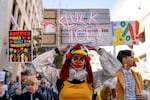
Charlie, who withheld his last name, wears a lucha libre mask and other items with indigenous and cultural significance, saying he is “bringing my Mexican and native cultures together.” Thousands gather for a “No Kings 2.0” protest and march at Pioneer Courthouse Square in Southwest Portland, Oct. 18, 2025.
Eli Imadali / OPB
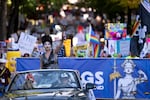
Saint Syndrome, a local drag queen dressed as Lady Justice, holds up a scale as she leads the “No Kings 2.0” march in Portland, Ore., on Saturday, Oct. 18, 2025.
Eli Imadali / OPB
“No Kings 2.0” protesters line Center Street Northeast at the Oregon State Capitol in Salem, Ore., Oct. 18, 2025.
Saskia Hatvany / OPB
“No Kings 2.0” protesters line Center Street Northeast at the Oregon State Capitol in Salem, Ore., Oct. 18, 2025.
Saskia Hatvany / OPB
"No Kings 2.0" protesters pass by the Oregon State Capitol in Salem, Ore., Oct. 18, 2025.
Saskia Hatvany / OPB
Caravaners pass by the Oregon State Capitol in Salem, Ore., Oct. 18, 2025. Two protests are happening Saturday in Salem — one is aligned with the national “No Kings 2.0” demonstrations, the other is organized by a group seeking to recall Democratic Oregon Gov. Tina Kotek.
Saskia Hatvany / OPB
People attend a rally to recall Gov. Tina Kotek in front of the Oregon State Capitol in Salem, Ore. on Saturday, Oct. 18, 2025.
Saskia Hatvany / OPB
People gather for a Charlie Kirk memorial service during a rally to recall Gov. Tina Kotek in front of the Oregon State Capitol in Salem, Ore., Oct. 18, 2025.
Saskia Hatvany / OPB
A protester argues with supporters of Charlie Kirk in front of the Oregon State Capitol in Salem, Ore. on Saturday, Oct. 18, 2025. Two protests were held at the Capitol on Saturday--one aligned with the national No Kings demonstrations, the other organized by a group seeking to recall Democratic Oregon Gov. Tina Kotek.
Saskia Hatvany / OPB
Angela Nichols, right, participates in the "No Kings 2.0" protest at the Oregon State Capitol in Salem, Ore., Oct. 18, 2025.
Saskia Hatvany / OPB
Posters inspired by Portland’s protest frog, in Portland, Ore., Oct. 18, 2025.
Eli Imadali / OPB
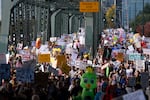
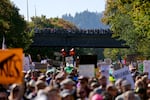
Thousands of protesters cross over the Hawthorne Bridge at the “No Kings 2.0” rally in Portland, Ore., Oct. 18, 2025.
Eli Imadali / OPB
Joan Collie, 100, attends a “No Kings 2.0” rally at the Tom McCall Waterfront Park in Portland, Ore., Oct. 18, 2025. Collie’s sign reads, “It’s like 1938 all over again. I was there!”
Eli Imadali / OPB
Rigo, who wasn’t comfortable sharing his full name, leads chants during the “No Kings 2.0” march in Portland, Ore., on Saturday, Oct. 18, 2025.
Eli Imadali / OPB
Demonstrators take a break from protesting at the “No Kings 2.0” rally in Portland, Ore., Oct. 18, 2025.
Eli Imadali / OPB
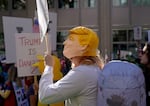
A protester, dressed in a baby inflatable costume and a Donald Trump mask, waves to the camera as people gather at the Tom McCall Waterfront Park in Portland, Ore., taking part in a “No Kings 2.0” protest and march, Oct. 18, 2025.
Eli Imadali / OPB
Job, who wasn’t comfortable sharing his full name, adjusts his clown nose before skateboarding toward the “No Kings 2.0” march on the Hawthorne Bridge in Portland, Ore., Oct. 18, 2025.
Eli Imadali / OPB
Protesters at the “No Kings” rally, marching to Tom McCall Waterfront Park in Portland, Ore., Oct. 18, 2025.
Eli Imadali / OPB
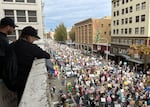
Thousands march through downtown Portland, Ore,. taking part in the “No Kings 2.0” rally, Oct. 18, 2025.
Joni Auden Land / OPB
Protesters’ shadows are cast in Tom McCall Waterfront Park during the “No Kings 2.0” rally in Portland, Ore., on Saturday, Oct. 18, 2025.
Eli Imadali / OPB
“No Kings 2.0” protesters line Center Street Northeast at the Oregon State Capitol in Salem, Ore., Oct. 18, 2025.
Saskia Hatvany / OPB
"No Kings 2.0" protesters at the Oregon State Capitol in Salem .
Saskia Hatvany / OPB
"No Kings 2.0" protesters at the Oregon State Capitol in Salem .
Saskia Hatvany / OPB
Angelina Bacon argues with counter protesters in front of the Oregon State Capitol in Salem, Ore. on Saturday, Oct. 18, 2025.
Saskia Hatvany / OPB
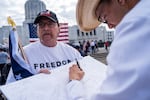
Skylor, a Charlie Kirk supporter who asked not to give his last name, signs a placard that will be sent to Erika Kirk in front of the Oregon State Capitol in Salem, Ore. on Saturday, Oct. 18, 2025.
Saskia Hatvany / OPB
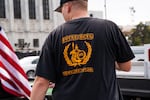
A man wearing a Proud Boys shirt packs up following a rally to recall Gov. Tina Kotek in front of the Oregon State Capitol in Salem, Ore. on Saturday, Oct. 18, 2025.
Saskia Hatvany / OPB
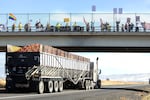
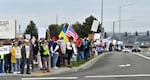
Protesters demonstrate atop an Interstate 84 overpass near Pendleton, Ore., during a “No Kings 2.0” rally, Oct. 18, 2025.
Kathy Aney for OPB
Jen Sandoval, aka "Día de los Meow-tos,” attends the “No Kings 2.0” protest in Prineville, Ore., on Oct. 18, 2025. Sandoval, 54, who is Mexican-American says she's protesting ICE detentions and deportations.
Kathryn Styer Martínez / OPB
Frogs turned out in force at the “No Kings 2.0” rally at McCall Waterfront Park in Portland, Ore., Oct. 18, 2025.
Joni Auden Land / OPB
Thousands gather for a “No Kings 2.0” protest and march at Pioneer Courthouse Square in Southwest Portland, Oct. 18, 2025.
Eli Imadali / OPB
Sue Peterson attended the rally wearing an inflated chicken costume, atop an Interstate 84 overpass near Pendleton, Ore., during a “No Kings 2.0” rally, Oct. 18, 2025.
Kathy Aney for OPB
Protesters demonstrate atop an Interstate 84 overpass near Pendleton, Ore., during a “No Kings 2.0” rally, Oct. 18, 2025.
Kathy Aney for OPB
Protesters line Columbia Center Boulevard in Tri-Cities, Wash., taking part in “No Kings 2.0” on Oct. 18, 2025.
Tracci Dial / NWPB
More than a thousand protestors lined Stewart Parkway in Roseburg, Ore., taking part in “No Kings 2.0” on Oct. 18, 2025.
Nathan Wilk / KLCC
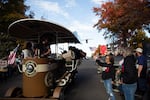
A Cyclepub passes by, grabbing a sign from the crowd at the No Kings protest in Bend, Ore., on Oct. 18, 2025.
Kathryn Styer Martínez / OPB
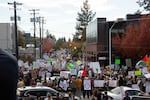
Hundreds of poeple pour into downtown after meeting at Drake Park for the start of the No Kings protest in Bend, Ore., on Oct. 18, 2025.
Kathryn Styer Martínez / OPB
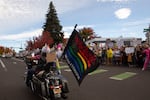
A motorcyclist rides by crowds, in support of the No Kings protest in Bend, Ore., on Oct. 18, 2025.
Kathryn Styer Martínez / OPB
Protesters for the “No Kings 2.0” rally in Gresham, Ore., Oct. 18, 2025.
Sarah Nairalez / OPB
Protesters for the “No Kings 2.0” rally in Gresham, Ore., Oct. 18, 2025.
Tens of thousands of people marched in Portland alone, and crowds saw minimal conflict with counterprotesters throughout the day. In the evening, a smaller group of about 500 protesters at Portland’s ICE facility were met with heavy force from federal agents in the evening.
A protester in an inflatable axolotl costume wrapped in a Mexican flag navigates a cloud of tear gas. Officers continued using a barrage of chemical agents and munitions on the nonviolent protesters after the driveway was cleared.
Eli Imadali / OPB
Federal officers deploy tear gas, flash-bangs and pepper balls on nonviolent protesters outside the U.S. Immigrations and Customs building in Portland, Ore., Oct. 18, 2025 in order to clear the driveway. About 500 people gathered outside the facility to continue protesting following the “No Kings 2.0” rally.
Eli Imadali / OPB
Briana Nathanielsz chants with other protesters.
Eli Imadali / OPB
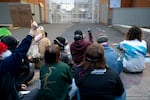
Protesters sit in front the ICE facility driveway wearing costumes, gas masks and black clothing in preparation for federal agents deploying tear gas.
Eli Imadali / OPB
A protester going by internet name Ignar Husky yells chants.
Eli Imadali / OPB
Protester Mackenna Roberts is assisted after being exposed to chemical agents.
Eli Imadali / OPB
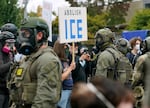
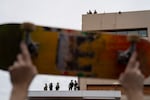
A protester holds up a skateboard with an explicit anti-ICE message as federal agents survey the crowd.
Eli Imadali / OPB
Protesters sit in front of the driveway flipping off federal agents and officers.
Eli Imadali / OPB
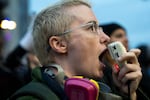
Freedom Road Socialist Organization organizer Holly Brown leads chants outside of the U.S. Immigration and Customs building in Portland, Ore., on Oct. 18, 2025.
Eli Imadali / OPB
A conservative protester and veteran, left, argues with Brent Fair at the ICE facility shortly before the argument diffused. The pair were arguing about whether protesters should be masked or not, with Fair stating that protesters wore masks for protection whereas many ICE and other federal agents there wore them to hide their identities.
Eli Imadali / OPB
A protester shows one of his injuries after being hit with pepper balls by federal agents.
Eli Imadali / OPB
A counter protester donning a red “Make America Great Again” hat films the crowd outside the ICE building.
Eli Imadali / OPB
An eight-year-old protester holds her homemade sign as her mother adjusts her gas mask.
Eli Imadali / OPB
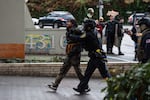
Federal officers walk out of the U.S. Immigrations and Customs facility in South Portland to clear the driveway and confront a crowd of about 500 people gathered to continue protesting following the “No Kings” rally in Portland, Ore., Oct. 18, 2025.
Eli Imadali / OPB
Federal officers stand across from protesters before deploying chemical agents and munitions to clear the driveway.
Eli Imadali / OPB
Federal officers deploy tear gas, flash-bangs and shoot pepper balls at nonviolent protesters.
Eli Imadali / OPB
A person films an active crowd munitions canister at the feet of a protester wearing an inflatable costume.
Eli Imadali / OPB
A protester opens a canister of baking soda and water in an attempt to neutralize tear gas deployed by federal officers and agents outside of the U.S. Immigrations and Customs Enforcement building in Portland, Ore., Oct. 18, 2025. Officers continued using a barrage of chemical agents and munitions on the nonviolent protesters after the driveway was cleared. About 500 people gathered outside the facility to continue protesting following the “No Kings 2.0” rally.
Eli Imadali / OPB
Steve Walker, a retired combat medic, rinses his eyes out after being tear gassed by federal agents.
Eli Imadali / OPB
A protester shows part of a munition fired by federal agents.
Eli Imadali / OPB
Rigo, who wasn’t comfortable sharing his full name, shouts up to federal agents.
Eli Imadali / OPB
A protester going by internet name Ignar Husky protests with an anti-Nazi pin, among others, on his hat.
Eli Imadali / OPB
Protesters dressed in various costumes dance outside the ICE facility.
Eli Imadali / OPB
A protester dressed in an inflatable chicken suit yells up to federal agents.
Eli Imadali / OPB
Federal officers stand atop the U.S. Immigrations and Customs building shooting chemical agents and munitions at nonviolent protesters in Portland, Ore., Oct. 18, 2025. where about 500 people gathered to continue protesting following the “No Kings 2.0” rally. The officers deployed tear gas, pepper balls and flash-bang grenades on Saturday evening.
Eli Imadali / OPB
Monday, Oct. 20: One restraining order overturned
A panel of three judges on the U.S. 9th Circuit Court of Appeals overruled a temporary restraining order from U.S. District Court Judge Karin Immergut that blocked the federalization of the Oregon National Guard.
But the ruling only covered one of the two temporary restraining orders she had issued. Her second restraining order was not challenged and remained in place, blocking federalized National Guard troops anywhere in the U.S. from deploying to Oregon.
The two judges who wrote the majority opinion for the 9th Circuit stated that because both of Immergut’s restraining orders are based on the same legal reasoning, they should both be dissolved — the two “rise or fall together” on the merits.
“Not so,” the third appeals court judge stated in her dissenting opinion. “Nothing in the majority’s order does — or could — require the district court to dissolve the second TRO, which is not before us.”
Judge Immergut held a hearing to try to resolve the matter of her second TRO, and she announced that she would rule on whether or not to dissolve it by Monday, Oct. 27, potentially opening the door to troop deployment.
But within a few hours, the 9th Circuit stayed its original order on Immergut’s first TRO. The appeals court wanted to give more time to a broader swathe of judges to decide whether to rehear the matter. The newly-issued hold was set to last until 5 p.m. on Tuesday, Oct. 28.
Judges on the 9th Circuit Court of Appeals voted to rehear a case over whether or not President Trump can call up and deploy 200 members of the Oregon National Guard. That decision also reversed an earlier ruling that sided with the Trump administration.
As part of the rehearing, or “en banc” proceedings, announced Tuesday, a panel of 11 different appeals court judges will once again consider the case, previously heard by panel of just three judges.
“The court is sending a clear message: the president cannot send the military into U.S. cities unnecessarily,” Oregon Attorney General Dan Rayfield said in a statement responding to the news. “We will continue defending Oregon’s laws, values, and sovereignty as this case moves forward and our fight continues in the courts.”
It’s unclear when the new hearing over the case will take place.
Wednesday, Oct. 29: Trial over National Guard deployment begins
With the timing on the appeals court’s rehearing still up in the air, the trial over the state and city’s underlying lawsuit challenging the National Guard deployment got underway on Oct. 29.
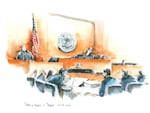
A federal trial is under way in Portland on Wednesday, where U.S. District Court Judge Karin Immergut will decide if President Trump acted lawfully or violated the state’s rights by trying to deploy the National Guard, Oct. 29, 2025.
Illustration by Rita Sabler / OPB
At the trial, U.S. District Court Judge Karin Immergut heard arguments over whether the Trump administration followed the statute that outlines when a president can federalize the National Guard and what the U.S. Constitution says about the authority of the executive branch to deploy members of the National Guard — or whether those efforts in Portland infringed on the state’s rights.
Wednesday, Oct. 29: Guard deployed to Portland despite judges order
The first day of the federal trial over the National Guard deployment to Portland got off to a surprising start, with the revelation that members of the Oregon National Guard briefly deployed to the Portland ICE facility in early October — a move that may have violated Judge Immergut’s restraining order.
Emails submitted to the court say nine members of the Oregon National Guard were sent to the ICE facility and concluded their shift in the early hours of Oct. 5.
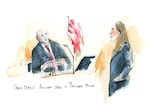
Portland police Assistant Chief Craig Dobson, left, is questioned by Senior Deputy City Attorney Caroline Turco, about the bureau’s crowd control policies during the second day of a trial over the legality of domestic military deployment to Portland, Oct. 30, 2025 in Portland, Ore.
Illustration by Rita Sabler / Special to OPB
“At 11:35 PDT today, a force of nine MPs arrived at the ICE facility in downtown Portland, Oregon where they assumed their first support mission,” wrote Col. Jeff Merenkov at 3:28 p.m. on Oct. 4.
The email included a schedule that showed the troops’ “shift conclusion” was set for midnight. That same day, Immergut issued a restraining order at 3:40 p.m. barring the president from federalizing the Oregon National Guard and blocking their deployment.
Jean Lin, special counsel for the Justice Department, confirmed the deployment to Immergut but provided few specifics — minutes before the trial began.
“We’ll talk later about whether that’s contempt,” the judge responded to Lin.
For the fourth time in the past month, Judge Immergut has again blocked the National Guard from deploying to Portland. The temporary injunction only lasts until Nov. 7 at 5 p.m., but her order suggested she was likely to side the city of Portland and states of Oregon and California.
In her 16-page order, Immergut said she found “no credible evidence” that protests outside the ICE building “grew out of control or involved more than isolated and sporadic instances of violent conduct that resulted in no serious injuries to federal personnel,” in the months before the president took control of the Oregon National Guard.