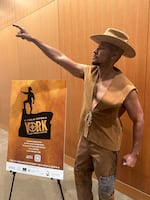
Cedric Berry poses for a portrait in costume as the titular character York from "York the Explorer" during a rehearsal held on Oct. 17, 2025 at the Patricia Reser Center for the Arts in Beaverton. "York the Explorer" is a folk opera about York, an enslaved Black man who was an invaluable member of the historic Lewis and Clark expedition.
Courtesy Chanell D. Walker
Starting in elementary school, students might begin learning about the epic expedition Lewis and Clark led 220 years ago to explore the newly acquired territory of the Louisiana Purchase, an 8,000-mile journey through present-day Oregon to the Pacific Ocean and back. While the names Lewis and Clark have been etched into history books, the name York is largely unknown. York, William Clark’s slave, was the only Black man on the expedition. A skilled hunter, naturalist and outdoorsman, York also helped Lewis and Clark during their negotiations and encounters with Native American tribes in the uncharted West. Yet, as a slave, York lacked the agency to tell his own story and was denied his freedom by Clark for nearly a decade after returning home.
Grammy Award-nominated Portland musician Aaron Nigel Smith is today helping bring York’s story to a wider audience in the form of an opera that blends different musical genres, from folk to classical and jazz to hip-hop. “York the Explorer” premieres this Friday at the Patricia Reser Center for the Arts in Beaverton for a weekend of performances as part of “York Fest,” a nine-day celebration of the explorer organized by the Oregon Black Pioneers.
Smith produced, co-wrote and composed the music for “York the Explorer.” He also performs in it with his friend Cedric Berry, an artist with the L.A. Opera, who plays York. Jasmine Johnson, the civic engagement and partnerships manager at Portland Opera, plays Rose, York’s mother. They join us for a discussion and in-studio performance of several songs from the opera.
Disclosure: Patricia Reser Center for the Arts and Oregon Black Pioneers are OPB sponsors. OPB’s newsroom maintains editorial independence and is not informed by financial support/individuals to the organization.
Note: The following transcript was transcribed digitally and validated for accuracy, readability and formatting by an OPB volunteer.
Dave Miller: This is Think Out Loud on OPB. I’m Dave Miller. “York Fest” began a few days ago. It’s a nine-day celebration of the enslaved man and hunter, naturalist and outdoorsman who was part of the Lewis and Clark Expedition. As the property of William Clark, York lacked the agency to tell his own story and was denied his freedom by Clark for nearly a decade after returning home.
Now, a new opera aims to bring York’s story to a wider audience. It’s called “York the Explorer.” It premieres this weekend as part of “York Fest” at the Patricia Reser Center for the Arts in Beaverton. It was created by the Grammy Award-nominated Portland musician Aaron Nigel Smith. He joins us now, along with two of his collaborators. The bass baritone Cedric Berry is an artist with the LA Opera – he plays York. Jasmine Johnson is a civic engagement and partnerships manager at the Portland Opera – she plays Rose, York’s mother.
It’s great to have all of you on the show.
Aaron Nigel Smith: Thanks so much for having us, Dave. Glad to be here.
Cedric Berry: Thank you.
Jasmine Johnson: Thank you.
Miller: Aaron, first – when did you first learn about York?
Nigel Smith: I am a little bit embarrassed to say that I first learned about’s story in 2020 during the upheaval around the toppling of his bust in Mount Tabor Park. And as I learned about his story and stopped beating myself up about not knowing, I was just really intrigued about this legacy, this untold legacy and this unsung hero. [I] just went on a journey to learn more and then more important than that, figure out how I could do better by him by amplifying his story.
Miller: I should say about that, four years ago or so, we did talk about that sort of guerrilla-style public art, an amazing bust of York that was put up, mysteriously at first, and then taken down and ransacked by some vandal. Portland’s Office of Arts and Culture told KOIN 6 News about six weeks ago that a permanent version of that York sculpture has now been completed and the city is planning to have it installed at some point next year at some, as yet, unidentified location. So that is going to happen, for folks who’ve been wondering about that story.
But Aaron, what was it about York, who you hadn’t been aware of, that first so captivated you? It’s one thing to read some news article. It’s another to say I’m going to spend years of my life collaborating with a dozen something people and make an opera about him. What was it?
Nigel Smith: I think it was just the connection, the human connection and understanding. As a Black man here in America, feeling unseen and unheard, and imagining how amplified that must have been in his time and in the way that he was treated. And one thing that struck me was learning that he had contributed to the journey equally to all the other members, if not a little bit more. We’re not saying he was the reason for the “success” of the journey, but he certainly contributed by caring for the crewmen, by hunting, by fishing and by just being a guide for them all.
And then after all of that, [there was] no recognition for him. All the other crewmen and people were awarded land, money, other accolades, official roles in government. Even Sacajawea is much more known and more prominent than our brother York. So I felt really compelled to share his story. It felt like a responsibility of mine, as much as a passion.
Miller: And then once you feel that pull, then there’s a question of how to share that story and what you chose is opera. Why?
Nigel Smith: Well, it’s a long journey back to the classical music world for me. I was trained classically, exclusively classically, from the age 10, starting with the American Boychoir School and on to Interlochen Arts Academy where I met my brother Cedric here. I studied at Manhattan School of Music, University of Southern California and Marygrove College, all as a voice major, really focused on classical music.
Something though, as I started to enter the classical music world as an adult, I felt a sense of disillusionment actually and just I didn’t feel necessarily welcomed or that that was really my rightful place. I don’t know if that was just internal insecurity or what, but something just drew me away from it.
Miller: But you’d love the music at that point. But you didn’t feel like the music world, the white music world loved you? I mean, not to put too fine a point on it, but it wasn’t like, “oh, I’m done with Berlioz” or something. It wasn’t that?
Nigel Smith: It wasn’t that. I have a passion. I love Mozart as much as I love Bob Marley. I had started my locks as I got into adulthood so my look, my stature, my color, all of those things, made me feel like I wouldn’t really be able to succeed in the classical world. So I diverted myself and started working in the world of reggae music and children’s music. And I have a great passion for all of those genres as well. But there’s something about my roots in classical music that were continually knocking at my door and in my spirit.
So I decided to take a risk and, in fact, I’m so grateful to the Oregon Community Foundation for awarding me the Creative Heights Grant, which is meant to stretch your capacity, take you out of your comfort zone, do a project that you would not conceive of doing without this type of support. So they provided the seed funding that allowed me to endeavor to do something so bold.
Miller: Speaking of boldness, can we hear one of the songs from this? Let’s listen to “Toe to Toe.” Anything we should know about this?
Nigel Smith: We’re only gonna give you a sneak peek of this song. We’ll give you about half of it because it’s part of the culmination of the opera itself. But this is a moment where York finally confronts Clark.
Miller: OK. And I should say we’re also gonna hear Catone Lyles on djembe, Paul Brainerd on guitar – and all three of you are singing?
Nigel Smith: On this particular one, it’ll just be Cedric and myself.
Miller: And Cedric Berry, as well as Aaron Nigel Smith.
[“Toe to Toe” playing from “York the Explorer,” featuring Cedric Berry and Aaron Nigel Smith]
After two years and 8,000 miles
Missouri River led them home
St. Louis was shocked into celebration
For Lewis and Clark were written off long ago
York stood and watched the jubilation
Upon the triumphant return
As Jefferson rewards the other man
With money and land that he had also earned
Adding insult to injury, Clark insisted
That York go on as he once existed
The world that seemed to open up wide
Quickly closed in on every side
And without any compromise
York’s quest for freedom, brutally denied
Again and again and again my friends
Til one day the stuff hit the fan
[York singing] We can go toe to toe
I demand that you let me go
Gonna do slave work no more
So you gonna have to send me down the road
It’s been 10 years since the expedition
Long past time that I should live in freedom
And I’d rather die here right now
Than be a slave for one more hour
We can go toe to toe
I demand that you let me go
And gonna do slave work no more
So you gonna have to send me down the road
Down the road
Down the road
[Song ends]
Miller: That is “Toe to Toe,” performed by Aaron Nigel Smith and Cedric Berry, starting as a lilting waltz and then changing – changing tempo, changing time, changing a little bit of everything and voice too. It’s a good time to bring you in. Before you started work on this opera, how much did you know about York?
Berry: I have to admit I knew very, very little. I did know about the bus situation because that made national news. And I knew about, of course, Lewis and Clark, but very, very little about York until I was approached to do the opera. And then I learned that he suffered the same plight that many of us still suffer. And that’s unfortunate.
Miller: As we heard from Aaron, the two of you have been friends for decades. You met at music camp. So was it an immediate “yes” when he said you want to take part in this?
Berry: I mean, we both followed each other’s career for many, many years. We knew that we have the same background, we have the same belief system, and we come from the same influences. So I knew that if he was writing something, it would be on the level that I would appreciate and something that I could understand. And it is like a glove. It’s a glove that actually fits. So it’s like riding a bike. I knew I could plug it in and so I was an immediate yes.
Miller: How did you figure out how to interpret this character? I mean, one of the things about York, which you both mentioned, is that there are a lot of things we don’t know about him. A lot of ways, a lot of details we can sort of imagine, I suppose. But there is a mystery there, in addition to some allegiance you feel or similarities that you might feel, in terms of your life today, as you mentioned. But how did you go about piecing together who York was so you could then inhabit him?
Berry: Well, by just simply studying him. And then the more I discovered his journey, the more I saw parallelisms to my life. I won’t get into all of the details, but it’s a thing. Walking through life having to be not as good as, but better than, and then you may get as much accolade as the lowest totem pole. And you have to supersede that in order to move forward. It’s a struggle at every point.
So it’s an immediate parallelism to what’s going on today. And also, in my life, however, I have gone past that and moved on and found some success. But I can’t deny the struggle that has ensued to do that.
Miller: Jasmine, I mentioned that you are, in addition to playing York’s mom in this, you’re the civic engagement and partnerships manager at the Portland Opera. So you’re the perfect person for this question. Why opera for this story? What do you think opera can do for a story like this that other forms can’t?
Johnson: First of all, I’ll say that opera is one of the longest living art forms, and opera itself has rebranded time and time again. Opera was different in 1600. It was different in 1700. It’s different in 2025. So what better way to tell such an unconventional story, a lost story, than with opera, the art form that has rebranded itself time and time again. And opera really focuses on the storytelling. The driving force is the singing, right? We get to sing, big stages without mics, big costumes. But what you’ll see with York is that we are using mics. We are adjusting to the times and it is still opera. So what better way to tell this story than with this art form.
Miller: What has it meant to you to take part in this production?
Johnson: For me, it’s truly inspiring because I get to understand what the mothers of that time felt like. I’m a mother myself and I know what it feels like to raise a young Black boy in this time. But I couldn’t imagine what it could have been like back then. So for me, it’s really important to show that York did have a mother and a father and family support, guiding him. Whether they might have not been there physically, they were there spiritually. And for me, that’s very inspiring.
Miller: Can we hear your aria, “Remember Our Love?” What should we know about this before we hear it? Can you set it up for us?
Johnson: What you should know is this is the only time you’ll see me in the opera. First of all. Second of all, Aaron was really smart to not write this melody again in the opera. So when you hear it, you’ve heard it once and that’s it. And that’s what is indicative of my character. You only see me once. And then I’m gone.
Miller: Did York see his mother again after he left to go west?
Nigel Smith: There’s not a lot known about that. We assume that he did not though, unfortunately. We believe that that may have been his final farewell.
Miller: That’s an important piece here that it’s not just a musical melody you only hear once, but that this is a mother saying goodbye to her son, because the man who owned both of them made a decision.
Johnson: Yeah. And she knows in her heart that York is going to be OK because he’s the strongest, he’s the smartest. He’s the one that’s already been leading them on the plantation. But what he is having to do is going to be hard work and you know he won’t get to see his mom again.
Miller: Let’s have a listen.
[“Remember Our Love” playing from “York the Explorer,” featuring Jasmine Johnson]
Think of us my son
When you’re far away
As we are thinking of you
And saying a prayer for you every day
What you carry deep in your heart
Provides the will to sustain
Even though months and year may pass
Your family’s love will remain
So go my York
Be blessed on your adventure
Mr. Clark and your daddy taught you well
Can’t wait to hear how you spin all the stories
In the adventures you tell
Your daddy, Old York loves you too
And he can be stubborn
Stubborn as wood rot
If he ever showed how he really feels
He’d be crying and never stop
Little Nancy and Juba
Will always look up to you
They out here shinin’ and doing their best
Just like their brother done taught them to do
What you carry deep in your heart
Provides the will to sustain
Even though months and years may pass
Your family’s love will remain
Keep standing tall
Just as tall as an oak tree
Feel your ancestors holding your hands
You just might be the first to get to freedom
At least you’ll get on from this land
Touch your heart
Cause that’s where we’ll be
Grateful for life
For the possibilities
Touch your heart
Cause that’s where we’ll be
Grateful for life
Full of possibilities
Think of us
My son when your far away
As we are thinking of you
And say a prayer for you everyday
When you look at the stars
Remember the light
That will lead you back
To our loving arms
Remember our love
Remember our love
[Song ends]
Miller: That is “Remember Our Love,” sung by Jasmine Johnson from “York the Explorer,” the folk opera that is premiering this coming Friday.
I think we have time to squeeze in one more song, and I really want to do it. Cedric Barry, can we hear “If the Ocean is Free?”
Berry: Absolutely.
[“If the Ocean is Free” playing from “York the Explorer,” featuring Cedric Berry]
Miller: That is Cedric Berry from “York The Explorer,” the new opera. It’s premiering this weekend at the Patricia Reser Center for the Arts.
“Think Out Loud®” broadcasts live at noon every weekday and rebroadcasts at 8 p.m.
If you’d like to comment on any of the topics in this show or suggest a topic of your own, please get in touch with us on Facebook, send an email to thinkoutloud@opb.org, or you can leave a voicemail for us at 503-293-1983.