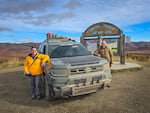
Portlanders Mercedes and Andy Lilienthal placed second in the Alcan 5000 Rally, which took them up to the Article Circle in the Yukon Territory, Canada.
Shane Bowman
The Alcan 5000 Rally isn’t the kind of car race you might think of. It runs from Kirkland, Washington over 5,000 miles up to the Arctic Circle over 11 days. It’s what’s known as a time-speed-distance rally, where following the course, maintaining the right speed and arriving at checkpoints on time is what matters the most. Portlanders Andy and Mercedes Lilienthal placed first in their class and second overall this year. The couple, who are both automotive journalists, have been obsessed with TSD rallies for years. They join us to talk about their win.
Note: The following transcript was transcribed digitally and validated for accuracy, readability and formatting by an OPB volunteer.
Dave Miller: This is Think Out Loud on OPB. I’m Dave Miller. The Alcan 5000 Rally is probably not what comes to mind when you think of a driving competition. It takes 11 days and more than 5,000 miles – many of them on dirt and gravel roads in the summer, and ice and snow in the winter – [and] goes from Kirkland, Washington all the way up to the Arctic Circle. And instead of a continuous event, there are one or two time-speed-distance rallies every day, competitions in which following the course, maintaining the right speed and arriving at checkpoints on time is what matters the most.
Portlanders Andy and Mercedes Lilienthal have done four Alcan 5000s. The automotive journalists placed first in their class twice now, including just last month. They join us now. It’s great to have both of you on the show.
Andy Lilienthal: Thank you.
Mercedes Lilienthal: Thanks so much for having us.
Miller: Mercedes, first – how do you describe the Alcan 5000?
M. Lilienthal: Oh gosh, it’s all travel, all cars, all challenge, spending time with like-minded people, and it’s absolutely brilliant.
Miller: I mentioned that this is part of it, they’re known as time-speed-distance rallies. What is that?
A. Lilienthal: So a time-speed-distance rally is a competition held in a vehicle of some sort. It has to be a street-legal vehicle. It’s held on public roads at or below the speed limits, and it’s a precision driving event. So you have checkpoints that are laid out by a rally master and you need to cross through those checkpoints at a specific time. So the Rally Master will run the route and have dropped these GPS checkpoints.
You have an app on your phone and you have a route book, and the route book gives you the average speed you’re supposed to go and gives you the directions on where you’re supposed to turn. But you have to find out the whole time aspect. So there’s big, long equations you can do and you’re penalized for arriving early, penalized for arriving late, and a perfect score is 0.
Miller: What does it take to do well at that? My understanding, Andy, is you’re the driver of the duo. So what are the skills that are required to do well at this?
A. Lilienthal: Patience. [Laughs]
Miller: Patience because it’s hard to drive the speed limit, to not go past the speed limit?
A. Lilienthal: It’s hard. Because it’s on public roads, oftentimes sort of in rural areas, sometimes it’ll start in a city, but you have traffic and you’re supposed to show up at a certain spot at a certain time. And there might be a train, or you might run into a traffic jam, or if you’re out in the middle of nowhere, a herd of sheep or cows – which has happened to us. And it can become a bit of a pressure cooker inside. So it really does take excellent communication between driver and navigator. It really does take patience. It also does take some driving skill, not to go too fast or go too slow. And it takes a lot of concentration.
Miller: Mercedes, what are you doing as a navigator during these rallies?
M. Lilienthal: So each rally organization has a different type of rally. They’re all time-speed-distance, but they might have a route book that shows little arrows as to where you need to go. They might set things up a little bit differently. The Alcan 5000 Rally, for instance, is almost 6,000 miles over 11 days. It’s very intense.
But myself, as a navigator, we run collectively, husband and wife, what is called the SOP class or Seat of Pants. That basically means you’re kind of flying by the seat of your pants, if you know that saying. You can do long-form math, you can do just a plain calculator to help you figure out incremental times, but you’re not in what is called the unlimited class. Unlimited class essentially is any rally app, any rally computer, things like that. So we basically kind of play it old school, and I’ve got a kid’s calculator that’s lime green from Amazon and a kitchen timer to keep me on time.
Miller: Because you need to just do a lot of multiplication and division, and say if we have to be at this point in 57 minutes, how fast should we go to get there at the exact right time?
M. Lilienthal: Right, exactly. And like Andy alluded to, there may be cows, there may be trains, there may be sheep, other people that are driving too slowly. But myself, as a navigator, we can either take time allowances in certain brackets of time, whether it’s 10, 20, 30 seconds … So I might have him pull off and I might reset myself, and get myself back on track for us. Or we just try to make up that time a little bit. Mind you, this is not a race at all. It’s not a speed event. It’s a precision event. So you have to be perfectly on time, perfectly on course, exactly to how the Rally Master wants it.
Miller: How did the two of you figure out this division of labor – Andy, driving [and] Mercedes, calculator, stopwatch?
A. Lilienthal: It’s pretty easy because I get car sick if I start reading in a car. So the division of labor was pretty easy on that one. She’s a very good driver. She’s done other rallies where I’m not with her and she drives …
Miller: But you’re a car-obsessed person who loves driving and rallies, but you can’t look at text without wanting to throw up.
A. Lilienthal: Pretty much. I can’t be on my phone. Like, you’re driving down the road and you’ll see people, passengers on their phone playing on their iPhone or whatnot, and I can’t do that. I just can’t. So I just drive.
M. Lilienthal: And I know some people are a little bit better inclined as far as directions, too.
A. Lilienthal: I’m not gonna lie, she’s a better navigator.
M. Lilienthal: [Laughs] But he’s a great driver, so we try to compliment each other as best as we can.
Miller: Do you have favorite stretches from these 5,500 miles?
A. Lilienthal: Oh, absolutely. One of my favorite parts of the Alcan 5000, which usually does change routes … Almost every year, you go from Kirkland up to Quesnel, British Columbia, and then from Quesnel, you either go into Alberta or you keep going north up towards Fort Nelson. But there’s an area outside of Fort Nelson called Muncho Lake, and it is breathtakingly beautiful – beautiful mountains, there’s herds of bison, lakes. It’s unbelievable. That’s one of my favorite ones.
M. Lilienthal: I think for me, the Arctic Ocean, getting there for the first time and the only time right now in 2020, which was awesome. And we took a right hand drive, 1991 Mitsubishi Pajero Diesel, and that was a winter competition. That was our first foray into the Alcan 5000 rally. But for me, seeing new geography and returning to current geography that we’ve seen before, whether it’s summer or winter, for me, that’s absolutely breathtaking because you can see how people live. You can see the geography, you can see, “Oh my gosh, there were mountains. The last time we were up here, it was all completely fog, a blizzard or things.”
Miller: What is it like to drive to the Arctic Circle in the winter?
A. Lilienthal: It’s incredible. When we did this in 2020, once we got north of Quesnel, which is like South Central British Columbia, we never saw bare pavement again. It was an incredible winter, a very harsh winter.
Miller: And this was the first COVID winter?
A. Lilienthal: It was. This was the last normal thing we did before the world shut down, was drive to the Arctic Ocean.
Miller: They call this a “normal thing.” [Laughs]
A. Lilienthal: Correct.
M. Lilienthal: We flew back on Alaska Airlines. We had a direct flight from Anchorage and everything just reeked of hand sanitizer and bleach, and we had no idea what was going on. We were in the Arctic competing for the 10 days beforehand. We had no idea what COVID even was.
Miller: The world closed in March when you were driving to the Arctic Circle?
A. Lilienthal: Correct.
M. Lilienthal: And we didn’t know anything was going on until we flew back and we started getting all these pings: “Buy toilet paper, buy beans! You got to get rice!” Just mass mayhem. We had no idea.
Miller: How did the two of you get into cars? Mercedes, first – why cars?
M. Lilienthal: Funny enough, I’m named not after a car, although there’s a very popular manufacturer of Mercedes. My parents emigrated from Germany in the ‘60s, so I’m a first generation and dual citizen German-American. My dad always loved cars. He always worked on them and I was always the kid holding the flashlight or using the toothpick, helping to fix rock chips or things like that. So I always loved vehicles. My dad was a welder and fabricator with my mom.
They had their own business, so I was always around that fixing type of mentality, or welding, or or doing something new with vehicles. And so that just transitioned into high school, into college. I was always a gearhead, although I went to school for almost 20 years as a commercial interior designer project manager. But oddly enough, on the way to Chicago from the Minneapolis area, I met Andy. He was my ride down to meet some buddies for an import car show in Chicago and the rest is history for the both of us.
Miller: Andy, what about you?
A. Lilienthal: My father loved cars. He didn’t work on cars, but he loved cars. We would go to PIR, Portland International Raceway. We’d go to Brainerd International Raceway, all kinds of stuff. He didn’t work on cars and I wanted to learn that. So I got into that and my parents always joke around saying that once they gave me my first Matchbox car, that was it.
Miller: You’ve done other rallies, right? We were talking about this Alcan up to the Arctic Circle, but what are some other famous races or beloved races you’ve done?
A. Lilienthal: Yeah, we did one in Europe last year. It wasn’t a time-speed-distance rally. It’s more what they call a gimmick rally. So it’s more like scavenger hunt, that kind of little tasks you have to do. But that’s called the Baltic Sea Circle Rally, and that started in Hamburg, Germany and then went through 10 different countries in 16 days. We did it in an all-electric Volkswagen bus or the ID Buzz. So that was incredible, because we were also not supposed to drive on the highways and the freeways. We were supposed to stay off the motorways and take all back roads.
So getting turned around, crossing into Poland from Lithuania on a farm road by mistake. We just see the sign that says “Polska” and the EU sign. I’m like, “I think we just drove into Poland. But it’s that adventure, it’s that, inexplicably we’re one of these people that wanna know what’s on the other side of the hill all the time. And these rallies pair this ability for us to spend time together, to see the world, and explore, experience all these new cultures and all these new things, whether it’s regionally or internationally.
Miller: How different do you think the rally community is from a racing community? We haven’t said the word “race” once and you’ve been very clear that these aren’t races. You’re on just public roadways and it would be illegal to go 130 miles an hour on them, in addition to being completely unsafe. But how different are the communities?
M. Lilienthal: The communities … we’ve been to many races as well, go fast, closed course type of races, and communities may be a little bit different, but they all love cars. They all are willing, to me, in my experience, to help each other if somebody has a breakdown, if somebody needs help or something like that, or stay back, loan tools or whatnot.
Especially, focusing on the rally community for a second for myself, we’ve been rallying now since about 2018 and there’s local … for instance, here in Portland area, there’s the Cascade Sports Car Club, the Gear Grinders, as they’re known – they do once a month, half-day rallies. And you see a lot of the same people, but you see some fresh, new faces. And you get to see and experience all of this together and I think that that’s what binds us, whether it’s Rainier Auto Sports Club – that’s up in Washington area – here Cascade, the Alcan 5000 or anywhere around in the world. The community is so tight knit because, as Andy likes to call it, fringe lunatics that like to do something massive like the Alcan 5000 rally or something that’s a half-day rally.
Miller: Fringe lunatics.
M. Lilienthal: It’s amazing.
A. Lilienthal: In the best way possible.
Miller: For more than a decade, you two have run a website called Subcompact Culture, dedicated to all kinds of different small cars. Why do you love small cars?
A. Lilienthal: Yeah, we started Subcompact Culture back in 2008, 2009. And I grew up with small cars. Mercedes, they had Volkswagen Rabbits and we had little Mitsubishis. I don’t know, it was always enough that we needed, but they’re easy to park. They’re frugal. They’re something that, we still own some small cars and we’ve never had big cars.
Miller: Some – how many vehicles do you own?
A. Lilienthal: Well, right now we have four.
M. Lilienthal: Only four.
A. Lilienthal: So most of them are …
Miller: Two each. [Laughter]
A. Lilienthal: Well, so three of them are Japanese-market vehicles that are right-hand drive and have been brought in under the 25-year rule. And then we, daily, drive a Subaru. But we also rally the Subaru. But yeah, four is a manageable amount for us.
M. Lilienthal: Yeah, for right now.
Miller: It seems like in this country, especially in this country, cars are just getting bigger and bigger and bigger. Is there a future for small cars in the United States of America?
A. Lilienthal: Every time the economy takes a downturn, it seems that small cars come back. And I think that there’s a variety of factors behind that. As the economy does well, they generally go away. I think it’s an interesting thing, you go to Europe and everybody drives small cars, or Japan or whatnot. And is it possible we’ll see small cars again? It’s possible. There really aren’t many subcompact cars left anymore, which is unfortunate for us, but I mean, such is the way of the world.
Miller: Mercedes, what is the new rally you’re most excited about right now? You’ve done Alcan 5000 four times now. What’s next on your list?
M. Lilienthal: Oh gosh, we’ve already signed up for 2026, for the Alcan 5000 Rally. This one will go beyond north of the Arctic Circle, both in Canada and in Alaska, and back to the Arctic Ocean, but it’s summer. So right now, we’re signed up for that. And then also, CAR, which is a Colorado Adventure Rally, a brand new rally from longtime rallyist and SCCA, Jim Crittenden. That’s going on in July in Colorado. It’s a three-day event and I’m looking forward to that too.
Miller: Mercedes and Andy Lilienthal, thanks very much.
A. Lilienthal: Thank you for having us.
M. Lilienthal: Thank you so much.
Miller: Mercedes and Andy are a wife and husband team of automotive journalists and rally enthusiasts. They recently placed first in their class and second overall in the Alcan 5000 Rally.
“Think Out Loud®” broadcasts live at noon every day and rebroadcasts at 8 p.m.
If you’d like to comment on any of the topics in this show or suggest a topic of your own, please get in touch with us on Facebook, send an email to thinkoutloud@opb.org, or you can leave a voicemail for us at 503-293-1983.