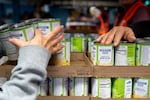
A person gets canned pears from the Ecumenical Ministries of Oregon’s Northeast Emergency Food Program food bank in Portland, Ore., on Tuesday, Oct. 21, 2025.
Eli Imadali / OPB
Earlier this month, the Trump Administration said it will not tap emergency dollars to keep funding for the Supplemental Nutrition Assistance Program flowing during the government shutdown.
On Tuesday, Oregon Attorney General Dan Rayfield announced that Oregon had joined a coalition of more than 20 states, including Washington, suing the Trump Administration for suspending the federal food assistance program. Organizations that provide groceries and other services have already faced an increased strain in resources due to inflation and funding cuts.
Earlier this year, the U.S. Department of Agriculture, the agency that funds SNAP, announced it will no longer release an annual household food security survey which researchers use to measure hunger in the U.S.
Krista Harper is the development director for Clackamas Service Center. Mark Edwards is a professor of sociology and director of the Oregon State University Policy Analysis Lab. They join us for more details about how recent federal actions affect Oregonians who rely on SNAP benefits.
Note: The following transcript was transcribed digitally and validated for accuracy, readability and formatting by an OPB volunteer.
Dave Miller: This is Think Out Loud on OPB. I’m Dave Miller. We start today with hunger. Earlier this month, the Trump administration said it will not tap emergency dollars to keep funding for the Supplemental Nutrition Assistance Program, or SNAP, flowing during the government shutdown. This comes at a time when organizations that provide groceries or other food assistance have already faced an increased strain due to inflation and funding cuts.
We’re going to get two perspectives on all this today. We start with Krista Harper. She is the development director for Clackamas Service Center, which operates a Food Hub, among other services. Krista, welcome to the show.
Krista Harper: Hi, it’s great to be here.
Miller: Can you describe how the Food Hub works?
Harper: So the Food Hub is an 8,000 square foot warehouse that we operate in Clackamas County that collects food from a number of places. So we receive food from the Oregon Food Bank, from many grocery stores, just about any grocery store you can think of, and then public donations. And then we redistribute that food both within Clackamas Service Center’s own programs, which include meals and groceries, and then to several other nonprofits and schools in the area.
Miller: So it’s sort of like a mini Oregon Food Bank.
Harper: Yeah, exactly.
Miller: Federal food support right now is being eroded in a variety of ways. There is the government shutdown, there are the new eligibility requirements from the One Big Beautiful Bill, and other USDA spending or funding cuts. I want to take these one by one, starting with the shutdown. What concerns do you have as we head into November?
Harper: So we are really bracing and already starting to experience an outpouring of requests for support to a degree that is honestly terrifying. At a national level, about 90% of food aid is actually provided by SNAP benefits versus about 10% from pantries and food banks. So you could do the math. Where are people going to turn when SNAP is not an option?
Miller: It’s almost like you’re the safety net for a safety net.
Harper: Yeah, that’s exactly correct. We see ourselves as sort of the last line of defense. We know that people don’t necessarily want to have to go somewhere at maybe an hour that isn’t convenient to them to get in line, to wait for an assortment of food where they don’t know exactly what they’re going to get. We do the best that we can to provide the best services that we can, but we know that that’s not what people want. What they want is the dignity of going to a grocery store and buying food that they want. And SNAP enables that for a lot of families that don’t have other options.
Miller: The Trump administration has also slashed millions of dollars from federal programs that deliver truckloads of food to pantries throughout the country, meaning a drop in those supplies since February. Have you been affected by that?
Harper: Absolutely. So until recently we got about 60% of our food from the Oregon Food Bank, and they’ve gotten a 20% cut in the amount of food that they receive because of those federal cuts. And that is reflected in the deliveries that we receive from them – we get less food from them, and especially less shelf stable food. So we are just out of things that normally we would be plentiful in from USDA, like canned beans or rice, those kinds of things.
Miller: And then there are the new eligibility restrictions for SNAP, similar in a lot of ways to Medicaid that we’ve talked about more. What are those eligibility requirements going to mean for Oregonians?
Harper: Basically, they create another barrier to access, because people that are being asked to prove the necessity for them to be on SNAP repeatedly. In some cases it’s a disability reason that they’re on SNAP, or it’s related to how many hours they work. So if you’re not working at least 20 hours, after a certain point, you’re no longer eligible. Some people work very unpredictable jobs and have different hours, you have to keep coming back and reproving your worth. If you have a disability, a lot of times those things aren’t going to change.
So asking people to come back and prove again, that’s a lot of what the extra battle is for SNAP. And then there’s also groups like refugees that are being taken off the eligibility list. So that creates huge problems for those people. And then organizations like ours are expected to pick up the slack when we’re already facing a huge need that we can’t fully meet.
Miller: So then what are your plans?
Harper: As usual, we are going to do the absolute best that we can. We are purchasing additional food. We have had a lot of individual donors come through with support, and that makes a huge difference right now. We’re going to be turning around and using those dollars to purchase food in bulk from some of our grocery store partners where we can get good deals.
And then we also would just call on everyone to not just support organizations like ours, but also turn to your family and friends, maybe the people that you know from where you might go to church or school. There’s people all around you that are on SNAP – 1 in 6 Oregonians is on SNAP. So you know someone who is losing benefits next month. What can you do to help?
Miller: Krista, thanks very much.
Harper: Thank you so much for having me.
Miller: Krista Harper is the development director for Clackamas Service Center.
Mark Edwards joins us now. He is a professor of sociology at Oregon State University and the director of the OSU Policy Analysis Laboratory, OPAL. He has studied food insecurity for decades. Mark Edwards, welcome to the show.
Mark Edwards: Thanks, Dave. I’m glad to be with you today.
Miller: OPB recently reported that the number of visits to food banks in Oregon and Southwest Washington increased from under 900,000 in 2019 – already a high number – to 2.5 million just five years later. How do you explain that?
Edwards: Well, it’s been a pretty rough few years. During COVID, obviously, there was a tremendous surge of need. And then surprisingly food insecurity, the measures that we have of it, did not shoot through the roof, in large measure because of the ways that the food pantry stepped up, the way that the community stepped up, the way that public programs were made more accessible. And yet, even as those programs started to be unwound, kind of sunset after the pandemic, what happened is people were once again finding that food prices were going up, cost of living was going up and the supports that they’d had were no longer available.
Miller: There have been government shutdowns in the recent past and further back. There have been society-wide economic shocks, like COVID you mentioned or the Great Recession in 2009-2010. How does the current time compare?
Edwards: I would say that in terms of the sense of fear, where things are going, this is particularly a scary time because never has this safety net program been so seriously under threat, in the sense of concerns about how hard it is to get access to it, whether it’ll be funded at all. So I think that’s the part that makes this very, very different. In the other situations, there were economic challenges, programs stepped up to solve and address those problems. In this situation, the program itself that has been that safety net seems to be under a kind of attack.
Miller: The USDA didn’t just reduce the amount of food it sends to states, as we heard just now from Krista, it’s also reducing the data it collects. Last month, it said it was going to stop data collection that’s been going on since the ‘90s. And it said this about that change in a short announcement: “For 30 years this study, initially created by the Clinton administration as a means to support the increase of SNAP eligibility and benefit allotments, failed to present anything more than subjective liberal fodder. Trends in the prevalence of food insecurity have remained virtually unchanged, regardless of an over 87% increase in SNAP spending between 2019 and 2023.”
This is data that you have used as a researcher, Mark Edwards. What’s your response to this short announcement from the USDA?
Edwards: I would say there are many elements of that statement that are just demonstrably false, as well as it has cherry picked unique, specific statistics that kind of make that false case. For example, it talks about the 87% increase in SNAP spending. Well, most of that was during COVID. In fact, that was something to celebrate. We invested heavily in programs that helped people during a particularly difficult time.
The idea that it is producing “subjective liberal fodder” is false. There are many, many, many really high-quality research projects by researchers around the country that have used these data to better understand what has been going on state to state. The National Academy of Sciences under the Bush administration approved and validated this study. There were many things said about the data itself that are false and it’s a real shame that we won’t have this in the coming years to be able to give a sense of what are the trends, which way are things going from year to year?
Miller: How does the huge hit to Medicaid compound the financial challenges that millions of people will soon be facing?
Edwards: We’ve known for a long time that food insecurity is linked to other kinds of struggles and insecurities: economic insecurities, housing insecurity, health costs. And so there’s every reason to believe that the dual challenge here of keeping Medicaid available to people, plus then this concern about SNAP not being as accessible, will really combine. So health concerns and food concerns are really, really closely linked.
Miller: What kinds of individual decisions will families and individuals be making in the coming weeks and months?
Edwards: There will be more people having to make the same kinds of decisions that many food insecure people have had to make for a long time, there will just be more of them. People will be deciding between buying prescriptions or buying food. They’ll be making decisions about cutting the portions of meals, skipping meals, choosing less healthy foods. There are just all of those sorts of things, all of which are addressed in the measures of food insecurity. We can anticipate that more and more families will have to make those kinds of very difficult choices.
Miller: In a lot of ways, the federal message to states has been, even pre-shutdown, basically “you’re on your own.” Washington and California, because of the shutdown and the looming end to SNAP nationwide, have said, along with some other states, that they’re going to put some of their own money towards SNAP next month. It wouldn’t be surprising if Oregon announced something similar in the coming days. But how much slack can be picked up locally or statewide as the federal government cuts holes in the safety net?
Edwards: I’m not an expert on state budgets, but I can say that the total amount of money that is being pulled back from the federal program cannot be met fully, either by our state budget, nor even by the emergency food system in terms of the amount of need that’s going to be produced from this.
Miller: Mark Edwards, thanks very much.
Edwards: Thanks for the conversation.
Miller: Mark Edwards is a professor of sociology at Oregon State University. He’s also the director of OPAL, the university’s Policy Analysis Laboratory.
“Think Out Loud®” broadcasts live at noon every day and rebroadcasts at 8 p.m.
If you’d like to comment on any of the topics in this show or suggest a topic of your own, please get in touch with us on Facebook, send an email to thinkoutloud@opb.org, or you can leave a voicemail for us at 503-293-1983.