

Looking for the rest of the Superabundant newsletter?
Subscribe now to get original recipes, PNW food news, and ideas for the kitchen and garden!
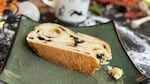
Irish barmbrack baked for Halloween often includes a hidden trinket for predicting one's fate
Heather Arndt Anderson / OPB
You may know about the plastic baby Jesus in the Mardi Gras king cake, but did you know that there’s an ancient history behind hiding symbolic trinkets in baked goods?
Special-occasion breads (think brioche, challah and various Easter breads) are typically lavish; they’re enriched with butter, milk and eggs, have enough sugar that they easily slide into cake territory and were invented in ancient Rome as an indulgence for celebrating the pre-Christmas holiday Saturnalia.
The breads were baked with various hidden objects like coins, rings or twigs to tell the future — a sort of party trick for entertaining drunk party guests.
In the mid-14th century, the bread became tradition in the town of Apt, a commune in southern France then-famous for its jewellike candied fruits and as it spread and evolved, continued to include dried fruits and a hidden surprise.
Gâteau de Rois (the French progenitor of the Mardi Gras king cake) and the Greek vasilopita — a bread or cake made for St. Basil’s Day, which also falls on Jan. 1 — both come from the same observance.
Today, these symbolic breads (or cakes) are usually served on Jan. 6 for Epiphany, but the Irish barmbrack baked for Halloween includes the same sweet, enriched dough and the hidden trinket as a pagan fortune-telling device.
My hunch is that these are so similar because they’re literally the same thing — after all, the pre-Halloween day Samhain is the original Celtic New Year, observing the end of the harvest and welcoming the days of darkness. (Coincidentally, in some parts of Greece another sweet, raisin-y wheat-based dish is prepared for the souls of the dead on Jan. 1.)
Recipes vary of course, but most contain tea-soaked dried fruits of some kind. Many of the barmbrack recipes that appeared in 20th-century cookbooks are baked round, and are more scant with the sultanas and currants than the loaves seen on modern food blogs, which have transformed it into a raisin-fest.
I thought it’d be fun to make mine more snail-shaped for the creepy-crawly factor, and to kick things up a witchier notch, I used a small skull bead made of real bone for the “trinket” (it was woven into a braid in my hair for a year in my late teens, for extra power). Feel free to omit the choking hazard. Makes 1 loaf
Ingredients
Dough
3½ cups all-purpose flour
1 cup warm milk
⅓ cup butter, softened
2 eggs, lightly beaten
¼ cup sugar
1 teaspoon fine sea salt
2¼ teaspoons (1 packet) active dry yeast
Filling
1 cup coarsely chopped raisins
1 cup hot, strong black tea (I used smoky lapsang souchong)
1 teaspoon orange zest
2 tablespoons softened butter
½ cup sugar
2 tablespoons cinnamon
Icing
1 tablespoon tea (reserved from soaking raisins)
1 tablespoon cream or milk
1½ cups powdered sugar
Instructions
- In the bowl of an electric stand mixer with the dough hook attached, combine the dough ingredients. Mix on medium until fully combined, then increase speed to medium-high and knead for 7-8 minutes, until a soft, sticky dough is formed. [If not using a stand mixer, stir the ingredients together in a large mixing bowl until a shaggy dough is formed, then knead for 10 minutes on a lightly floured surface until a soft and sticky dough is formed.] Don’t worry if it seems like a springy ball doesn’t come together. Move the dough to a buttered bowl, cover, and allow the dough to rise in a warm, draft-free spot until doubled in size, about 1-1½ hours.
- While the dough is rising, soak the raisins in the hot tea until plumped, about 15 minutes. Pour the raisins through a fine-meshed sieve, reserving the liquid, and then mix them with the orange zest. Set aside.
- When the dough has risen, turn it out onto a floured surface and roll it to a rectangle about 24 x 36 inches (the dough should be about ⅛ inch thick). Smear the surface with a thin layer of butter, then sprinkle the sugar, cinnamon and the raisins evenly across the dough.
- Roll the dough away from you, using a bench scraper as needed to keep it from sticking to your work surface, until you have a snake, then roll the snake into a coiled spiral (like a snail shell).
- Line a 10-inch cast iron skillet or ceramic baking dish with a slip of parchment paper and slide in the barmbrack. Lightly cover the dough with a tea towel and return to the warm spot to get nice and puffy, another 45 minutes or so.
- In the last 15 minutes of proofing, preheat the oven to 325 F. When the loaf has risen enough, bake for 15 minutes and then reduce the heat to 300 F. Continue baking until it’s golden brown and a thermometer inserted in the center reads 190-200 F, about 45-50 minutes. Grab the parchment to lift the barmbrack out of the baking dish, then transfer to a cooling rack.
- When the barmbrack has cooled (lukewarm to warm is best), whisk together the tablespoon of reserved raisin-soaking tea and cream with the powdered sugar until a smooth icing comes together. Either drizzle the icing over the finished barmbrack or brush it on evenly, depending on your preference. Slice and serve warm with more butter.