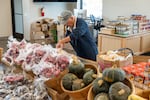
A volunteer at the Clark County Food Bank is shown preparing produce and other food for distribution in Oct. 2024 at the nonprofit's pantry in Northeast Vancouver. The food bank has seen an increased demand in recent weeks from clients at risk of losing their SNAP benefits as a result of the Trump administration's announcement that it would not fund the SNAP benefit during the federal government shutdown.
Courtesy Clark County Food Bank
On Monday, the Trump administration announced that it will partially restore funding for the Supplemental Nutrition and Assistance Program, but only at half the amount recipients of the food aid program would normally get this month. In separate rulings on Friday, two federal judges had ordered the Trump administration to tap billions of dollars in emergency reserves to continue to fund the program which 42 million Americans rely on, including 1 in 6 households in Oregon. .
SNAP recipients will likely still face delays, which could last weeks, as state agencies scramble to account for the reduced November benefits. Oregon and Washington were part of a coalition of 25 states and the District of Columbia that had sued to prevent the loss of monthly SNAP benefits beginning Nov. 1 after the Trump administration said it would halt funding for the program during the federal government shutdown. Washington Gov. Bob Ferguson and Oregon Gov. Tina Kotek last week authorized millions of dollars in state funds to support food banks in their respective states.
Roughly 930,000 people are enrolled in SNAP in Washington state. Sixty thousand of them reside in Clark County, according to Emily Straw, president of the Clark County Food Bank. She says there has been increased demand from clients in the past week or so at the two pantries the food bank operates in Vancouver.
Straw joins us to share how her organization has mobilized to help vulnerable Clark County residents facing hunger.
Note: The following transcript was transcribed digitally and validated for accuracy, readability and formatting by an OPB volunteer.
Dave Miller: From the Gert Boyle Studio at OPB this is Think Out Loud. I’m Dave Miller. Before the break, we talked with Oregon Governor Tina Kotek about delays in SNAP benefits and broader shocks to the system that addresses hunger in the U.S.
We’re going to get another perspective on this right now. Emily Straw is the president of the Clark County Food Bank. Emily, welcome to the show.
Emily Straw: Hi, thanks for having me.
Miller: Can you describe the regular work that happens at Clark County Food Bank?
Straw: Yeah, it feels like every day is different at the Food Bank. But in general our mission is to alleviate hunger and its root causes in Clark County. We do that by distributing about 10 million pounds of food per year throughout Clark County. And we work with 50 nonprofits, so that the food gets out into 130 different distribution sites. So that’s how we reach about 148,000 people every year with food assistance,
Miller: Where do you get 10 million pounds of food every year?
Straw: Great question. Just like any supply chain, you want to diversify your sources, so that when something changes, you still have food. So we do purchase a small quantity of food whenever possible. We get donated product. We have relationships with the federal government for the USDA TFAP program [The Emergency Food Assistance Program] and that is about 2 million pounds of food a year. We do a lot of grocery store recovery, so that’s another 2 million pounds of food.
Miller: Food that’s about to go bad?
Straw: Yep, it’s just at or near expiration date. It’s not actually bad product. And then we have about 30 volunteers every single day who come through and sort that food just to make sure that it really is good quality product. And then we actually have our own farm. We farm about 12 acres in Clark County over at Heritage Farm on 78th Street. We partner with a lot of local farmers. And then we have a lot of industry partners, entities like Starbucks or United Natural Foods Incorporated. Any food that they can’t sell to their normal vendors we’ll go pick up. We pick up like six truckloads just out of Ridgefield alone, every single week.
Miller: So that’s the supply side. What is demand like right now?
Straw: Well, demand is really high right now. I pulled some numbers just from two of our own distribution sites – so a very small sample set – just because we’ve been hearing so much concern in the community. And year over year, we saw a 26% increase last week, and that’s just because people are worried about SNAP.
Miller: But, am I right here? I mean, the timing is worth lingering on for a second because you’re saying you saw a 25 or whatever percent increase from last week compared to the same week the year before – that’s before SNAP payments were put on hold.
Straw: Correct. I don’t know if you tried to buy toilet paper during COVID, but there wasn’t much out there. So the same kind of thing happens. People have heard that SNAP was going to get defunded and they can’t afford that. How do you compensate or how do you plan ahead? Just like the Food Bank’s been planning ahead that it might not be funded. Individual homes really have to do that too. So the spike was just in preparation for the fact that there would be additional need.
Miller: Can you give us a sense for the role that SNAP benefits play in Clark County – this seems like really a nationwide story and a household by household everywhere in the country story – in terms of addressing hunger, and the role that food banks play, and the scale of those two different responses? The point is all the same thing. People shouldn’t be hungry. These are very different ways to address that. And the scale seems really important to just keep hammering in our heads.
Straw: Yeah, it’s definitely been said that food banks will take care of them, and I don’t know that you’ll ever find a food bank that will say that we know that we can cover SNAP. Feeding America is a nationwide network of food banks and they have looked at the numbers. For every one meal that a food bank in the nation covers, nine are covered by SNAP. So nationwide, we would have to nine [times] our production, which doesn’t feel reasonable or doable in any real way. In Clark County alone, Clark County Food Bank’s annual operating budget for all of the food distribution and all of the other programs we run, like financial wellness and nutrition programs and every single thing we do, costs us about $7 million a year. That’s the Clark County Food Bank annual operating budget.
Miller: And that’s not just food?
Straw: That’s not just food.
Miller: OK, that’s a $7 million budget for the Food Bank program for a year.
Straw: Yep. And in Clark County alone, in November alone, we will be missing $19.4 million of SNAP, if it’s not funded. So we are not fooling ourselves, thinking that our $7 million per year budget will jump up to $19.4 million for this month. That’s a gap we can’t fix.
Miller: But it’s like $230 million or something a year, versus $7 million?
Straw: Correct.
Miller: OK, and then we have announcements from Oregon Governor Tina Kotek or Washington Governor Ferguson. In the case of Ferguson, he’s directing $2.2 million weekly in state dollars to the state Department of Agriculture to disperse food to food banks and pantries in the state. So, I mean, just based on the numbers you were talking about, it’s not nothing. But it’s nowhere close to the hole that’s been blown in the food safety net. Have you seen that money yet, first of all?
Straw: We’re really appreciative that there was any funding allocated to help with this situation. And exactly, it’s not even close to the scale that we’re facing. We don’t have cash in hand, but we do have amendments coming our way today. They have to figure out the legal workings of this, of course, and our Clark County allocation will be $93,000 for this week. I was just on the phone with WSDA, Washington State Department of Agriculture. [They have] a food assistance program. They’re great helpers and advocates of ours, but we don’t even know what to do next week ...
Miller: That’s an important point. When you say we don’t even know what to do next week, what do you mean?
Straw: What I mean is that the $93,000 is just for this week, and we have no idea if we’ll get $93,000 again next week. So when we’re doing our purchasing, Clark County Food Bank, for example, has an annual food purchase budget of about $500,000 per year. We’ve already spent over $200,000 in this last two weeks on food alone, just in preparation to help cover the gap. The governor has promised, through this WSDA run program called EFAP – they run it through an allocation just because they already have that method, it’s the fastest way to get us money and to cover the entire state – we’ll get $93,000 this week.
So, if we want to plan for next week, we really don’t know because we don’t know if we’ll be partially funded because SNAP’s partially funded or if we’ll be fully funded. Until SNAP is fully refunded, we don’t know if the government will be reopened or shut down. And so, for us, luckily, we have a really supportive community, really supportive board, a really supportive leadership team at the Food Bank. But we’re just reallocating our own funds and we kind of have to operate somewhat blindly, not knowing if we’ll be reimbursed for any of it.
Miller: Do you feel like you have any more clarity about SNAP in Washington state than we heard from Tina Kotek and her just gigantic question marks about what the feds are doing for Oregon?
Straw: Sadly, we don’t. I wish there was some secret source of content or information, but we’re also somewhat in the dark. We’ll celebrate when people get funding on their EBT cards, but we don’t have any kind of inclination on when that would happen.
Miller: Do you have a sense for how many of the folks who use your food pantries are themselves SNAP recipients?
Straw: Yeah, many. Just narrative alone, we know that many folks are already using SNAP. We’re not supposed to substitute SNAP. When SNAP runs out and you still need assistance, that’s usually when people come to food banks and food pantries.
Miller: How much have you heard about SNAP signups over the last 10 months? Because we haven’t even talked about the work eligibility requirements that are coming. They are similar to the ones for Medicaid which, every expert says, will mean that fewer people will be on the rolls of both of those programs in the coming years. That hasn’t happened yet. What have you seen in terms of actual SNAP roles or SNAP eligibility?
Straw: One of the programs that we do at the food bank is to partner with DSHS, who’s the entity that runs SNAP in our state. And we enroll folks in SNAP. So when someone Googles “food stamps, Washington,” we often come up instead of the U.S. Department of Human Services, just because we’re working with people so regularly. When folks enroll through us, we partner with DSHS, they get enrolled through SNAP. That has dropped off significantly. We went around the state with some of our partners and said, “are you guys seeing this too?” Because SNAP still exists. This was before the government shutdown declared that they would not fund SNAP.
Miller: Was this after the One Big Beautiful Bill passed?
Straw: It was, yeah. That’s when our decrease happened, correct. Talking to clients, what we have heard across the state – because the state’s down on SNAP enrollment, not just Clark County – there are two primary reasons that we hear. One is “I thought SNAP was already cut.” That can come either because SNAP-Ed, which is a completely unrelated program, was defunded already. And so they thought SNAP was also defunded. That’s not true, but it’s easy to get confused if you’re not in this industry. And there’s so many acronyms running around. Some people just thought SNAP already ended. Some people thought that the work requirements were already there and they might not be eligible. So that’s the primary reason; they had confusion whether they could apply for SNAP.
The other folks, the other category are folks who are scared. [In applying for] SNAP, rightfully so, you have to give a lot of information. And it is a government-run program. So you’re giving your name, your address, and the content about all of your family, your income. Anything you could think about a person, you basically use when you’re signing up for SNAP. And people are too scared to give that out, particularly when their name might sound like it’s a Hispanic background, Arab background or anything like that. So the folks who are enrolling, no matter their citizenship status, they’re just scared to enroll. And that’s [resulted in] a big decrease in the enrollment that we’ve seen.
Miller: It’s really notable that the different reasons you just gave for the drop in new enrollments, you did not say that fewer people are hungry. You said people have gotten scared to interact with the federal government. Or they have gotten incorrect messages about what is available to them, not that hunger has gone down.
Straw: Yeah, scared or confused would be the top two reasons. Absolutely not, because the need has decreased.
Miller: What have you been hearing directly from SNAP recipients in recent days?
Straw: Like I said, last week alone, we had a huge increase. I am not always in our food pantries, but I asked a couple of folks, and then I actually received a kind of unsolicited email last night. And it’s a very common story that there is oftentimes some disability. So, one of the folks came in and he had had two traumatic brain injuries. There’s nothing that you can do about that. But it makes it really hard for him to walk around. He’s on disability. And so without SNAP, he came last week knowing that he wouldn’t be able to pay his rent on the 1st. So his big concern was that money that he gets through SNAP, is just absolutely bare minimum for him to then also have the money to pay rent. So he reallocated that to his rent because he’s worried about being homeless.
Now, he came up to talk to us to ask if we had any updates because he’s saying, “I heard this was partially funded and then not going to be funded in the future,” which then, of course, he’s putting one plus one together and realizing, he’s not going to be able to pay rent next month. And so he was asking about housing resources kind of preemptively to say, “I know there’s a housing crisis. I can’t afford anything else. I’m going to be homeless in a month. How can you help me out with that?” So that’s very common. That’s one individual who came in. But that’s a very common story that we’re hearing.
Miller: And all this is before those new eligibility requirements are even going to kick in. What are those going to look like?
Straw: Yeah, I mean, there’s a lot that we don’t yet know in that space, and we want to be a partner however we can, to get people access to the resources they need. So if people need to volunteer with us, we have many opportunities. We will comply with whatever we need to, but it is a big question mark and a big concern for the folks that will no longer qualify for SNAP. And when you’re already month to month, that’s just a resource that you need. You can’t possibly afford to lose that.
Miller: You’ve been at the Food Bank for nine years. Am I right about that? Have you ever had a moment like this before in your nearly a decade of work?
Straw: I mean, it’s truthfully really reminiscent of COVID. The spike that we saw at the beginning of COVID was absolutely as dramatic.
Miller: But wasn’t it the opposite? During COVID the federal government was, in various ways, giving people money, not reducing benefits?
Straw: Correct. The really big difference was we had a huge spike and then there was a huge allocation of resources. There were checks, as many people received, and then really big food programming also. So we, the Food Bank, received more food than ever from the federal government and distributed that. And it was its own level of chaos. We laugh at our own notes when we were strategically planning, trying to get ahead of this virus and what to expect. So, there was definitely chaos, but there was an incredible amount of resourcing. The really big difference is the silence in the government now. The community has stepped up in the same way. It is absolutely breathtaking.
Miller: When you say community, do you mean contributions?
Straw: Donors, volunteers and people who care about each other.
Miller: What is the most effective way for people to actually help out?
Straw: That’s a harder question than I wish it was because it just depends on everyone’s own resources. We had someone come in yesterday who I met at the front desk, and she had cleaned out her entire pantry, her entire kitchen to donate it, brought $100 cash, and then said, “Well, I’m out. That’s all I can do. Can I volunteer as well?” So that resource, we don’t want everyone cleaning out their entire pantry. We don’t want more food insecure folks. But that’s what she could do and that’s how she could participate, and that matters a lot. It diversifies our food source, it is money that we can purchase food with, and it’s time, dedication and care for the community.
Other people, it’s just invite their neighbor over. If you think about it, there’s over 60,000 people in Clark County right now affected by this. You know them. If you’re in Clark County, they’re your kiddo’s friends. They’re your next door neighbor. They’re your co-worker. And so inviting them over for dinner and supporting them on an individual basis might be the way that fits your family well. And then donations of cash are huge because we can, of course, leverage that and make big purchases at really discounted rates.
Miller: Meaning that if [someone] is thinking about giving something to you or other food banks, you’d rather have $50 in a check or cash, as opposed to somebody spending $50 at Fred Meyer and giving you the groceries they could buy with $50?
Straw: Yeah, if you have something in your pantry you’re not gonna eat, that’s a free donation for you. That’s a great thing to do. If you’re gonna go to the store and buy at your rate, at the normal consumer rate, we can beat that. So, a $1 donation is definitely more effective in that way.
Miller: Emily, thanks very much.
Straw: Yeah, thanks for having me.
Miller: Emily Straw is the president of the Clark County Food Bank.
“Think Out Loud®” broadcasts live at noon every weekday and rebroadcasts at 8 p.m.
If you’d like to comment on any of the topics in this show or suggest a topic of your own, please get in touch with us on Facebook, send an email to thinkoutloud@opb.org, or you can leave a voicemail for us at 503-293-1983.