
Dust fills the air at Kirsch Family Farms in St. Paul, Ore. during the hazelnut harvest on Oct. 7, 2025.
Crystal Ligori / OPB
It’s a crisp October morning and just outside St. Paul, Oregon there are what looks like plumes of smoke in the air. Only it’s not smoke, it’s clouds of dust kicked up during a nearby hazelnut harvest.
“This is the sweeper machine that sweeps the row into place,” said Brenda Frketich, pointing to what looks like the farm version of a street sweeper.
Essentially everything is swept off the ground in this orchard; dirt, sticks, worm casings, leaves, and of course, hazelnuts, which Frketich explained naturally drop when they’re ready to be harvested.
“The almond industry, they are the ones that shake the trees, but filberts, they just pop out of the trees,” she said.
Frketich is a third generation farmer who, along with her husband, owns Kirsch Family Farms. This season is a little earlier than normal, so they’re already on their second harvest of filberts, more commonly known as hazelnuts.
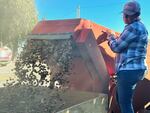
Farmer Brenda Frketich processing the second hazelnut harvest of the season on Kirsch Family Farms in St. Paul, Ore. on Oct. 7, 2025.
Crystal Ligori / OPB
Of their 1,000 acre farm about 130 acres is hazelnut orchards — the rest largely grass seed, clover and other rotational vegetable crops — but in the last five years a half of those trees have been replaced.
“We’ve taken out every block of Barcelonas, which was our original variety that we planted in 1990,” said Frketich.
Instead, they planted locally bred varieties like Jefferson, Wepster, and PollyO.
The diversification was spurred by the spread of Eastern Filbert Blight, a fungal disease that was introduced to the Pacific Northwest in the late 1950s.
“It was accidentally introduced somewhere in the Vancouver, Washington area and it slowly started to move down the valley,” said Nic Wiman, a hazelnut specialist and associate professor of horticulture at Oregon State University.
Eastern Filbert Blight wasn’t officially discovered in Oregon until 1986, but Wiman explained that OSU researchers recognized early on that the best way to manage the disease would be to breed varieties with resistance to it.
“Our first hazelnut breeder started in the 1970s, but hazelnuts are a very long-lived crop and so it literally takes about 17 years from the time when they make a cross to when they know if it’s a variety worth releasing or not.” said Wiman.
In the decades since, OSU has released dozens of commercial hazelnut cultivars, many using a single gene discovered to be resistant to Eastern filbert blight.
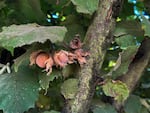
A cluster of hazelnuts still on the tree at Kirsch Family Farms on Oct. 7, 2025. Unlike other nuts, hazelnuts must naturally fall off the tree to be harvested.
Crystal Ligori / OPB
But Wiman says their work is far from over. “Just in the last couple of years we’ve realized that the disease has mutated,” said Wiman. “We have new raises of the Eastern Filbert Blight which overcome the single gene resistance.”
Meanwhile, the market for hazelnuts in Oregon is growing. In the last decade alone, the amount of acreage dedicated to the crop has more than tripled and this year’s harvest is expected to break records, with estimates of 115,000 tons in-shell, or about 20% more than last year.
The guaranteed prices for farmers are also up about 40% from last year’s minimum to $1.05 and $1.30 per pound. That’s welcome news for farmers like Frketich.
“We have about three or four years of really bad prices to make up for,” she said. “So it’s been a long road, but I’m happy it’s our last harvest of the season and we’re ending on a positive note.”
Oregon produces 99.7% of the hazelnuts in the U.S. and is now neck-and-neck with Chile to become the second largest producer in the world after Turkey. It’s something hazelnut buyers are taking note of.
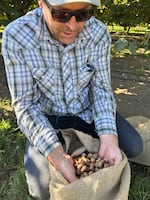
OSU hazelnut specialist Nic Wiman shows off a freshly harvested bag of hazelnuts at the North Willamette Research and Extension Center in Aurora, Ore. on Oct. 7, 2025.
Crystal Ligori / OPB
“Ferrero is the world’s largest hazelnut buyer and they have been very generous to Oregon State University,” said Wiman. “They see our industry becoming the main source for the nuts that they are gonna utilize in North America.”
Best known for the chocolate hazelnut spread Nutella, the Ferrero Hazelnut Company is the single largest buyer of Oregon hazelnuts and over the past five years has invested around $1.5 million into OSU’s research.
But Oregon hazelnuts are utilized closer to home as well, by iconic local brands like Bob’s Red Mill and Tillamook Ice Cream and smaller companies like King Family Hazelnuts.
“We started out packaging hazelnuts right from our kitchen and sold them at farmer’s markets and people liked them so much, eventually we needed a bigger facility,” said JoAnn King of King Family Hazelnuts.
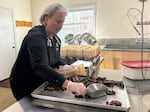
JoAnn King packages chocolate covered hazelnuts at the production facility at King Family Hazelnuts in Silverton, Ore on Oct. 29, 2025.
Crystal Ligori / OPB
JoAnn and her daughters Ashley and Kristin run the business together, hand-making each batch in variations from lightly salted and cinnamon sugar to garlic parmesan and hazelnut clusters covered in chocolate. All of which use the same hazelnut variety.
“We use Jefferson since they have a lower oil content, they just seemed to work better than other varieties we’ve tried,” said King.
That variety was developed right down the road at OSU and is essential to helping Oregon’s hazelnut industry survive and thrive as one of the most prestigious in the world.
“Those [original] trees, they did a great job for us for a very long time and now we’re set up to continue on with these other newer varieties,” said Frketich. “With farming you’re used to legacy, you’re used to that long term outlook to say this is gonna be what’s best for our land and it’s something that we want to continue.”