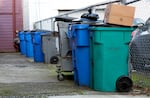
Trash cans in downtown Vancouver on Nov. 10, 2025. Garbage rates will increase slightly in the city in 2026.
Erik Neumann / OPB
Rates for trash, recycling and organic waste are going up in Vancouver next year. But you can probably pay the difference with what’s in your change drawer.
The new costs to customers are due to inflation, increased fees from Clark County and the city and a decrease in diesel fuel costs.
The result will be an increase for the typical residential customer of about $0.32 cents per month for garbage, recycling and organic waste collection. The estimate is based on a residence using a 32-gallon garbage can with weekly pickup. On the commercial side, costs for a 2-yard garbage dumpster will increase by $3.74 per month.
The 2026 garbage and recycling rate adjustment was approved by the Vancouver City Council on Monday night.
The City of Vancouver contracts with Waste Connections of Washington for local trash and recycling pickup. It’s then sorted, processed and disposed of at transfer stations managed by Columbia Resource Company at several sites around Clark County.
Big water projects planned
Vancouver residents may see more substantial increases in their water bills in the near future.
Over the next six years, the Vancouver Public Works department is planning for several large capital projects to continue getting clean water to residents.
It will upgrade drinking water, sewer and stormwater utilities, make improvements for natural disasters and increase capacity to handle long-term population growth in the city.
“There’s this bubble of work in the next six years associated with the new operations center and the PFAS,” said Chris Malone, the business services manager for the Vancouver Public Works department, during a Nov. 3 city council meeting.

An undated photo of Vancouver's Water Station 4. The facility is one that the city will upgrade to mitigate for PFAS contamination in the coming years.
Courtesy of City of Vancouver
PFAS is a type of persistent, human-created chemical that can increase the risk of cancer and other serious health issues.
This year, the city began construction on a $175 million Public Works operations center that includes drinking water utilities. The existing facility is too small and not seismically resilient, according to documents for the city’s capital improvement program.
Vancouver is also in the process of upgrading water stations to mitigate contamination from PFAS. Upgrades will happen one station at a time and are expected to cost approximately $300 million, according to Malone.
To pay for these projects, the city has adopted a 4.5% annual rate increase for the current 2025-26 biennium.
Malone said staff will likely recommend another 5.5-6% water utility rate increase for both 2027 and 2028, meaning water bills could increase by nearly 17% over that time.
The city is also exploring bonds, low-interest and forgivable loans and EPA loans to fund the projects.
Next, the city’s wastewater utility is in need of upgrades because of aging infrastructure, including pump stations and an incinerator at the wastewater treatment plant on the west side of Vancouver.
To that end, the city adopted a 6% rate increase in the current biennium. Malone said his department will likely propose a 5.5% increase for 2027 and 2028, tacking another 17% increase onto wastewater bills.
The final infrastructure upgrades relate to stormwater. Aging infrastructure, substandard water mains and the need for flood resiliency have prompted the need for rate increases with the stormwater utility, Malone said.
Projects include the Mill Creek culvert replacement project and water quality improvements along Burnt Bridge Creek.
In the current biennium, the city adopted an 8% rate increase for this relatively smaller utility. Malone said the Public Works department is recommending the same increases in the next biennium for a possible 24% increase through 2028.