OPB followed 25 students from first grade through high school as part of the Class of 2025 project to track the state's progress toward 100% high school graduation starting in 2025.
The project’s final documentary is now available on YouTube, and will air on OPB-TV on Thursday, Nov. 13 at 9 p.m. You can also attend a free screening and discussion at Mt. Hood Community College on Sunday, Nov. 16 at 3 p.m. Register here.
In OPB’s 13 years documenting the Class of 2025’s experience in public schooling, regular school attendance in Oregon has only gotten worse. In Oregon’s effort to push up its graduation rate toward its goal of 100%, poor attendance and chronic absenteeism have been like anchors weighing down the efforts of leaders and educators.
“It’s hard to graduate if you’re not here,” said David Douglas High School counselor Kagan Young.
Even before the pandemic, Oregon’s rate of students missing 10% or more of school days — two days a month — was increasing. But in the years after COVID-19 shut down schools, it ballooned, reaching a high in the 2022-2023 school year, where state data reported almost 4 in 10 students were chronically absent.
According to the U.S. Department of Education, Oregon was the state with the worst chronic absenteeism in the country that year — when the Class of 2025 was in their sophomore year.
Attendance was a persistent issue for a handful of students in OPB’s Class of 2025 project, a cohort OPB followed from kindergarten through high school graduation this past June.

Class of 2025 student Kaylie plays with Paige, a preschooler, at David Douglas High School. Kaylie is part of a career technical education program focused on early childhood education, which involves planning lessons for a preschool class.
Elizabeth Miller / OPB
“Some stuff happened and it just kinda all went down the drain,” said Kaylie, a student in OPB’s Class of 2025 who ended 10th grade with a 44% attendance rate.
That stuff included her mom’s extended illness and hospitalization.
Two years later, Kaylie graduated with her class, improving her attendance to about 90% senior year. She credits her parents with helping her get there.
“The only place that I got support from that got me to graduate was my parents, but there was nothing from the school,” Kaylie said.

Class of 2025 student Kaylie pictured here in the summer after sophomore year.
Elizabeth Miller / OPB
Attendance — and keeping track of attendance — is important. Missing a lot of school can mean not reading at grade level, or a higher likelihood of dropping out, said Rachel Anderson, vice president for policy analysis and impact at Data Quality Campaign, a national nonprofit focused on the use of data in education and the workforce.
“It’s a predictor of certain types of later outcomes but then also it can be sort of a warning signal for other underlying concerns that a school or district or state might need to address,” Anderson said.
Kaylie’s school, David Douglas High School, does have efforts intended to support student attendance — but as schools face budget challenges, those efforts have been undermined. More state support could be welcome.
As a state, Oregon is not confronting its chronic absenteeism problem as directly as it could. Guidance documents, grants, “Attendance Awareness Month” proclamations, and a new bill requiring a report of these “initiatives” all point to the state passing the burden of improving student attendance to overburdened local school districts. Should chronic absenteeism be more of the state’s problem to solve?
The why
OPB talked to several school leaders about attendance and absenteeism in their schools.
“If the students aren’t here, they’re not learning,” said Monica Haley, principal of Evergreen Elementary School in Cave Junction, Oregon.
But, Haley said, there are attendance factors that she can and cannot control.
“What I can control is the culture of my building,” Haley said. “I can build a culture at the school within my staff that is welcoming to students, where they know that they belong.”
But outside of her control are two factors: the district’s four-day school week and transportation challenges. Haley said the shorter school week has made it easier to retain staff, but to get the same amount of instructional time, students are in school longer. Some students may have to be ready for the bus before 6:00 a.m. to make it to school by 7:15, compounding transportation difficulties for children and families.
“To expect a 5-year-old, a 6-year-old to be in the dark in the middle of the winter to get on the bus, to then ride the bus for an hour, and then come to school, be ready to learn,” Haley said, “If you missed the bus … there’s a lot of geographic and financial barriers [for families].”
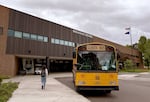
A school bus in front in Salem, Ore. May 2024. School leaders across the state say transportation challenges are one reason students struggle with chronic absenteeism.
Elizabeth Miller / OPB
For the 2023-2024 school year, 50% of Evergreen Elementary students were chronically absent, including 63% of kindergarteners. This year, the school is trying something new for kindergarteners: moving special classes like PE to first thing in the morning. The reason is twofold, Haley said: having a popular class first thing may increase interest in getting to school on time, plus tardy students do not miss important core instruction.
From elementary schools in Southern Oregon to high schools in Southeast Portland, transportation is an issue plaguing students of all ages and across the state.
At Parkrose High School in Portland, school starts at 8:45 a.m. Principal Molly Ouche said that’s later than it used to be — a change she says has led to more students showing up on time.
“They’re up late, they’re getting home late from sports or work, or they’re just up late,” Ouche said.
But a later start time doesn’t change the availability of public transportation or the weather. In the 23-24 school year, chronic absenteeism was at 56.7%.
“Public transportation in Portland, especially out in East County, is a challenge,” Ouche said. “They [students] don’t have cars … and it’s really up to them to walk to school and sometimes there’s distractions along the way or in their home.”
At La Pine Middle School in Central Oregon, the most recent state numbers available show nearly half of the school’s students — 48.8% — were chronically absent. The biggest attendance problem is in 8th grade, where almost 60% of students were chronically absent.
La Pine principal Brian Barringer said transportation is also a challenge for his students, who come from a broad geographic area.
To improve attendance rates, Barringer said making students feel welcome is key, even when they haven’t been showing up to school. In Oregon, a student is dropped from a school’s enrollment if they miss 10 consecutive days of school. This summer, the Bend-La Pine school board updated its policy. Now, if a student with multiple unexcused absences misses between 3-6 days, they’ll be contacted by the “student’s support team.” If the student continues to miss days, they’ll get personally contacted again, not just via an automated message.
Barringer added that a daily advisory class is meant to help students build a strong connection with at least one teacher.
“If we create an environment where students want to be at, and it’s a place they feel good about coming to, and don’t want to miss, that’s how we’re going to probably make the biggest gains,” Barringer said.
Christine Bowlby currently leads Houck Middle School in Salem, but before that, she was one of the principals of EDGE, the Salem-Keizer Public Schools’ online program.
In changing jobs from an online program to a brick-and-mortar school, Bowlby said the culture of school being “optional” during COVID-19 and distance learning hasn’t gone away.
“We are still needing to remind kiddos that school isn’t optional,” Bowlby said.
Oregon’s timid response
“Every day matters”, says the Oregon Department of Education’s page on attendance and chronic absenteeism. The page includes endless lists of links for schools, districts, and families about why attendance matters, causes of chronic absenteeism, and an attendance tracker families can print out to monitor their child’s attendance.
But, similar to Oregon’s effort to increase graduation rates, all of these resources don’t necessarily point to how Oregon will reduce absenteeism.

For the last 2 years, Gov. Tina Kotek has participated in phone bank events calling families to encourage regular school attendance and congratulate students for good habits. Kotek joined volunteers at Waldo Middle School in Salem, Ore., in Oct. 2024. This past October, Kotek called families from Silver Rail Elementary School in Bend.
Natalie Pate / OPB
According to an Attendance Works survey of state attendance policies, Oregon has set goals to reduce chronic absenteeism to 15% for all students, 18% for students of color, and 21% for students experiencing disabilities.
Yet according to the survey, Oregon has no guidance to reduce absenteeism and reach those goals.
Two bills that passed this year, House Bill 3199 and Senate Bill 315, may help.
HB 3199, whose chief sponsor was the late Rep. Hoa Nguyen, requests Oregon’s Legislative Policy and Research director to study the effectiveness of statewide attendance initiatives. The bill also creates an attendance advisory committee to review the study and recommend an attendance improvement policy by 2027.
SB 315 requests the Department of Education to publish a report by May 31, 2026, with recommendations on how to best standardize student absence data collection.
But actual shifts in how Oregon responds to chronic absenteeism will likely take longer. Administrators OPB spoke to say state intervention would be welcomed.
“I would argue that we’re begging for them to have a more active role,” Haley, the principal in Cave Junction, said.
Haley said the state’s “lack of follow through on attendance” only got worse after pandemic restrictions ended.
“We’ve never gotten our families and communities to go, ‘no wait, this is a number one priority,’ — it’s almost like we’ve just given in to, ‘we can’t control attendance,’” Haley said.

In spring 2021, only a fraction of students had returned to in-person schooling at Southeast Portland's Ron Russell Middle School. Oregon schools remained closed longer than other states, and attendance hasn't fully recovered.
Stephani Gordon / OPB
Bowlby, the principal in Salem, said staff at her school are working on what they can do to help build better habits as students return from being dropped from enrollment rolls, such as having a re-entry meeting with the family.
“A lot of our families know the 10-day game,” Bowlby said
“It would be nice if there was … something that would have, I don’t know, a little bit more teeth, or require some sort of intervention or something for our families once they enroll in school,” Bowlby said.
One thing Oregon does not do — and that school officials say doesn’t work — is take a punitive approach to absenteeism.
“I don’t really think that kids or parents don’t want their kids to be here,” Ouche said. “It’s just sometimes there’s things that get in the way.”
In other states, more reporting and more awareness
Chronic absenteeism is a national problem that each state is tackling differently. And as an October report from nonprofit advocacy organization EdTrust shows, several states are taking a stronger approach than Oregon.
That includes Oregon’s neighbors to the north and south, who have committed to a 50% challenge with 14 other states and Washington D.C. to cut chronic absenteeism in half.
Both Washington and California make chronic absenteeism data more readily available than Oregon. In Oregon, one can only see absenteeism data for one year at a time. But California and Washington each offer easy-to-find year by year comparisons. Both states also collect data on excused vs. unexcused absences, though only California publishes that information.
However, EdTrust found “no evidence” that Washington has a long-term plan to reduce chronic absenteeism.
Other states have gone even further in their efforts to reduce chronic absenteeism.
In 2021, Connecticut started its Learner Engagement and Attendance Program (LEAP) that uses home visits to reduce chronic absenteeism through relationship building and family support. A review of the program’s effectiveness found a 15 percentage point improvement in attendance for students at the high school level.
“The pandemic really did mark this turning point when education leaders realized how useful that data could be to tease apart some of the larger challenges that they were facing, and also to use attendance as a marker of seeing progress in addressing some of those larger underlying problems,” said Anderson with the Data Quality Campaign.

Ava, part of OPB's Class of 2025 cohort, sits in class at Ron Russell Middle School in spring 2021. In the return to school after distance learning, COVID precautions included small classes, masks, and distancing between students.
Brandon Swanson / OPB
Rhode Island offers an attendance dashboard it updates on a daily basis to “help school leaders identify attendance issues early and often.” The dashboard’s information can be broken down by neighborhood, with a heat map to show which days the most students were missing. State officials say publishing the data increases awareness and helps attendance become a community problem to solve, rather than just the focus for school or district officials.
In Monica Haley’s close-knit Southern Oregon community, the focus is on trying to make connections between students, families, staff, and even law enforcement — it’s up to Oregon to remove some of the barriers that keep kids from getting to school.
“We’re building those relationships, we’re building the bridge,” Haley said.
“We need someone a lot more powerful to come in and say, ‘no, this is important to us as a state, and it’s going to help our state in the long run, in 10 years, in 15 years, for students to turn into productive citizens.’”