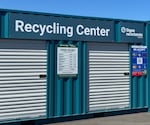
In this undated photo, provided by RecycleOn, its new Ashland center that opened in October is pictured.
Courtesy RecycleOn
Oregon lawmakers passed the Plastic Pollution and Recycling Modernization Act in 2021, but the changes just went into effect on July 1, 2025. It’s a sweeping, multi-pronged approach to reduce waste, and many of the changes the law drives are the responsibility of producers and manufacturers. New recycling centers are one element of the Act, the first of which came online this fall. At the RecycleOn Center in Ashland, more kinds of plastic can be recycled, along with shredded paper, aluminum foil and other materials that often end up in landfills or contaminating recycling picked up by curbside collectors. Kim Holmes is the executive director of Oregon’s Circular Action Alliance, the Producer Responsibility Organization that co-operates the Ashland facility. She joins us to tell us more about the impact of this center and the other 143 planned for the state.
Note: The following transcript was transcribed digitally and validated for accuracy, readability and formatting by an OPB volunteer.
Dave Miller: From the Gert Boyle Studio at OPB, this is Think Out Loud. I’m Dave Miller. A new recycling center opened in Ashland last month that accepts certain plastics and other materials that otherwise can’t be recycled in Oregon. The center is just the first of more than 140 that are planned in the coming years as part of the state’s Plastic Pollution and Recycling Modernization Act.
Kim Holmes is the executive director of Oregon’s Circular Action Alliance. The nonprofit helps to operate the facility. She joins us now. It’s great to have you on Think Out Loud.
Kim Holmes: Great. Thank you, Dave. It’s nice to be here.
Miller: So your organization, Circular Action Alliance, is what’s known as a Producer Responsibility Organization, a PRO. What does that mean?
Holmes: Yeah, a Producer Responsibility Organization is an organization that’s funded by the producers to ensure their compliance obligations are met within the state. So, in the state of Oregon, we have extended producer responsibility [EPR] for a wide range of products. We’ve had EPR for electronics for about 20 years. We also have extended producer responsibility for paint, pharmaceuticals, mattresses, and now, as of July 1, for packaging and paper products. So the producers pay into our program for us to make sure that we are fulfilling all of the obligations of the producers.
Miller: There’s a lot, but what are the basic obligations of these producers? What do they have to do now under this Oregon law that passed in 2021 and is now in effect?
Holmes: Well, fortunately, because of the Producer Responsibility Organization, participation and compliance is simple. They register with the Producer Responsibility Organization, report the products that they sell into the state and then pay their share to fulfill their obligation. Then we use that money. And within the state, the compliance requirements are [that] we are providing funding for expansion of recycling systems across the state. In some cases, building new curbside programs from the ground up. In other cases, providing new equipment so that they can collect an expanded range of products.
We are building out the new network of collection points. We’ll have over 140 new collection points that expand the range of products that can be recycled beyond what’s in curbside. We’re also funding contamination reduction programming for local governments so that we can make sure that we recycle better and reduce the contaminants that go in.
We’re also ensuring that our recycling goes to responsible end markets, restoring transparency and faith in the recycling system.
Miller: What kinds of materials are going to be accepted, say, in Ashland or soon in other places that aren’t currently recycled or recyclable in Oregon?
Holmes: So, the Producer Responsibility Organization has been charged with collecting a set of materials that are recyclable and there are strong end markets, but they’re a little bit more challenging to sort out in our current system, in our current commingled recycling system. So the materials that will be collected separate through these recycling centers include plastic bags and your stretchy plastics, your foam plastics, plastic lids, rigid plastic ...
Miller: Lids. That makes me happy. If you get the yogurt and you put the yogurt tub in the recycling and the lid goes in the trash, it’s the same kind of plastic, but the shape is different and it drives me crazy. So lids are on the list now.
Holmes: Yeah, so you’re right, lids are the same type of material but challenging to sort, right? One is a container and …
Miller: They mess up the machines is my understanding.
Holmes: One is a 3D item, one is a 2D item, and they travel differently, right? So along those same lines, those rigid plastic packaging handles, also kind of a 2D item that moves like a plastic lid. So we’ll be collecting those, plastic buckets and pails, aluminum foils and trays, shredded paper and glass as well.
Miller: So how is it going to work? And it seems like what you were saying at the beginning is that there’s going to be still a kind of a patchwork of systems. Some places in the Portland area, for example, there’s curbside recycling. Some places in Oregon don’t have that. So in the new system, will people be able to put lids, in the Portland area, in curbside recycling, or there will now be more places around where you can make a special trip to drop off this stuff that can mess up machines.
Holmes: Yes. So, we will maintain two separate lists, what can be collected curbside. And one of the exciting pieces of the law is that that will be standardized across the state. So, what we’re recycling curbside in Portland is what will be recycled in Baker City. So, that’s a nice new expansion. Those lids though will be maintained separate, so we will be building out these collection points over two-and-a-half years. So, by the end of 2027, we will have completed the collection network.
We started down in Southern Oregon. We initially projected we’d have 15 sites by the end of the year. We will surpass that and have 20 moving up to the Deschutes County area by the end of the year and then coming to the Portland metro region. So, here in Portland, the community will begin to see some of those new opportunities coming in 2026.
Miller: So everybody’s going to have access to curbside recycling, or curbside recycling, if you have it, it’ll be standardized all across the state?
Holmes: Great question. Under a separate law called the Opportunity to Recycle Act, which has been in effect for decades, there’s a requirement that cities over 4,000 offer curbside recycling. There have been some cities, largely in more rural parts of the state, that have been able to operate under alternative compliance. Because the Producer Responsibility Organization is coming in and offering funding, we’re providing trucks, carts and other equipment, and covering the cost to transport those materials. Because we are able to offer that assistance, they are now able to put those programs into place.
Miller: But if I understand you correctly, some of the stuff won’t be allowed, that it goes in the commingled recycling. There will be places that you can go as an Oregonian all around the state to drop off through the lids, the plastic bags or whatever. So am I right, first of all, about that? It’ll still be up to us as consumers to collect this stuff and to take to make a sort of a special trip to drop this stuff off.
Holmes: Yes, for those promanaged materials, correct.
Miller: How are you going to actually encourage Oregonians to do that? I mean, it seems like this is still going to then put the onus on us as consumers to take that extra step in our busy lives, to be good stewards of these materials that now are easier to recycle. But it’s still going to be a little bit more effort on our part to do that.
Holmes: You’re right, participation is key and incentivizing participation, and also looking at consumer behavior. So in more rural parts of the state, such as Southern Oregon where we’ve initially launched these collection points, they are co-located in places that people are coming already. So, for example, our first site in Ashland is located at a community recycling center that is well established, highly utilized by the community. We’re not asking them to make a dedicated trip.
We are also putting collection points at transfer stations. If you look at rural communities in Oregon, some communities have self-haul rates as high as 70%. So, these are trips that they’re already making to the transfer station and they’re already pretty practiced in bringing some materials for recycling. This will just allow them to expand on what they can recycle, for the trips that they’re already making.
Miller: So in other words, if you’re used to going to a certain place for your trash or for some existing recyclables, the new step will be to have a bag of bags or a bag of lids, and then just throw that in your trunk or in your pickup truck before you go to the transfer station.
Holmes: Exactly. And in the Portland metro area, we recognize these recycling opportunities might look different. They might not be the kind of container that we’re putting in Southern Oregon with roll-up doors. They might be, really what we’re gonna call, recycle-on spots where it’ll be more like what’s offered in New Seasons, where they’re more conveniently located points for materials across the metro region. We’ll also be considering these collection spots’ proximity to things like public transit to make sure that they are convenient for people in the metro region.
Miller: Is there no technological solution to this that could actually simplify the work on the part of consumers? I guess what I’m wondering is, is it not possible to build advanced recycling machines that can grab the lids, that can disentangle the bags, that can deal with a whole bunch of commingled stuff.
Holmes: So, this is called the Recycling Modernization Act. So, yes, we very much want to look at how we can use producer dollars to start to modernize the system. That modernization and investment takes time. One of the funding obligations we have is to those material recovery facilities that are sorting out those materials. Some of the funding we’re providing helps insulate them from the volatility in commodity pricing, fluctuating commodity pricing. Some of that funding is to enable them to invest in some of that technology. We’re also undertaking work right now – we’ve stated our intent to onboard to the curbside program five materials. Three of them, our plastics, PET thermoforms, are not accepted on either list right now.
Miller: What does that mean?
Holmes: Oh, sorry, your clamshells – great question. Your clamshells that you get from a bakery or your berries, those plastic lids, those carrier handles and the aluminum foil products.
So, we are very much looking to expand what can be collected in the curbside system, but that investment at the MRF, that material recovery facility, has to occur first. And so that that change does take time. And as the Producer Responsibility Organization, we’re in this for the long term. Our team is already thinking about how we construct our program plan for 2028 through 2032. So, we are really taking a long-term funding vision to how we improve and modernize, deliver on the promise of that Recycling Modernization Act.
Miller: We’ve been focusing on the third R of the famous three R’s: reduce, reuse and recycle. But what about the first one, reducing, in particular, reducing the amount of old dinosaurs that we put into our packaging.
Holmes: So, that is a unique feature of the Oregon EPR law. Oregon was very thoughtful about how they can drive improved packaging and design changes. And one way is to create bonuses for producers that can reduce environmental impact. And sometimes that reduction comes through source reduction using less material, designing …
Miller: When you say bonuses, meaning if you put less stuff, less plastic, I suppose, in particular in your packaging, you have to pay less as a producer organization, as as a producer?
Holmes: Correct, yeah, if you can achieve certain environmental impact reductions, you will see a reduction in the fees that you pay for that material.
Miller: Has that incentive already yielded changes in producer behavior? I mean, has there been a reduction in plastic use since this law went into effect?
Holmes: We will see our first round of applications for this bonus in 2026. And then those producers that can demonstrate they’ve achieved that environmental impact reduction, they’ll get those bonuses for 2027. So, again, this is all very new and so we’re scaling up these pieces of the program, but that’s a new element that will be coming next year.
Miller: Has there been any thought to incentives on the other side, on the consumer side, the way the Bottle Bill was a national model – we’re obviously the first state in the country to do that and it’s been seen as wildly successful. You don’t see that many depositable cans and bottles on the side of the road anymore the way you did before the Bottle Bill went into effect. Is there any thought to do something like that for other kinds of packaging?
Holmes: No, I don’t think a direct deposit model, but what we do anticipate is that when consumers can recycle more, that means they are inversely disposing of less. And, does that mean that in communities that a new recycling cart comes, can they reduce the size of their garbage carts? So, is there a direct financial incentive that consumers can realize through recycling more?
Miller: Kim Holmes, thanks very much.
Holmes: Great. Thank you for having me.
Miller: Kim Holmes is the executive director of Oregon’s Circular Action Alliance. It’s the industry-funded nonprofit that is administering Oregon’s new Extended Producer Responsibility law.
“Think Out Loud®” broadcasts live at noon every day and rebroadcasts at 8 p.m.
If you’d like to comment on any of the topics in this show or suggest a topic of your own, please get in touch with us on Facebook, send an email to thinkoutloud@opb.org, or you can leave a voicemail for us at 503-293-1983.