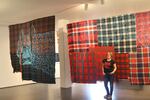
Marie Watt, with "Companion Species: Canopy."
April Baer / OPB
Every year, the Heinz Family Foundation awards $250,000 to six “changemakers” whose work transforms lives and communities. This year, Portland artist Marie Watt is one of the winners. Watt is a multidisciplinary artist and a citizen of the Seneca Nation, Turtle Clan, with German-Scot ancestry. We talk to Watt about her work, the award and the project she’s working on now in neon.
Note: The following transcript was transcribed digitally and validated for accuracy, readability and formatting by an OPB volunteer.
Dave Miller: From the Gert Boyle Studio at OPB, this is Think Out Loud. I’m Dave Miller. Every year, the Heinz Family Foundation awards $250,000 awards to six “changemakers” whose work transforms lives and communities. The Portland artist Marie Watt is one of this year’s winners. Watt is a multidisciplinary artist and a citizen of the Seneca nation, Turtle Clan, with German-Scot ancestry. She joins us now. Welcome back and congratulations.
Marie Watt: Thank you. It’s a pleasure to be here.
Miller: I understand that in the past you had recommended people for this award. Did you have any idea you’d be getting one yourself?
Watt: I had no idea. It came as a complete surprise and as you talk about it, I still feel shocked.
Miller: What has it enabled you to do, freed you to do?
Watt: I think for many artists and arts organizations, this year has been full of a lot of economic uncertainty. For me, I was preparing for a show that opened at the Marc Straus Gallery in New York in December. It really allowed me to help pay for the fabrication of a new neon piece, and also help me frame 26 pieces, and it also supports my staff.
Miller: How big is your staff right now?
Watt: I have seven people. They’re working artists and I feel really lucky to be in a position to continue to hire them.
Miller: You’re a small business, in a sense, as an artist.
Watt: That’s very true. I think that a lot of people don’t recognize that artists are small businesses. It’s something that’s sometimes not taught in art school. But one of the things that you learn pretty quickly is that there’s writing, bookkeeping, carpentry and PR work that all needs to be done to get one’s work out into the world.
Miller: You mentioned neon as one of the works that you’re doing now. It’s one of the newer forms … not new anymore, I suppose. You’ve been doing it for a couple of years now. But what first interested you in neon?
Watt: I first was really drawn to this idea of neon being both a bead, because it’s a hollow tube of glass … So it was sort of bead-like and also cord-like. I’ve long worked with textiles, so I started to think about what it would look like to stitch with neon.
The first project I wanted to make – which has taken, actually, a lot longer to realize – was this idea that I refer to as “chords to other chords,” which is a phrase that’s based on a Joy Harjo poem about Charlie Parker, the saxophonist. Joy Harjo, from the Muscogee Creek Nation, is also a saxophonist in addition to being a Poet Laureate. She talks about how “we are chords to other chords to other chords,” and “if we’re lucky, to melody.” I started thinking about a chord as not just a musical chord but as a piece of thread.
Miller: I had seen that that poem was really meaningful to you. I hadn’t been familiar with it, but I looked it up and I was struck by the line right before the one that you just mentioned, because this is a line before it – and this is obviously a writer saying this about her own medium. She writes: “All poets understand the final uselessness of words. We are chords to other chords to other chords. If we’re lucky, to melody. The moon is brighter than anything I can see when I come out of the theater, than music, than memory of music or any mere poem.”
If she were here, we could talk about what exactly she means by that and what she thinks that her chosen medium … what she can’t express with it. But I wonder how you think about that as a visual artist? what you can’t do with what it is that you do?
Watt: Yeah [Laughs]. We do need Joy here. What I can’t do …
Miller: She’s talking about the uselessness of words and I guess I’m wondering if that strikes a chord in you in any way, if you feel that too, the uselessness of what you do?
Watt: I think it’s so interesting to think about language and words in that way. In part because words are useless unless we have a shared understanding of what those words are. Also though, I think one of the beautiful things about poetry and language is that we also can change those meanings and we can define words in new ways.
Miller: Words have become a pretty significant part of a lot of your art recently. Sticking with neon, can you describe a work that’s about to be on display in Portland at the Portland Art Museum starting this weekend that plays with language. It’s called “Shared Horizon (Keepers of the Western Door).” Can you describe it?
Watt: Yeah, so the Seneca are the Keepers of the Western Door within the Haudenosaunee Confederacy. The French used to call us the Iroquois Confederacy of Six Nations. I was thinking about that reference to the Western Door. But also, having grown up in the West, this too, living in the Pacific Northwest in Oregon is also an association I have with the Western Door.
In this text piece, there is neon that is different colors that start to evoke a light on a horizon – perhaps setting, perhaps rising. There is also twinning language. My interest in twinning language came about through the anthem, “What’s Going On,” by Marvin Gaye. Of course, that song debuted in the ‘70s and it was actually written by Obie Benson, who saw this protest in People’s Park in UC Berkeley, and the protest was about the Vietnam War. From his seat on this bus he was questioning what’s going on. At that time though, I think it’s really important to know that we had the Civil Rights Movement, we had the American Indian Movement, occupation of Alcatraz.
So, moving forward in time, I was thinking a lot about social and political things that were happening. When I was listening to this song by Marvin Gaye in the car – streaming now, not on the breezy ‘70s station wagon that my parents used to drive – now, I started to realize that this call, “mother, mother, brother, brother, sister, sister,” it would also include, “grandmother, grandmother, water, water, sky, sky, basalt, basalt.” You’ll see this twinning language in this piece.
One of the things that I think is really important to me about this language is I start to think of how using two words, it is both part of a call and response. It is part of trying to make and cast an urgent message further in space. And in an Indigenous way, it is about calling back to our ancestors and forward to future generations.
Miller: You’re working on an enormous neon sculpture now with the letters “Turtle Island,” if I’m not mistaken. I’ve heard that it’s 6 feet tall, but 52 feet long. Why Turtle Island?
Watt: For a long time – this is really the project that got me started with neon – I wanted to sculpt with neon and see these stitched letter forms calling out to not just humans but our animal relations and to water and sky. One of the things that’s very interesting about the history of neon is that we’re accustomed to it with signage. So in many ways, I love the idea of having this phrase “Turtle Island” that is related to something near and dear to Haudenosaunee people and myself as a Seneca person.
I like the idea of people not necessarily knowing what it means, but then I think the text itself is evocative and poetry-like, and might make people curious about what Turtle Island is. Really I want to invite people to … I’m placing people in this position to say it out loud. Say something that’s important to not just Haudenosaunee people, but there are other woodlands tribes, including the Lenni Lenape and the Anishinaabe who also have Turtle Island stories. I want people to go through that process of learning, taking on the responsibility to learn what that means and affirm something that’s important to Indigenous people.
Miller: How do you think about scale at this point in your career? I mean, the physical scale. Have you made something that is 52 feet long before?
Watt: No, this would definitely be the largest scale and outdoor work in my career.
Miller: What happens when you put that in a landscape?
Watt: I think that you can’t help but see it, and acknowledge it, and say it. Part of my hope is that in learning what that phrase means, it might help us steward this place in a different way. And also I think it’s an invitation to consider the Indigenous place names around us and really take time to understand our relationship to those places and to these communities.
Miller: Collaboration and working in community, I think it’s long been a part of your studio practice. You don’t just work alone. What does it mean to you right now to make art with other people?
Watt: I feel like this is the way that artists have long worked in my community, in Indigenous communities. I think if we look back far enough in all of our histories, collaborating is a big part of what brought us to being together today.
Miller: Well, even in Western art museums there may be one famous person’s name, but often those people had a whole workshop behind them. I don’t know if that’s exactly community or if that is an owner and some worker bees in that tradition, but they weren’t alone.
Watt: Yeah. I would say my interest in community is … I oftentimes like to say I set the table and what is created is created by everyone in that moment. I think that what I’m thinking is being created is stories and connection. The gatherings are not a means to an end. It’s not really a means to kind of making a piece, even though that is perhaps a part of it.
I think the one thing that excites me about people being involved in community conversations over a piece … Like, I host open-to-the-community sewing circles, and if your eyes are diverted and you’re working with something as familiar as cloth, and there’s no sewing experience required, stories just sort of flow in that setting. I think that one of the things, though, that I really like if a piece does become completed, and perhaps it might go to an institution … I think it’s really that it’s important for people to see themselves in art. And I think that that’s a story that working collaboratively helps acknowledge.
Miller: Just briefly, what are your thoughts right now about the future of the Portland Art Museum? It’s about to open a brand new connector building, so it’s not broken up into two different buildings.
Watt: I think it is so exciting to see so many community partners and individuals come together to make this happen. I was in the museum for the first time yesterday. To be in a space that has these sort of curtain windows that brings the outdoors in and the indoors out, I think it feels incredibly welcoming and light filled. I think one of the challenges with the museum has been the space was architecturally very disconnected. I feel like finally there’s this place that’s very welcoming and I’m looking forward to what’s going to happen next.
Miller: Marie Watt, thanks so much and congratulations.
Watt: Thank you.
“Think Out Loud®” broadcasts live at noon every day and rebroadcasts at 8 p.m.
If you’d like to comment on any of the topics in this show or suggest a topic of your own, please get in touch with us on Facebook, send an email to thinkoutloud@opb.org, or you can leave a voicemail for us at 503-293-1983.