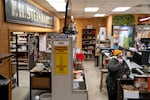
The original F.H. Steinbart sign hangs in the Portland, Ore., store as shipping manager Jeff Hoffman talks on the phone with a customer on Dec. 4, 2025. Open since 1918 and the oldest home brew shop in the country, F.H. Steinbart is closing this month due to a shifting industry where it’s increasingly difficult to survive as a brick-and-mortar shop.
Eli Imadali / OPB
You may have noticed that Oregon’s brewing scene appears to be in retreat.
Breweries seem to be closing around the state practically every day. Rogue Ales — a microbrewing pioneer and the 50th largest craft brewery in America — abruptly closed and filed for bankruptcy late last month. After more than three decades of welcoming summertime day-drinking enthusiasts to Waterfront Park, the Oregon Brewers Festival (which saw upwards of 80,000 visitors over a few days during its prime) canceled events in 2023.
Now, F. H. Steinbart Company, thought to be America’s oldest home brewing supply store, is joining the exodus. Steinbart announced it’s closing this month, after more than a century in business.
But for a long time, Oregon was a destination for folks who drink and brew beer. Portland was the destination.
Home brewing takes off during Prohibition
Fun fact: Home brewing wasn’t re-legalized in the U.S. until 1978, more than 40 years after the end of Prohibition. And it was only 15 years ago that it became legal in Oregon to consume home brew outside of the home in which it was brewed, meaning the Oregon State Fair’s home brewing competition (and all those growlers of skunky IPA your neighbor foisted on you back in the aughts) were contraband in the eyes of the OLCC.
When it comes to flouting temperance laws, Oregonians just have a knack.
Oregon’s initial statewide ban on alcohol manufacturing and sales was passed in 1914 and took effect in 1916. By the time the 18th Amendment to the United States Constitution went into effect three years later, not only was it illegal to buy and sell liquor and beer in Oregon, but making the stuff, even at home, was also against the law.
The problem was, lots of Oregonians did brew their own beer for home consumption, especially German families, of which Portland had many.
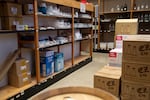
Shelves begin to empty as F.H. Steinbart sells off its current stock.
Eli Imadali / OPB
Before the passage of the federal prohibition amendment, prohibition had sparked an explosion in home brewing in Portland and abroad. National companies like Budweiser were eager to offload their supplies while they still could, and sold gallons of malt syrup through mail order.
With alcohol sales banned, most commercial breweries pivoted to making soda to stay in business, but many home drinkers weren’t going to go to the effort and expense of brewing something that didn’t get them at least a little bit sozzled.
And that is why, regardless of the law, a few stores kept selling home brewing supplies, even after the country had supposedly gone dry.
Steinbart opens shop
At the turn of the 20th century, Prussian immigrant Franz “Frank” H. Steinbart moved to Portland, joining the many German-speaking people involved in the city’s booming brewing industry.
Business dried up when Oregon passed its prohibition law in 1916, so Steinbart and his son Claus opened their home brewing supply company in a downtown office building. The 1918 Portland city directory lists the company as a manufacturer of anhydrous ammonia, used at the time as a refrigerant, and bottler’s supplies like bottle caps, labels, and box and label paste. It also sold stuff like brooms, clog shoes and rubber products. By 1920, the company had moved across the Willamette River to just a few blocks from its final resting place.

Mark Gillette, sales manager at F.H. Steinbart, fills orders of different brewing grains at the storied Portland, Ore., store on Dec. 4, 2025.
Eli Imadali / OPB
Most dealers of brewing supplies laid low during this era, but a few were less than covert, boldly advertising their malt, hops, kegs, bottles and capping machines for sale — everything one needed to brew beer at home. Among those who failed their stealth checks, downtown stores like Malt Syrup and Supply Co. and Portland Beverage Co. were easily busted when undercover agents asked for supplies that would enable them to give their near-beer an alcoholic “kick.”
Frank Steinbart died in 1934, and two longtime employees took over operations. One of them, Joseph DeBenedetti, became the owner in 1957. Years later, DeBenedetti’s son John kept the place running until he died in 2021. During that timespan, Steinbart’s ushered a new generation of beer enthusiasts into the Portland brewing fold.
People returning from 20th-century wars brought a taste for European beers home with them. Imported beers often went stale or became damaged by light in transit. Ultraviolet light denatures the hop molecules called isohumulones, resulting in the freeing of sulfur molecules, giving an unpleasant skunky odor and flavor.
Compared to the rich, malty beers of Europe, skunked beer sure wasn’t going to cut it, nor would the peaked pale, domestic lagers.
In 1969, Portland beer enthusiast Fred Eckhardt came to the rescue with his groundbreaking pamphlet “A Treatise on Lager Beer: How to Make Good Beer at Home.” This would be most Americans’ first time learning that flavorful beers even existed elsewhere in the world, and now Eckhardt was here to cheer them on to brew for themselves – often with the help of supplies sold by Steinbart’s.
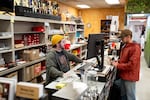
Jeff Hoffman, sales manager at F.H. Steinbart, checks a customer out, Dec. 4, 2025.
Eli Imadali / OPB
Born in Washington state in 1926, Eckhardt moved to Portland after his return from the Korean War.
He was a stalwart presence in the home brewing community nationwide, advocating for more than a decade before it became legal to brew beer at home in Oregon. He convinced a few brewers to give it a shot on a slightly larger scale — and showed them where to get what they needed.
Both the Widmer and McMenamin brothers were Steinbart’s regulars before the brands they founded became household names in the Northwest. The shop also functioned as a hub for local brewers, pro and hobbyist alike, to teach and attend classes, meet and swap stories and taste each other’s wares.
Steinbart’s closure marks the end of one branch of Portland’s beer family tree. With other branches also withering, time will tell if craft brewing’s roots are as strong as ever.