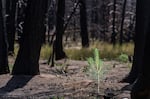
FILE - A ponderosa pine seedling in its second growing season in the Klamath Basin forest, June 29, 2023. The Bootleg Fire of 2021 burned more than 400,000 acres, including ponderosa pine forests.
Kristyna Wentz-Graff / OPB
Ponderosa pine trees dominate parts of Eastern Oregon and Washington and have long been an icon of the American West, but in the past decade more than 200 million ponderosa have died. Particularly in the Southwest, scientists estimate that by mid-century less than 5% of the ponderosa trees may remain. Portland author Gary Ferguson explores the history and the future of the ponderosa forests of the Southwest in his newest book, “The Twilight Forest.”
Note: The following transcript was transcribed digitally and validated for accuracy, readability and formatting by an OPB volunteer.
Dave Miller: This is Think Out Loud on OPB, I’m Dave Miller. A devastating fact animates Gary Ferguson’s new book. Hundreds of millions of ponderosa pines are vanishing because of climate change and nearly a century of fire suppression, and this is just the beginning. Scientists predict that more than 70% of all evergreen forests in the Southwestern U.S. could die off within the next 25 years. It’s a human-caused vanishing of hard to fathom proportions. Ferguson tried to wrap his head around this by traveling. He traveled throughout New Mexico, Arizona, Utah and the California Sierras. He wanted to learn more about what’s happening and why, and how the loss of ponderosa will affect the complex ecology of the American West. He was also just as motivated to find out what this will mean to us as spiritual beings, as myth makers, as storytellers, as solace seekers. Ferguson is the author of 27 books, including “The Carry Home.” His new book is called “The Twilight Forest: An Elegy for Ponderosa in a Changing West.” Gary Ferguson, welcome back to Think Out Loud.
Gary Ferguson: Thank you, Dave. It’s so good to be back with you.
Miller: What do you mean by an elegy?
Ferguson: Well, on one hand, there is certainly grief in what you just described, and I feel the grief too, but I decided to walk through this grief door, not just to chronicle it, but to pay honor to a tree that has not only meant a lot to our culture and cultures long before us, but also to me personally. So I’m trying to hold this book up as a thank you to the ponderosa tree for all it’s done for so many of us over so many centuries.
Miller: I want to dig into all that, including what this has meant to you personally. But first, can you just help us understand the scale of the loss of ponderosa that we are in the middle of right now?
Ferguson: Yes, it’s really staggering and not something that I think anyone would have predicted in the 1990’s. At this point in the last 25 years, estimates are that we’ve lost, in the Southwest – in that region you talked about from New Mexico to the Sierras – we’ve lost between 250 and 300 million ponderosa trees. The real big story here is not just that we’ve lost them, but in a great many places they won’t be coming back. These lands are turning into permanent grasslands. And that’s a big deal. It’s a big deal for all of the species that depend on the forest, and it’s a big deal to those of us who love this tree.
Miller: Could you read us a short excerpt from the book? This is about the broader context of what’s lost when ponderosa die out. And it’s maybe helpful, as you said, say 250 or 300 million trees in the Southwest lost just in the last 25 years, so it’s helpful to think, for any one of those, what’s at stake, who calls it home, what it could mean. Do you mind reading this for us?
Ferguson: Of course, be happy to.
“When we talk about the forest, we’re never really just talking about trees. Disappearing along with the ponderosa are pairs of goshawks, those extraordinary birds found twisting above the canopy in early summer on their legendary sky dances and while hunting, spinning low around the tree trunks like jet planes in a Pixar movie. Fading, too, is the fluty drumming of Grace’s warblers and the hammering of the white-headed woodpecker, the dusky grouse as well, along with great horned, flammulated and Mexican spotted owls.
And then there’s the red-tailed hawk and the eagle sitting in the tops of the big ponderosa in their nests made of broken sticks. Ebbing too are the midnight yelps of the red fox, the chattering of tassel-eared squirrels, the trills of bobcats, the grumbles of black bears. Even dead-standing ponderosa have long been vital to the community, what with the holes and hollows in their trunks being prized by everything from bluebirds to nuthatches, flickers to woodpeckers. The Southwest without ponderosa is like an orchestra stripped down to a pair of violins and a kettle drum.”
One thing I wanna say – this is such a significant deal, not just for all of those creatures I just mentioned, but in the Southwest, in so much of that region, the ponderosa is the only tree of real stature. Up in much of the Northwest or in the Eastern United States, if you lose a particular species it’s a tragedy, but there are other trees that will sort of ease the pain. But in so much of the Southwest, the ponderosa is it. There are pinion and juniper, but as far as reaching a towering, statuesque presence that has such inspirational aesthetic value, ponderosa is it.
Miller: How does ponderosa do it? It shows just how challenging this is if they’re the only ones in these vast tracts of land that have evolved to be able to handle those extremes, even before human-caused climatic changes or changes in the fire regime. One of the things you write is that ponderosa have shown an amazing knack for fine tuning themselves to changing conditions and new opportunities. Can you give us a sense for the range of zones where they can be found?
Ferguson: Yeah, this is actually the most widespread pine in North America. It started from just, at the end of the last ice age, a few huddles in Southern Arizona and New Mexico and Southern Sierras. And from there, once things started to warm again, the tree marched: one Eastern version, one Western version, all the way up into Canada, into the Black Hills, and then joined together to basically meet – the two different species, the West Coast and then the Central Rockies – to meet in western Montana. So they were very successful, and they were successful because of what you just said, they’re really good at fine tuning themselves to all kinds of different situations.
We obviously have ponderosa growing in Oregon in very different circumstances than at the edge of the desert in Arizona and New Mexico. This is why this is a bit alarming to me, too. Ponderosa is an incredible survivor. There are some trees that are really tough, and they’re just good no matter what you throw at them, and ponderosa has traditionally been this way.
Their seeds can withstand 150-degree temperatures. They’ve evolved this very sophisticated fire strategy where they tend to drop branches in the first 30 ft or so of the trunk, so that if a fire comes through, the fire can’t ladder-climb the branches and take the crown out of the tree. They have an uncanny ability to conserve water. They’re four times more efficient at conserving water than, say, a Douglas fir as far as how much water they let out.
Miller: How do they conserve their water? And obviously, they’re legendary for growing in places that get very little water, so it’s incredibly important. How do they conserve water?
Ferguson: They’re really managing, on a very microscopic level, the pores in their needles, how long those pores are open, what time of day those pores are open. They’re micromanaging so that they only typically lose water at the very best time, maybe in the middle of the night they open and they open for a very limited time. And there’s a consequence. Every choice you make as plants or any other creature, you gain some and you lose some. But the ponderosa, by managing those pore openings as carefully and closely as they do, they’re able to go into those areas in the Southwest where, again, no other tree, other than pinon and juniper, much less in stature, has been able to do.
Miller: You mentioned in passing, I want to come back to this, that there were two different versions of ponderosa that met up in the northward-going arms, one on the east side, one on the west side, and they met, I guess, in Montana. What are the differences between the two versions of ponderosa?
Ferguson: The biggest difference is, let’s say the West Coast version, ended up thinking, and I’m being facetious, but, concluding that, hey, there’s more moisture available to us here, we’re going to go with three needles in a bundle.
Well, back in the inland west, toward the Rockies where it’s much drier, that strain of ponderosa is dealing much more with limited access to water. And so they’re going to just develop a two-needle bundle in those ponderosa, so that they actually conserve water more efficiently because there’s only two needles instead of three.
As you go up the Rockies or up the Sierras into Oregon and Washington, you’ll see more fine tunings. This is one of the reasons why, if you want to go out and collect ponderosa seeds – and that’s a big, big deal to collect them and to grow them into seedlings – you want to make sure to have the seeds taken from trees that are very near where, say, a wildfire was that you want to reforest. Because if you take a ponderosa seed from New Mexico and bring it up here to Oregon, its chance of survival is much less because it’s not as finely attuned to the specific habitat.
Miller: Can you even do that, at this point, after some of the immensely hot and powerful fires? We don’t have fires now in general like we did 100 years ago. They can create their own weather, they can scorch and make landscapes almost antiseptic. Are there seeds?
Ferguson: You’re so right. Camille Stevens-Rumann, she’s a biologist who did a wonderful survey of ponderosa forests up and down the Rockies, and she found, a few years ago, that in fires that happened since the year 2000, more than a third of those areas that burned don’t have a single seedling, don’t have a single ponderosa on them again. This is how we’ve chronicled that these are going to grasslands, permanent grasslands.
And yes, you’re right, with fires being hotter and more intense and coming more regularly along with climate change lifting the temperatures up, diminishing the water tables, making less water available, what happens, it’s not so much a matter of ponderosa dying from thirst, although that can happen, it’s called cavitation. It’s more often that they get stressed because there’s so much less water, there’s so much more heat, and in that stress condition, pine bark beetles come in, mistletoe comes in, blight comes in, and they don’t have the defense mechanisms that they developed over millions of years to deal with it anymore.
Miller: How have Indigenous people, in what we now call North America, lived with and used ponderosa pine over the last 10,000 years?
Ferguson: One of my favorite things to point out is that the oldest cities in what would become the United States, we’re talking more than 1,000 years old, were basically made possible because Pueblo cultures decided that the ponderosa was the perfect structural roof beam that they could use to incorporate in those multi-story dwellings.
Miller: Apartment buildings from 1,000 years ago.
Ferguson: Exactly. Mesa Verde, Chaco Canyon, that sort of thing. In fact, that tree was so important to them to build these cities that, in the case of Chaco Canyon, there were about 250,000 ponderosa used, archaeologists have figured out over time, over 600-700 years, and they would have to travel by foot, of course, 40 to 50 miles, because the nearest groves were that far away. They would dispatch a team to go out and cut young trees, roof beams don’t have to be giant ponderosa, but nonetheless they weigh a lot…
Miller: Hundreds and hundreds of pounds …
Ferguson: ...hundreds of pounds, and then they would carry those trees 40 or 50 miles back.
Miller: Groups of people.
Ferguson: Groups.
Miller: Walking 50 miles carrying tree trunks on their shoulders.
Ferguson: Exactly, it’s astonishing. Now, we don’t know if they use some sort of tumpline that they attached to their back and drug it, or exactly how it worked, but it’s really quite remarkable. So that’s my first favorite example.
Miller: OK, that is habitation. What else did you find?
Ferguson: They also discovered, long before that even started happening, that ponderosa could offer a great source of food. The nuts, of course. In fact, the nuts tend to be two to three times bigger than a lot of other pine nuts, so they’re really sought after not just by humans, but other creatures who like that sort of calorie option, too. But then a lot of the prehistoric people stumbled across the fact, or sought it out or somehow divined the fact, that the inner bark of ponderosa is really, really rich in carbohydrates, in iron, in zinc. I mean, they didn’t know that it was rich in that, but they knew it really was essential to their health, and so by eating the cambium layer – basically the inner layer of the bark of the ponderosa – they were able to make that an essential part of what they, in a given year, would add to their to their food options.
The famous sand paintings of the Navajo use ponderosa for the yellow that you see in those particular sand paintings. Indigenous cultures to this day use pine boughs from the ponderosa in sweat lodges because they think it has an effect of relieving muscle pain. So as far back as we can see, and I think it’s probably safe to say as soon as humans started walking through and past the ponderosa groves, the ponderosa started becoming for them, and still is really today, the giving tree. I don’t think there’s a tree in the West that’s given more to those cultures or to our more modern cultures than the ponderosa.
Miller: Can you tell us a story of Andrew Douglas, who pioneered the science of reading tree rings, with a big focus on ponderosa?
Ferguson: Yes, he was sent out to Northern Arizona to found an observatory, and look for signs on Mars that his particular boss back east at Harvard was convinced was showing evidence of advanced civilizations because of the so-called canals. Douglas arrives in northern Arizona and he’s really not interested in that, and he and a lot of other astronomers think that’s kind of a far-fetched idea. So he starts paying more attention to his personal interests, which had to do with climate, and what Douglas wanted to do was figure out, do sunspots line up with climate change? Can we link sunspots to how the climate varies over time?
Miller: And if there’s some burst of solar energy, does that show up in some way on Earth?
Ferguson: Right, right. More rainfall, less rainfall, more humidity, who knows? That was what he wanted to investigate. The problem was that there were only climate records in northern Arizona at that time, and we’re talking about 1900, 1903, that went back about 20 years. So if you want to do a climate study, like what’s the climate been like in the last 1,000 years, and you only have 20 years of climate records, you’re gonna have to find another way to figure out what the climate was doing, and that way was tree rings.
Tree rings not only record climate – most people have heard of that, like was it cold, was it wet, was it dry – but they record solar blasts, they record every nuclear test that’s been done on the planet you can find laid down in the rings of a tree. Anyway, Douglas spent the next 25 years basically trying to assemble a graph, if you will, that would allow him to go out and determine how old certain things were so that he could match the climate record to sunspots. As it turns out, sunspots don’t seem to have all that much to do with the climate. They do affect it, but not as much as he thought.
But what happened was while he was doing his work, some archaeologists from Chaco Canyon come over and they say,
hey, could you help us with your work to figure out how old these roof beams are? The ponderosa roof beams I talked about earlier. He said, well, I can only tell you they’re more than 500 years old, but I haven’t completed my map, my master chart yet, because I haven’t found enough old tree rings to put that together. But even that, to them, was hugely important. They had no idea if Chaco Canyon was 400 years old or 3,000 years old.
Miller: Wait, just so we can understand this, how was it, in that first part, that he was able to even say that – to say, whatever it is, it has to be more than 500 years old. How could he say that?
Ferguson: What he had been able to do at the point they showed up was he was able to, by finding stumps and sometimes live trees – you know a tree doesn’t have to be live for a dendrochronologist to study the rings – and he had assembled basically 500 consecutive years, going back from, say, 1903, back into the past 500 years. So he knew that, but at that point he wasn’t able to go beyond 500 years.
Miller: He had gotten enough of those tree ring samples to say, we know that if there’s this particular pattern, this is 1785 to 1792. We know this is a telltale fingerprint, that it exists in this area for all these trees at that time.
Ferguson: You are exactly right. That’s precisely what he was doing. And every region is different. Now, eventually Douglas would go off and use redwoods and giant sequoia, and he would go back 3,000 years with them. But the fact of the matter is the climate is not the same, and he was interested in climate. Climate’s not the same in California as it is where he was working in northern Arizona. So yes, there’s a fingerprint. Depending on what the climate was, it creates a certain ring pattern, and his ring pattern he held up to the ring patterns on those ancient beams was able to say, OK, I can tell you it’s older than this, but I can’t tell you its exact age.
Miller: What makes ponderosa special about capturing history in its rings?
Ferguson: A lot of trees can be used for sure for dendrochronology. Ponderosa happens to have this trait of showing particularly distinct borders between the annual rings, so it’s easier for you to determine, OK, this is this year, this is this year, whereas some of the other trees, the rings are much murkier and muddier, and it’s hard to distinguish from one year to the next.
Miller: Can you describe what’s known as a mast crop?
Ferguson: Every five to seven years, and other pine trees will do this too, every year, usually ponderosa produces seeds. But it’s interesting, every so often when the conditions have been right in the previous 18 months, and that means the right amount of moisture, a mast crop or a giant crop, a massive crop coordinated by all the ponderosa in the groves who tend to go into flowering and pollinate each other at the same time, create this phenomenal abundance of seeds.
You can imagine what a heyday this is for the creatures, but it also helps propagate the forest, because in a typical year, 90% of the seeds that a ponderosa produces will be eaten by somebody. They just won’t germinate. In a mast crop year 90% of them may germinate. So it’s a huge difference. There’s just such a big vast amount of seeds compared to what the demand by the creatures are to eat them that they do very well. So by virtue of those mast crops is how ponderosa has been so successful marching north.
Miller: Are there still mast crops? Are there still the climatic conditions that this evolutionary strategy that has served these trees well, is it still happening with any regularity?
Ferguson: I think it is becoming and will become more and more sporadic. The reason has to do with what I said earlier about the previous 18 months before a mast crop has to fall along certain lines as far as moisture falling in the spring, moisture falling at certain times of the fall, moisture falling the next spring. And with climate change especially drying out those moisture requirements, I would imagine that mast crops are going to be more and more difficult to predict and fewer and fewer in the decades to come.
Miller: Can you describe the smell of a ponderosa grove?
Ferguson: I hope that’s my last smell on earth, Dave, I must tell you. When you go into a ponderosa grove, especially if you just walk up and hug a tree is always a good idea, but in this case, put your face, put your nose in that
cinnamon-colored furrowed bark, and you will get the most amazing delicious mix of… some people say it’s butterscotch, some say it’s vanilla. And it’s caused by the terpenes that the tree produces, which has to do a lot with, among other things, keeping pests and insects at bay, but it smells to us like we just walked into grandma’s kitchen.
That’s one of the things that I’ve most loved about the ponderosa, the fact that they’re tall, statuesque, and that they’re so well spaced. One of the things that early explorers used to comment on all the time is, man, we can not only ride a horse at full gallop through a ponderosa grove, we can drive a box wagon through a ponderosa grove. So when you get into that, this isn’t the old, scary woods of Little Red Riding Hood. This is open. It’s lit, John Muir used to say it looks like it’s lit from within. It’s restive. It’s peaceful. It’s inspiring. It’s, to me, the most beautiful forest environment in North America.
Miller: Also very different from the forests of the Northeast or the Midwest, which are much closer, more like, in some cases, sort of a green tunnel. This is a high canopy, and a grove where you can stretch out your mind and your body.
Ferguson: Absolutely. You can look up and watch those goshawks I read about earlier flying through the canopies, and it’s a very different feel.
Miller: To go back to the smell a second, you actually write about the smells a lot, and one of the things you say is that the smells can change based on what’s happening to the trees. What can change?
Ferguson: One interesting example, and I’m not sure scientists completely understand this, but the ponderosa is somehow able to, it appears, sense the number of birds that are insect feeding on its trunk. I don’t know how exactly, nobody knows how that happens, but when the bird population on the trunk feeding reaches a certain level, it seems to be communicating, perhaps among other things, to the tree that there must be a lot of insects, more than would be healthy for me long term. And so I’m going to change my terpene, that smell we talked about, the formula.
And that takes energy and that’s why they don’t do it all the time. I’m going to change this terpene mix and I’m going to send it to the bark, and that will serve as sort of an insecticide. Fewer insects will come to feed and threaten me. And so as the insect levels go down, the bird population numbers go down, and as the bird population falls, feeding on the bark, then that terpene will go back to its original recipe.
Miller: You also note that you noted a change in smell that you tied to climate change and drought. What did you notice?
Ferguson: In this book, so many days, and ponderosa forests, they have a great ability to go anywhere from 4,000 ft to sometimes 7-8,000 ft, but I was often in 5-6,000 feet levels where the summer was hot. It was a drought. The Southwest is now, just to put it in perspective, in its 32nd consecutive year of drought, of supremely intense drought. What happens is that smell starts to be overwhelmed by a kind of, almost a white wine smell, a thin white wine dust smell that reduces the availability, to my nose anyway, of the terpenes.
That could well be because, also, the flow of sap as it gets so hot and it gets so dry will start to diminish, and so there may not be as many of those terpene fluids available to my nose.
But yeah, it’s a different feel, and when you walk through the forest these days in the Southwest in the summer, instead of those soft needles that make it feel like you’ve got slippers on, it’s crunchy, it’s loud, it’s very disturbing by virtue of what the smell and the audio alone is telling you about the state of that part of our planet.
Miller: You know that you could hear the sound of mice walking through these dry needles, the needles were dry enough that you could hear mice in them.
Ferguson: Yes, and my hearing is not great, so that was notable. Really, probably 15, 20, 25 feet away, I could hear mice walking. It’s that dry. And that’s a good way to sum up how dry it really was.
Miller: I want to turn more squarely to fire now. You talked about it a little bit, but it’s a really important part of this book. You write, “On some 500 million acres of public lands in the interior West, regular wildfire does nothing less than drive the cycle of life.” What has that cycle looked like for hundreds of thousands of years?
Ferguson: Before there were any humans on the scene, likely fires caused by lightning would come through about on average every 5 to 7 years, that the scientists believe, ecologists believe, and what that tended to do, it limited the spread of disease and insects. In the inland north, inland west, especially, it burned the debris that otherwise builds up on the forest floor. One thing that it’s so important to understand, without fire you cannot have in the inland west, a healthy forest. Because we don’t have the microorganisms that other places like the Pacific Northwest or the East or even the Midwest have to break down trees when they fall in the forest, or branches. These things will pile up year after year, century after century, even if you don’t have fire to return those nutrients to the soil.
Miller: I probably should have known this before, but it was sort of revelatory to me that, in a sense, fire plays the role that water plays in other places. In the most arid parts of the West fire helps break down the cellulose, and in ways that water can help microbes do in other places. I guess I’ve never heard anyone tell me that way.
Ferguson: I like you linking it to water because yes, it is essentially doing the thing that water, or microorganisms that live with more water, do. And the unfortunate thing is Indigenous people, when humans came, whether it was 14, 15, 20,000 years ago, perhaps; very soon after they arrived, we believe they started burning the forest because they watched enough consequences of, say, a lightning strike, to know that the forest is healthier after it burned than it was before. And so they started managing their forest long before Anglos got here from Europe.
Miller: What are the ways that ponderosa evolved to not even simply to coexist but to rely on fire?
Ferguson: If ponderosa doesn’t have fire, a couple things happen. I mentioned the debris piling up. Right now, there are an estimated 300 million acres in the west – so we’re talking three times the size of California, that’s a lot of the west – that are under unnaturally heavy fuel loads. This is a big part of why, when fires break out these days, especially if you link it to climate change, they’re very likely going to turn into enormous megafires because of all that accumulated debris that we decided to let happen. Because fire was the enemy, fire was bad, and the early forest service from roughly 1910 to 1980, late 1970’s, was determined that they were going to put out every fire to the point they developed a 10 a.m. rule. Back in 1934 the forest supervisor said our policy is every fire gets put out by 10 the next morning, which is a ludicrous fantasy in any era.
Miller: Ludicrous, impossible, but absolutely did lead to tons of wildfire suppression that we’re now dealing with today.
Ferguson: Yes, absolutely. The other thing that, if you stop fires, that happens, and this had a profound impact on me, you stop getting rid of, shall we say, the bunch trees. After a fire goes through, a lot of little trees may start out – young ponderosa, other trees – and when the fire comes through eventually, it reduces the population. That spaciousness I talked about, riding your horse at full gallop through, that spaciousness is a result of the fact that fires have come through and burned the competing young trees.
There were places that I went in Arizona, where, on average, a mature ponderosa forest would have 150, say, trees per acre. Those same acres now have 5,000 trees. And this is largely because we stopped fire from coming through and keeping those forests thinned out. That’s less water for everybody. It’s less nutrients for everybody, and it feeds the kind of fires that are impossible to stop.
Miller: Wasn’t that also intentional? Weren’t there foresters who said this is a waste of land, let’s get more board feet?
Ferguson: Exactly right. The decisions were made entirely on the argument of efficiency, and the efficiency was meant to yield profit. So the notion that we should let fire burn through a forest when every one of those trees has a dollar value was just absolutely unacceptable.
Miller: Although, to me, one of the ironies of this is that some of those same Euro-Americans, they loved what they saw. In book after book, letter after letter back home, they talked about the same spaciousness of these groves that you were talking about earlier, spaciousness caused by frequent regimes of natural fire or introduced fire by native people. And so on one hand, they acknowledged the beauty and the intact ecology of this, on the other, they were starting all these processes that were going to mean an end to that spaciousness.
Ferguson: And you know, I can forgive them initially, concluding that it’s better to put all the fires out, but there were so many opportunities where Indigenous people would have these conversations with the forest service and say,
you know, the reason we burned is because of this, this, and this, and they were pretty much dismissed, well, because they were Indigenous people. What could they possibly know compared to our modern science.
Miller: Western modern science.
Ferguson: And so even though there were plenty of people to warn us about doing this, we decided to do it and then unfortunately, we tend to get a little stubborn sometimes, we didn’t just do it for 10 or 20 years, we did it for about 75 years.
Miller: What happens when climate change is layered on top of 80 years, 70 years of fire suppression?
Ferguson: Now you’ve got the magic mix for the kind of mega fires, which refers to a fire at least 100,000 acres, fires creating their own weather, creating lightning tornadoes. The collapsing of the heat columns that are going on right now and threatening wildfire fighters, this is all because, not only you’ve got lots of debris like we talked about, lots of bunch of trees like we talked about, and now all of that fuel is getting to a level of dryness that is impossible to even comprehend.
In fact, one of the big changes now, going on immediately, is that the humidity levels used to pretty much go up every night, so a firefighter would say, OK, the fire’s going to lay down as soon as the sun sets. It’s going to lay down, it’s going to calm down. Because the more humidity in the air, the less humidity, the more intense the burn. But now, because of climate change, that humidity is not falling at night, and so there’s no respite at night the way there used to be.
Miller: I wonder if you could read us another excerpt from the book?
Ferguson: “There’s an extra measure of poignancy to the wreckage of climate change when the casualties are trees, any kind of tree. The ones wrapped in gravitas like the white oaks of New England and the tulip trees of Tennessee, the California redwoods of Mill Creek and Bull Creek Flats, the big maples of Indiana and Illinois. And those more modest in stature, too. The red alder of Alaska in the Pacific Northwest, or the aspen groves in the southern Wasatch Mountains of Utah and southwest Colorado where the trees look like ballerinas in pirouette.
Part of our affection for trees arose from a long list of practical gifts they’ve given us: providing shelter, offering us quick escape from hungry predators, feeding us with fruit and nuts, and holding no end of honeycomb, giving us the fire that cooked our food and kept us warm. In more recent times here in the west, it was often the ponderosa we cut down and sawed into coarse planks, nailing them together into jails and rooming houses and long plank bars and shoddy saloons. We used the tree to make the ties that held the railroad tracks and then used still more of them to fire the steam locomotives that ran on them. Ponderosa built the ranchers’ homes and barns and irrigation gates, the corrals and the windmills and the pasture fences. They shored up the mines and made our boats, including the ponderosa that Lewis and Clark, guided by the Nez Perce, made into five large canoes they then paddled down the Columbia River to the Pacific.
During the Civil War when the Union Navy ran out of pitch and turpentine to tend their ships and could no longer get it from southern pines, they drove their taps into California’s ponderosa trees. Some lone ponderosa standing tall on the northwestern edge of the Great Plains became signposts for westbound settlers in wagon trains, offering not just direction, but flashing the hugely welcome news that the open, treeless plains were finally coming to an end.
But our long arboreal love affair goes way beyond the practical. You can see it in the way the ancient Greeks bestowed sacred honors on the oak and the Cayuga, much as people living in the British Isles did for yew, or the Arikara people, the great plains, bringing reverence to the cedar. Or the Conibo of the Amazon to the catahua. For the Norse it was the ash tree. For the Chumash, the pinion. For the Germans, the linden. For others it was pine or banyan, or sycamore or fig. For any culture living in or near trees, those trees were sources of the sacred.”
Miller: What myths or stories or notions of the sacred do you think it would be most helpful for us to reconnect to now?
Ferguson: I think trees and forests, and they’re not the only environmental aspect of nature that offer this, they offer a special opportunity for us to begin reweaving the stories we tell about the nature of the world and the nature of being human. We have come up since, in truth, the Enlightenment and the obsession with overwhelming nature – Francis Bacon said we need to put nature on the rack and torture her secrets from her – we have come into this part of the modern world thinking in terms of separation, that we’re all individuals. The fact of the matter is, a forest suggests the real reality, and that’s that we are all interconnected, absolutely all interconnected. We really need, I think, an opportunity to contemplate that interconnection.
One of the things I like to tell folks when I give talks is – and Mary, my wife, who’s a social scientist, came up with this – is do you end at the edge of your skin? Do you really? And when you start to think about it, well, gosh, every time I walk under a tree, the tree’s giving me oxygen, of course I’m giving it carbon dioxide, but it’s also giving me chemical compounds called phytoncides. Those phytoncides, every time I take a breath, strengthen my heart and my vital organs. It fortifies my immune system. Same for you. Melatonin and other hormone levels are being set in your body by the sun. You’ve got more microbes living in you than you do human cells, and those microbes didn’t come in with you out of your mother’s womb. They came to live with you after you were born. And they’re there to process the nutrients you take in and make it available for your muscles and your brain to work.
So, in truth, it is very difficult to say oh, I’m a self-contained person, and it certainly goes against that American classic myth of the lone wolf and the rugged individual. I challenge anyone to find a rugged individual anywhere on planet Earth. There is no such thing. And I think us being in the woods is an opportunity to reweave those stories. The trees not only work together to warn each other of pests coming in, they also use the mycorrhizal network underneath them, as your listeners have probably heard much about, to share nutrients, to share genetic responses to infestations by insects. So they are individuals, magnificent in themselves, but only surviving and thriving by virtue of the fact that those wonderful individuals are working together as a community, and that’s a story that I think we are so much in need of right now.
Miller: You grew up in Indiana. Do you remember when you saw ponderosa in person for the very first time?
Ferguson: The first time in person I saw it on television through “Bonanza” – thanks to Hoss and Adam and Ben and Little Joe – but I actually saw them in southern Colorado outside of Colorado Springs at a place called Cripple Creek when I was 10 years old. My parents decided, and I had already told them at 9 I was gonna move to the Rockies when I was old enough, so they knew I was infatuated with it, and so we went to Colorado and actually camped out in the ponderosa grove. That was the first time I saw them, and everything I assumed about them being magnificent from what the Cartwrights were showing me was tripled.
Miller: That’s not always the case. Sometimes as kids we see some mediated version of something and then we see it in person and it’s disappointing. In the case of ponderosa, it was not like that. It was better than you’d even imagined?
Ferguson: Yes, and I think one of the reasons for me feeling that way is there were some difficulties in my childhood. It was a tough time. And the ponderosa being created the way it has, with the spaciousness and the light that I mentioned earlier, and the smell, it’s sort of the equivalent of a lovely golden lab waiting on the porch after you’ve gotten home from a hard day. I felt like I had a sense of acceptance in that particular kind of forest, a sense of belonging, no judgment. There was a place for me somehow, and I think that that particular forest and others that would be more open and spacious like that has a unique opportunity to feel that kind of sense of belonging and sense of place.
Miller: You write really movingly about two different times later in your life when you turned to trees, to ponderosa specifically, for solace during grieving. The first one was with a tree that you named Bob. This is in Arizona. Can you tell us that story?
Ferguson: Yeah, and before I say that, my relationship with ponderosa, my respect for ponderosa increased the more I spent lots and lots of time on remote wild trails where there were ponderosa. Because when there was too much heat at the edge of Hell’s Canyon or down around Las Vegas, or if the winds and the snows and the rain, the sleet were starting to blow, ponderosa forests had sheltered me. They literally sheltered me, and that helped me feel an allegiance to them as well.
My father died in an accident when he was 52 and I was 24. I was living out in Northern Arizona in a ponderosa forest taking care of a remote ranch, and as part of the grieving process, there again, this beautiful open forest that gives you such a sense of belonging and place, was for me a reminder that no matter how sad you get, no matter how tragic your life is, there are things that are working. There are things still here that you’re a part of.
And so I found a particular ponderosa which was unusual in that it had a lower branch that I could use to climb up it. Part of my grieving process was to sit in that ponderosa at least two times a week, I’d say, and spend just a couple of hours thinking of my dad. My dad was the person who decided that his two boys should learn to climb trees and took us out into Northern Indiana on weekends to find trees for us to climb, so it felt like a perfectly appropriate circle coming to a close for me, to be in that tree.
Miller: When you would do that, did you sort of personify, anthropomorphize the tree?
Ferguson: Yes.
Miller: You did.
Ferguson: Yes, and I know traditionally, especially among science-leaning types, and I like to think of myself that way, anthropomorphizing has been, don’t ever do it. I don’t think that’s true. Now, I understand the reason to not do that, to imagine some motivation, say, for a wolf or a bear, that is a human motivation, and not cop to that. But on the other hand, I think anthropomorphizing and animating a tree, talking to a tree, is an imaginative exercise. If we’re gonna build those new stories I talked about, and those new relationships to the natural world, we need animation. We need stories that flesh out connection paths between us and them. And so I say, anthropomorphize all you want, realizing that that’s what you’re doing. But yes, I love to anthropomorphize.
Miller: Can we hear one more excerpt from the book? This is from near the end.
Ferguson: “So many kinds of life are waning now. Tens of thousands of species are at risk of extinction due to climate change alone. Incredibly, as I write this, American leaders are unraveling decades of critical sustainability successes, meanwhile slashing the very scientific research that will be critical to charting a less painful future.
Under the most severe climate change scenarios which suddenly we seem all too willing to unleash, some 30% of the life on Earth could go extinct before the end of the century. This centuries-old folly, where we imagine we can do whatever we want to nature, is about to become very costly. It’s enough to leave some people cynical, maybe lead them to conclude that ideas about fostering compassion for the earth are hopelessly naive. They are not.
A forest employs two key strategies to survive wholesale disruption. First, it does everything it can to lessen the blunt trauma of the event. Second, it makes a priority protecting the essential ingredients it will need for recreating the community after the disaster has passed – seeds, healthy soil, pollinators, reassembling them all as quickly as possible. If it can manage those two things, the aftermath of disruption will bring growth.
The current flush of arrogance in our culture is putting a great deal of life at enormous risk, but how much healing we can achieve is still very much an open question. Ultimately it will be determined by the depth of our community. This is one of the most essential touchstones of the forest. It is never static, any more than human society is, but rather always in motion.
There are ongoing restructurings of the underground mycelium networks that transfer messages and essential substances to the trees. Rates of photosynthesis change minute to minute, and continual adjustments are being made in the pores of the leaves or needles to better match the availability of water. There are rising and falling levels of the pheromones shared between the trees, some to repel leaf eating insects, some to synchronize reproduction with others of their kind. Individuals working together, in other words, to establish a continuity of kinship in the face of constant change.
I can feel something of this when I talk with people out on projects, gathering seeds for some future forest or planting trees. Some who I’ve spoken with explain that one way they keep going is to not get overly obsessed about the outcome of their efforts. Naturally, they’d like to think of what they’re doing as an act of restoration. But the biggest part of their satisfaction seems to lie in the fact in the act of tending what they consider precious. The reward, in other words, and at the same time a lesson for their children, is the feeling they get from bringing honor to something they love.”
Miller: That reminds me a little bit of where we started, with the word “elegy.” Because this whole book in a sense is a love letter to what we’re losing, because of what we as a species have done. We just have about a minute and a half left, but I’m just curious how you think about that love, and what you get to honoring all different parts of the natural world that we’re in the process of losing.
Ferguson: I understand this is a time when it can be overwhelming for those who love the planet and love the earth, love nature, because there’s so much going down. I suggest considering one thing that really calls to you, that’s struggling, suffering, maybe it’s in its last days. Walk through that door of grief, into really finding out everything you can about that particular one thing. Will that lead you to a place where you’re sad and you’re angry? Yes, that’s part of the grieving process. And one of the problems I think we have in this culture is we’re not particularly willing to walk through the grief we need to walk through, and so we don’t get to the healing on the other side. But the fact of the matter is, the only reason it hurts so much is because you’re reawakening in walking through that door how much you love and care about something.
Miller: As opposed to blunting the pain by closing our eyes.
Ferguson: Exactly. And the more you illuminate that love and care, even if it comes through grief, the more likely you are, I think, to live a life that’s aligned with the things you care about most.
Miller: Gary Ferguson, it’s always a pleasure to talk to you. Thanks very much.
Ferguson: Thank you, Dave. It’s a pleasure.
Miller: Gary Ferguson’s new book is called “The Twilight Forest: An Elegy for Ponderosa in a Changing West.”
“Think Out Loud®” broadcasts live at noon every day and rebroadcasts at 8 p.m.
If you’d like to comment on any of the topics in this show or suggest a topic of your own, please get in touch with us on Facebook, send an email to thinkoutloud@opb.org, or you can leave a voicemail for us at 503-293-1983.