Advocates for a new Interstate Bridge between Oregon and Washington won a victory Friday, with a ruling from the U.S. Coast Guard that will allow smoother traffic and reduce the ballooning cost of the bridge replacement by as much as $1 billion.
In its ruling, the Coast Guard said ships will need 116 feet of clearance under the future bridge. A bridge with that clearance — as opposed to the 178-foot clearance the Guard also considered — won’t require a drawbridge-style lift that would stop interstate traffic, and it will cost significantly less to build.
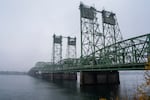
The Interstate-5 bridge in Vancouver, Wash., on Thursday, Dec. 4, 2025.
Saskia Hatvany / OPB
U.S. Senator Maria Cantwell, a Washington state Democrat, applauded the decision as a major step forward, and said in a statement that she hopes to see construction start later this year.
Backers have been trying to secure funding and political support to replace the current I-5 drawbridge for more than two decades. That bridge lacks seismic upgrades. It also hosts the only traffic light on an interstate highway that runs from Mexico to Canada, and its steep slope and narrow lanes regularly create traffic bottlenecks even when its lift is down.
Vancouver Mayor Anne McEnerny-Ogle has taken federal officials and state lawmakers on tours for years to highlight the challenges the current bridge presents and to advocate for funds to replace it.
She issued a succinct response to the news on Facebook: “We Got It!!!!”
While the Coast Guard’s decision won applause from advocates seeking a more speedy and less expensive option to replace the aging span on Interstate 5, commuters from Southwest Washington to Portland still likely have many years of gridlock ahead before they see a change. Building the bridge could take 15 years or more — and that’s if state and federal political leaders continue to support it across future administrations.
For now, both states’ leaders are signaling strong support for the project and for the Coast Guard’s decision.
“This is the right decision for our economy, and for commuters who use this bridge every day,” Washington Gov. Bob Ferguson said in a statement.
And Oregon Gov. Tina Kotek said the Interstate Bridge Replacement Program “now has the clarity it needs to advance and position a safer, multimodal river crossing and corridor that will serve both states for generations.”
The previous attempt to replace the bridge, a project known as the Columbia River Crossing, fell apart in 2013 when Clark County Republicans convinced fellow lawmakers in the Republican-controlled Washington Senate pull back funding. Disagreements over light rail, tolls, bridge height and spiraling costs — and even whether replacing the aging original bridge was the right approach — had undermined political support.
Oregon tried to go it alone, but ultimately ended the Columbia River Crossing effort for good in 2014.
Some companies that prominently opposed that earlier bridge building effort have now signed on to the Coast Guard-approved plan.
Thompson Metal Fab sued to stop the bridge project in 2012, saying a low bridge would harm its business. This time around, the company has signed a deal to accept nearly $90 million to offset the business costs a lower bridge will bring. Three other companies that rely on Columbia River traffic have agreed to payments, totaling $50 million, to mitigate their costs.
Oregon and Washington are splitting the cost of those payments. The states are splitting many costs associated with the bridge, and are also relying on federal support. Both states face strained budgets this year, and the Interstate Bridge Replacement Program’s price tag continues to balloon.
The project has been awarded more than $2 billion in federal funds, and it is seeking another $2.5 billion.
The last official estimate said replacing the bridge will cost between $5 billion and $7.5 billion. But economist Joe Cortright, a longtime critic of the project, estimates it will likely be more than $13 billion, as construction and engineering work have both gotten more expensive.
Officials with the Interstate Bridge Replacement Project said Friday’s Coast Guard decision will soon allow them to share a more precise estimate.